
Military transport aircraft / Ил-214 / Ил-276
Ilyushin Il-214 / Il-276 (MTA)
The Il-214, later called Il-276, is an unbuilt medium transport project that began as the Russian-Indian MTA programme. Its 2017 redesignation was not a first flight; no flying prototype is documented.
Development
History
The Il-214, later known as the Il-276, was a proposed medium military transport associated with the Russian-Indian MTA programme. It was intended to occupy the space between light airlifters and much heavier aircraft: a medium type could move freight and personnel on routes where a small transport had insufficient capacity and a large one would be excessive. Sources from different years use the names MTA, Il-214 and Il-276. These reflect stages and participants in one long programme; they should not suggest that three separate production aircraft existed. No documented production fleet or confirmed first flight of a flying Il-214/Il-276 is available in the cited open material. Dates once announced for its first flight were plans, not completed events.
The starting point was a need in both Russia and India for a transport of medium capacity. India considered replacements for part of its An-32 fleet, while Russia examined the renewal of airlift assets that included Antonov aircraft. Similar broad needs did not mean identical detailed requirements. The customers had to agree on the hold, payload, range, engines, manufacturing and division of work. This is especially difficult in an international programme. An aircraft must be engineered as one coherent system while political and industrial decisions are made in more than one country. The MTA's history is therefore as much about organisation and changing partnerships as about wing shape or planned payload.
Discussions among the companies began in the late 1990s. Programme references describe agreements involving Ilyushin, Hindustan Aeronautics Limited and Irkut on joint design and possible production. Early documents forecast flight tests and deliveries on schedules that later slipped repeatedly. Such forecasts have to be read against their publication dates. A planned first flight printed in an early-2000s source does not become a historical fact merely because the year has passed. A careful model page records agreements and known changes in the programme separately from projected timetables. This distinction is fundamental when a project has not reached the flight-test stage.
In 2009 the cooperation acquired another organisational form, and joint design work continued to be discussed. India's HAL and Russian companies expected to divide development and manufacturing tasks. Possible order quantities and even a civil derivative were mentioned at various points. Those numbers show the scale of the ambitions, but they are not counts of completed aircraft. A programme can have funding arrangements, preliminary commitments and display models while remaining far from series production. The history of the MTA needs to preserve that difference between intention and result. Large plans depended on technical progress and political decisions that still had to be made after the agreements were signed.
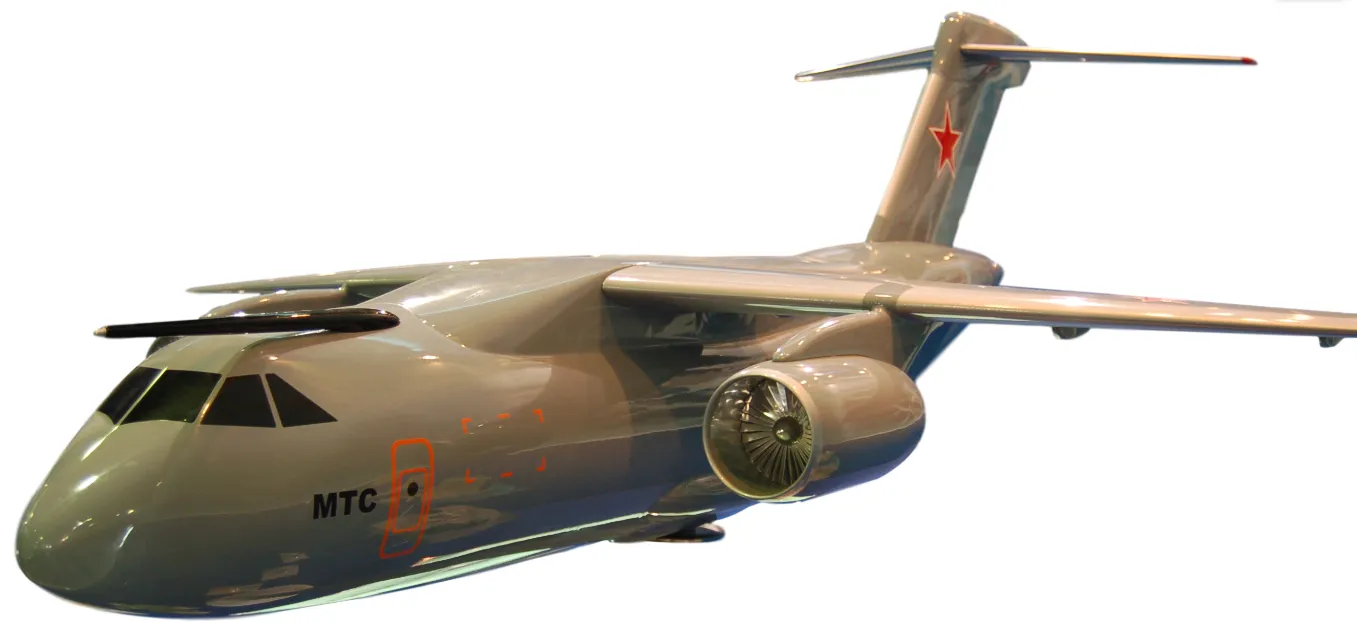
The proposed configuration featured a swept high wing, two turbofan engines beneath it, a T-tail and a rear cargo ramp. Such a layout is understandable for a medium jet transport. The high wing helps make room for a useful freight hold, while a rear ramp provides access for equipment and vehicles. An exhibition model, however, displays a proposed shape rather than an aerodynamically and operationally proven aeroplane. Figures for weight, range and runway length in early tables were design goals. In the absence of tests with a completed aircraft, they must not be reported as demonstrated specifications of a production fleet.
A payload in the region of twenty tonnes was discussed for the project. That target placed the intended aircraft between small local transports and heavy strategic airlifters. At such a load, cargo-door dimensions, floor strength, balance and the accommodation of containers or military equipment would all matter. A target payload does not establish that a particular vehicle would fit through the opening or that the aircraft could take off with it from every short runway. Design figures need conditions and context rather than becoming claims of universal capability. Without flight testing, precise-looking numbers require particular caution: they are statements about a proposal, not measurements from routine service.
Engine choice was another issue. Over the years, different powerplants and onboard systems appeared in descriptions of the project, including both Russian and foreign options. This is normal before a design is fixed, but it creates a risk of combining incompatible details from documents written at different stages. If one source proposes an engine and a later one suggests another, that does not mean an aircraft flew with both. For an unbuilt project it is more accurate to describe options under consideration than to invent a final installed configuration. The same caution applies to calculated speed, range and crew figures, which may depend on the assumptions used at the time.
In 2016 the previous form of Russian-Indian cooperation was halted, while the Russian side said it intended to continue development. In 2017 the Il-276 designation became associated with the later version of a concept earlier called Il-214 or MTA. This was a change of programme stage and name, not a first flight. The original OnlyPlanes registry incorrectly listed 2017 as the year of the aircraft's first flight; that entry has been corrected. Such errors arise easily when a project chronology is placed in a database field designed for an already built aircraft. For the Il-276, the first-flight field should remain empty until a flight by a specific prototype can be documented.
Later years brought statements about possible selection, schedules and renewed conversations with India. They show that the requirement for a medium transport continued to attract attention, but they do not verify production. A prospective operator named in an old presentation is not an operator that has received aircraft. Likewise, a photograph of a scale model cannot be labelled as a picture of a flying machine. Proposed aircraft often acquire detailed specification tables and polished imagery long before testing. An editorial account must distinguish a technical proposal from an accepted type and make clear which values are estimates. That is particularly important when plans have changed several times.
The Il-214/Il-276 is a useful example of a long international aviation programme in which two countries had genuine transport needs but partnerships, schedules and design assumptions changed. Comparing it with flying airlifters can explain the niche its designers hoped to fill. It cannot become a comparison of demonstrated performance if one side has only promotional targets. An operational aircraft has tested flight data and a service record. The MTA has agreements, engineering proposals and models. That does not make it irrelevant to aviation history. It shows how demanding the passage is from an agreed requirement and a drawing to a machine that has to satisfy several customers at once.
In a military aviation catalogue, the Il-214/Il-276 belongs under proposed aircraft. Its history is the search for a medium transport, Russian-Indian cooperation, the later change in partnership and repeated revision of plans. Future developments may clarify the programme's outcome, so the status needs to be checked when the page is updated. For now, a reliable description cannot credit the project with production flights, actual fleet operators or confirmed take-off performance. Separating ambition from evidence makes the page more useful. The reader can understand the task the aircraft was meant to solve, how the programme evolved and why a display model is not the same thing as a tested transport aeroplane.