
Military transport aircraft / C-1
Kawasaki C-1
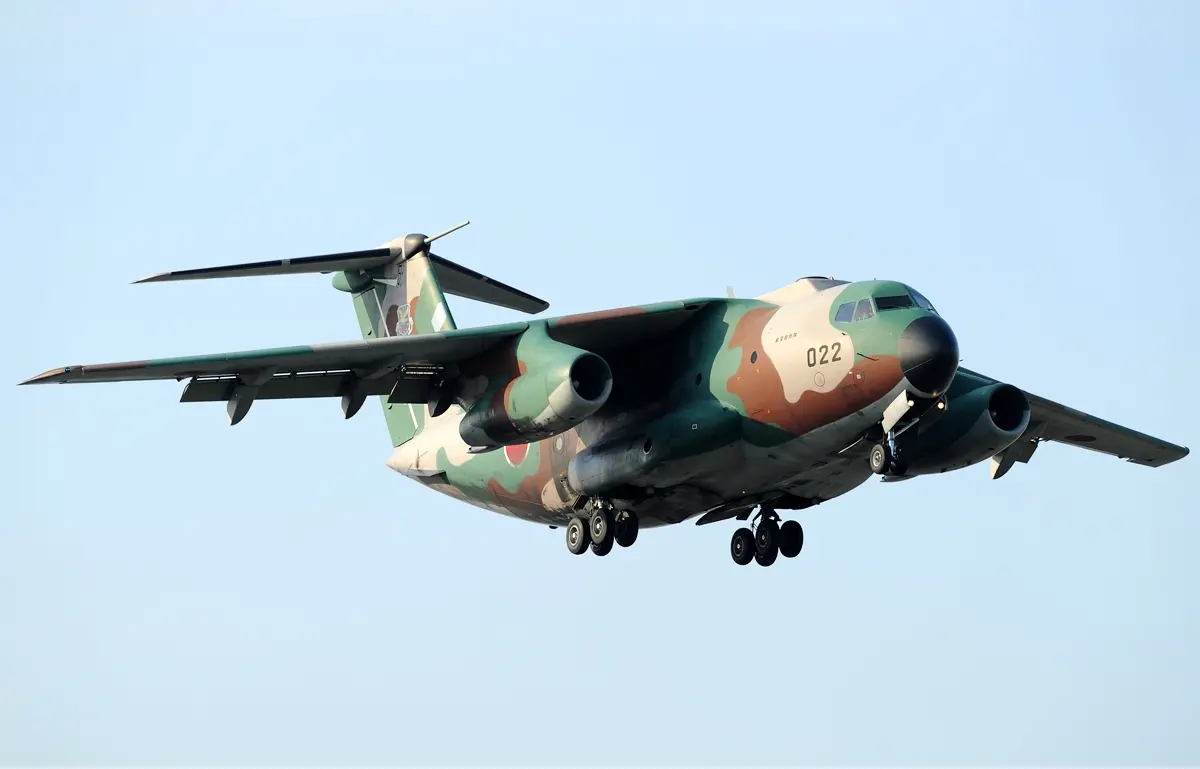
The Kawasaki C-1 was a Japanese twin-jet transport developed for domestic military airlift and replacement of the C-46.
Development
History
The Kawasaki C-1 was a twin-engine jet transport developed in Japan for the Japan Air Self-Defense Force. In the mid-1960s the service still used Curtiss C-46 aircraft designed during the Second World War. A replacement was needed for domestic routes, providing faster movement of people and freight between Japanese airfields. Development began in 1966, and the C-1 first flew on 12 November 1970. It marked an important step toward Japan's own jet transport capability.
The aircraft has a high wing, two engines and a rear cargo ramp. This arrangement leaves space for equipment and allows loading without an elaborate freight terminal. The ability to carry personnel and support airborne delivery made the C-1 useful in several Self-Defense Force missions. It was not conceived as a heavy intercontinental freighter. Its route network and customer requirement shaped a relatively limited range. A similar appearance to other jet transports therefore does not imply the same performance or purpose.
In service the C-1 supported routine supply, unit movements and exercises. The flight itself is only one part of that work. Loads need to be positioned and secured correctly, unloaded at the destination, and the aircraft prepared for another sortie. Actual freight weight depends on runway length, weather, fuel and the state of a particular aircraft. A maximum figure in a specification cannot be treated as the normal load for every flight. Everyday reliability may matter more than an isolated record.
The Japanese programme remained fairly small. The C-1 served the JASDF and did not become a major export product. As the fleet aged, Japan needed an aircraft with more range and capacity. Kawasaki's C-2 addressed that later requirement, but it is a distinct type rather than a simple renaming of the C-1. Comparisons must account for different generations, hold dimensions and operational aims.
The C-1's history shows how geography and defense policy shape a transport aircraft. Japan needed fast links among its own bases, not simply the greatest possible payload on the longest possible route. The C-1 served that requirement for decades. Its importance lies in establishing domestic engineering experience and a sustained airlift system that later supported larger national programmes.