
Military transport aircraft / C-27J
Leonardo C-27J Spartan
The Italian C-27J Spartan is a tactical transport developed from the G.222. Its high wing and rear ramp support personnel and cargo missions at restricted airfields; the C-27J first flew in September 1999.
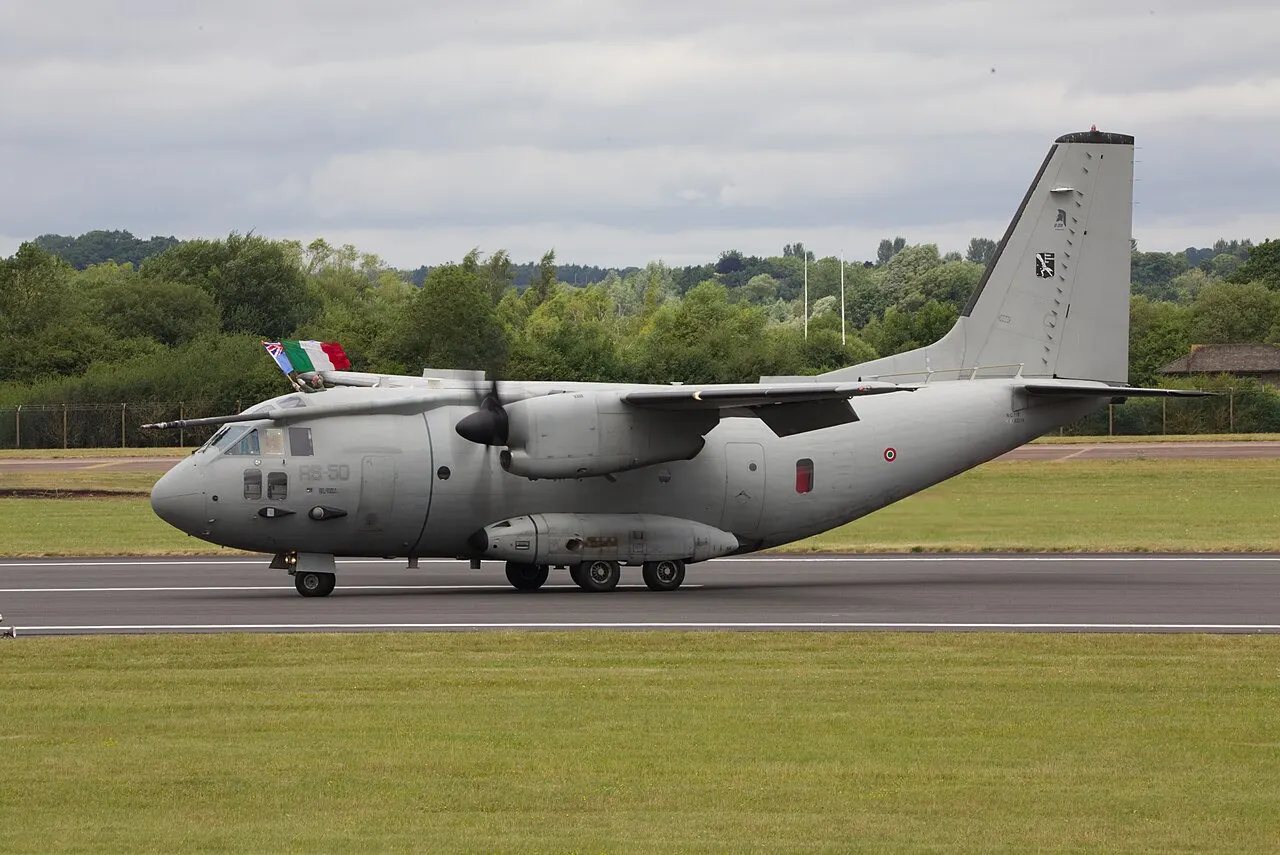
Development
History
The C-27J Spartan is a twin-turboprop military transport developed in Italy. It occupies a useful space between a helicopter that can land close to a small operating area and a larger fixed-wing transport that carries much more freight but needs a suitable airfield. The Spartan is intended to move personnel, equipment or a medical team to a relatively short and austere runway, then change its cabin arrangement for the next task. Payload and range matter, but they do not tell the whole story. The dimensions of the cargo compartment, access through the rear of the aircraft and the practical conditions at a remote airstrip are equally important.
The aircraft grew out of the Italian G.222 tactical transport. The new programme kept the broad concept of a high-wing aircraft with a rear loading ramp while substantially revising its engines and onboard systems. In the late 1990s Alenia and Lockheed Martin worked on a version that incorporated technology associated with the C-130J Hercules family. The C-27J should not, however, be described as a miniature Hercules. Its structural lineage is the G.222 and its intended missions belong to a different weight class. The new version first flew in September 1999. That date refers to the C-27J rather than the original G.222, which had flown in 1970.
The relationship with the C-130J is visible in the Rolls-Royce AE 2100 engines, six-bladed propellers and the approach to cockpit systems. Common engineering ideas can make it easier for an air force to operate both types, but the aircraft are not interchangeable in every part or maintenance procedure. The Spartan has two engines where the Hercules has four. Its smaller size is useful when a big transport's full payload is unnecessary or when operating a large aircraft at the destination is impractical. The two types can therefore form a distribution chain: a heavy aircraft brings a shipment to a hub and a C-27J carries a selected portion onwards.
The Spartan's arrangement is centred on the cargo mission. A high wing leaves room for a useful fuselage cabin, while a rear ramp allows loads to be brought in through a broad opening. Depending on the task, the interior may carry troops, stretchers, equipment, pallets or a mixed load of people and stores. The ramp is also relevant to airdrop operations, in which freight or parachutists leave the aircraft in flight. The presence of a ramp does not mean that every object can be loaded. Door dimensions, floor loading, aircraft balance and the method of securing the load all limit a particular mission. Ground crews and aircrew must plan the arrangement before departure.
The Royal Australian Air Force describes the C-27J as filling a gap between Army helicopters and the larger aircraft in its air mobility fleet. Its published figures for the Australian aircraft include up to 34 passengers, 21 litter patients or about five tonnes of cargo in appropriate arrangements. These are alternatives, not a combined load, and they should not be applied automatically to every version of the type. Leonardo publishes different maximum figures for a later Next Generation configuration. Differences can reflect the version, equipment installed, mission assumptions and an operator's approved limits. A catalogue should identify which aircraft and operating conditions a number describes.
The ability to use unsealed and restricted airstrips enlarges the aircraft's operating area, but it does not remove the need for preparation. The crew has to consider surface condition, available length, temperature, airfield elevation, aircraft weight and what support will be available after landing. A wet or damaged strip changes the calculation. So do terrain and obstacles near the approach. Calling the Spartan a short-field transport describes a designed and demonstrated capability, not a promise that it can safely land on any improvised patch of ground. Each actual sortie remains subject to the flight manual, local assessment and the limits of the specific aircraft.
Australia announced a purchase of ten C-27Js in 2012. The first arrived in the country in 2015, and the tenth was accepted in 2018. No. 35 Squadron operates the fleet. Australian requirements include reaching remote airfields and supporting operations across large distances at home and in neighbouring regions. The aircraft has also been used in humanitarian support and disaster relief. In those missions its value is not a spectacular top speed. It is the combination of useful cabin space, modest aircraft size and access to destinations that are less convenient for a larger transport. The same features can support both military supply and civil emergency response.
In military service the Spartan can move personnel, stores and supporting equipment. With a suitable cabin configuration it can evacuate wounded people. Cargo and personnel airdrop provide options when landing is impossible or undesirable. Such operations still require a prepared team, suitable altitude and speed, and careful calculation of the load and its release sequence. Medical evacuation changes the cabin layout and may require attendants and equipment. The published capacities for these roles therefore cannot simply be added together. The aircraft is configured for a particular task, and the equipment carried for one mission reduces the space available for another.
The experience of US-operated C-27Js shows that one airframe can be adapted to a different mission. After use in the American military transport system, a group of aircraft went to the US Coast Guard. There the Spartan entered the medium-range surveillance fleet for maritime patrol, search and rescue, disaster response and law-enforcement support. The Coast Guard described work to add mission equipment such as electro-optical sensors, radar and the Minotaur mission-system architecture. The transport's basic airframe and flying qualities remained, but its crew procedures and onboard equipment were changed to fit a surveillance mission rather than routine tactical freight delivery.
The HC-27J designation is associated with the Coast Guard's aircraft and role. It should not be confused with every original transport configuration. Likewise, a later C-27J Next Generation should not be treated as identical in equipment to an aircraft delivered in the early years of the programme. Leonardo has continued to offer avionics updates and specialised mission kits. Manufacturers' brochures may state maximum performance under defined conditions, while a military operator sets its own working limits. A reliable account separates the platform, a particular customer and the installed configuration instead of assembling the largest figures from unrelated versions into one misleading specification.
The C-27J matters because tactical logistics needs flexibility. It cannot replace a heavy freighter for a major shipment and cannot land where a helicopter can. It can connect a main airfield with a smaller destination, deliver supplies or personnel and return with passengers or patients. Its Italian G.222 heritage explains the airframe's origin, while the late-1990s systems update explains its place alongside newer military transports. Different services have adapted the same platform for airlift, humanitarian work and surveillance. That range of practical roles, rather than a single headline performance figure, is the Spartan's defining contribution to its class.