
Military transport aircraft / C-130
Lockheed C-130 Hercules
The C-130 Hercules is a military transport aircraft for tactical airlift. The US Air Force notes its ability to use rough airstrips, airdrop people and equipment, and carry varied cargo.
Development
History
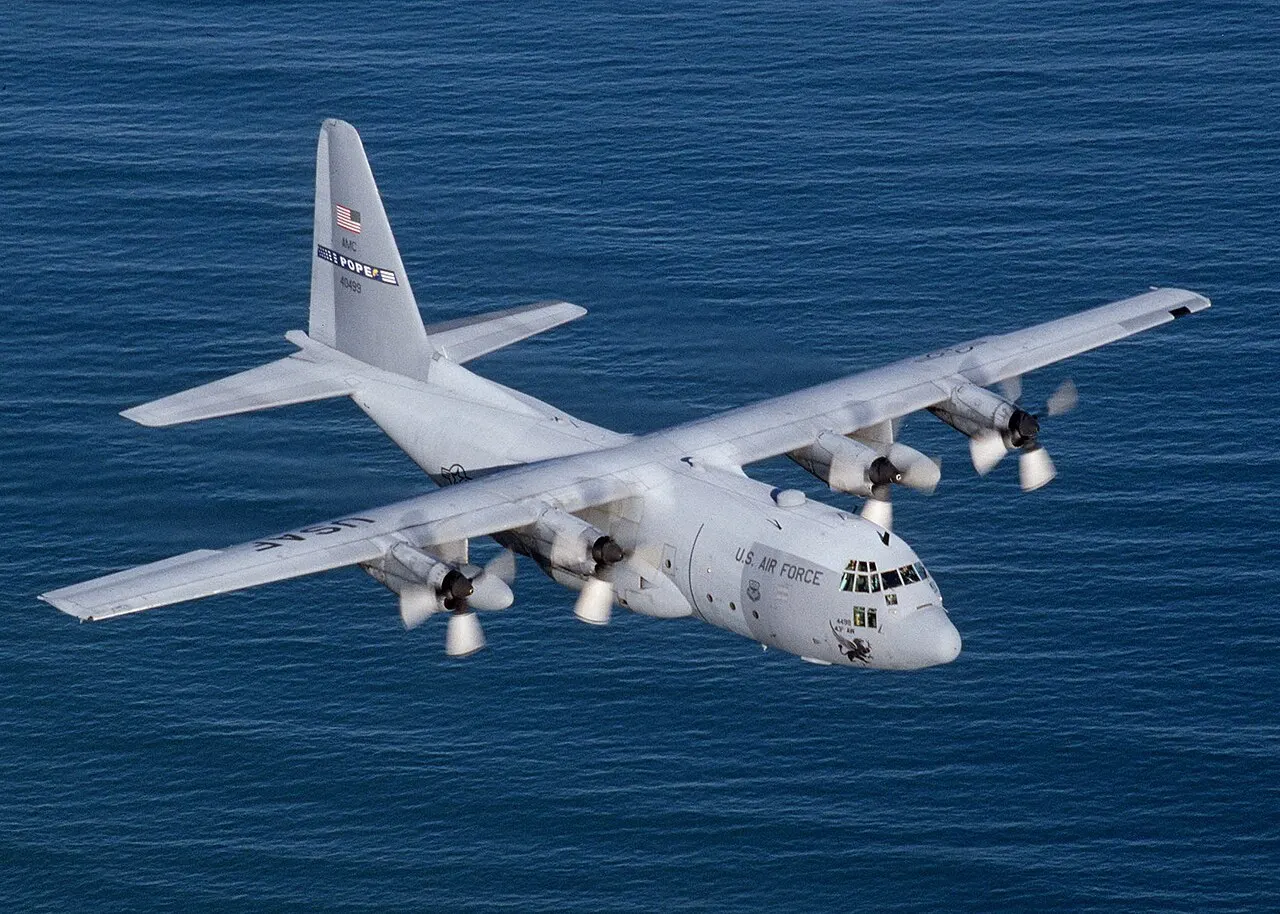
The Lockheed C-130 Hercules is a four-engine turboprop transport developed to carry people and freight to places where a large jet airlifter may not have a suitable prepared runway. Its high wing, rear loading ramp and robust undercarriage make the family easy to recognise. Those visible features, however, do not fully explain its long career. The same basic platform has been adapted for tactical airlift, parachute delivery, medical evacuation, rescue and many specialised missions. It is also essential to distinguish between variants. An early C-130A, a later C-130E or H and a modern C-130J share a family name but do not have identical equipment, crews or performance.
The Hercules programme answered a need for an aircraft that could support forces beyond major air bases. A useful transport had to do more than lift a heavy load. It had to reach an airfield with limited facilities, unload without an elaborate external system and be ready for another mission. Those requirements shaped the layout. The high wing leaves the lower fuselage available for a useful cargo compartment, while the rear ramp provides access for pallets, personnel and appropriately sized vehicles. Strength of the structure and landing gear matters as much as cruise speed when the aircraft is expected to work repeatedly away from a major airport.
The first C-130 flew on 23 August 1954. That date begins the flight history of the family; it should not be applied indiscriminately to every later version. Flight testing examined whether the new design met the demands of military transport and how it behaved at different weights and centres of gravity. Once the aircraft entered service, development continued. Engines, propellers, navigation equipment and cargo handling systems changed over the decades. Hercules is therefore the name of a family, not of one unchanging aeroplane. A description of a particular machine should identify its variant before giving numerical specifications or a precise crew complement.
Four turboprop engines provide a balance between useful route speed and operation from relatively short runways. Their propellers are prominent in photographs, but blade count and shape changed during the life of the programme. C-130E and H aircraft used different versions of the Allison T56, whereas the C-130J uses Rolls-Royce AE 2100D3 engines and six-bladed composite propellers. These differences affect climb, range and the work of the crew. A speed figure for one version should not be attached automatically to another merely because the two aircraft have a similar outline. Technical comparisons become meaningful only when the variant and conditions are specified.
The cargo compartment is arranged for different types of load. Pallets, equipment, people and suitable vehicles can enter through the rear opening. Seats, restraints, airdrop platforms or fittings for patients may be used according to the mission. Loading nevertheless begins with calculation rather than with the broad claim that an aircraft can carry a certain number of tonnes. The dimensions of an item, the load on individual parts of the floor, the centre of gravity and the method of securing it all matter. A vehicle can be below the payload limit and still be too large for the opening or impossible to place safely inside the hold.
Operation from rough and unpaved airstrips has been one of the reasons for the design's value. The US Air Force describes the C-130 as an airlifter able to use rough dirt strips and reach remote areas. That does not mean that any patch of ground is suitable for landing. A runway must be assessed for length, strength, slope, surface condition and nearby obstacles. Wet ground, high temperature or a heavy payload can change what is practical. These details are especially important for the Hercules because access to airfields with limited infrastructure is often the reason for selecting it in the first place.
When landing beside the recipient is impossible, the aircraft can deliver people or supplies from the air. C-130s have long been used for parachute operations and aerial resupply. Such missions require prepared platforms or seats, a suitable cabin arrangement, a planned drop zone and coordinated crew procedures. The US Air Force lists different load arrangements and paratroop capacities, but those numbers depend on the variant and the intended task. Having a ramp is only the beginning. The load must leave the aircraft safely, use the specified delivery system and arrive where ground personnel can actually recover it.
Members of the Hercules family have also worked well beyond ordinary freight carriage. The US Air Force lists aeromedical evacuation, weather reconnaissance, Antarctic supply, firefighting, disaster relief and special operations among its roles. Some mission equipment can be removed so that an aircraft can return to transport duties, but not every specialised version can easily become a standard freighter. Armed AC-130 gunships, for example, have their own equipment and operational history. It is more accurate to say that the platform supports many adaptations than to suggest that every C-130 is equipped for every mission. The role of an individual aircraft depends on its installed systems and its crew's training.
The C-130E and H illustrate the gradual development of the original transport arrangement. Engines and onboard equipment changed while the broad advantages of the high wing and rear ramp remained. The C-130J brought a larger step in systems: new engines, a digital flight deck and updated navigation and control equipment. According to the US Air Force, a typical J crew includes two pilots and a loadmaster, whereas earlier E and H crews also included a navigator and flight engineer. That difference reflects increased automation and should not be erased in a general account of the family. The stretched C-130J-30 offers more cabin space, but its dimensions and loading options differ from those of the standard J.
Technical tables give different speeds, ranges and payloads for Hercules aircraft. The variation does not necessarily mean that a source is wrong. It may describe another modification, a different cargo weight, another altitude or a changed fuel reserve. The US Air Force publishes separate figures for E, H, J and J-30 aircraft. Combining the maximum speed of a J with the loaded range of an E creates the misleading specification of an imaginary single aeroplane. For an actual mission, route, runway, cargo mass, balance and maintenance facilities at the destination all matter. The aircraft is selected for the complete task, not for the largest number in one row.
Military and civilian operators have used the C-130 on different continents. Its reach reflects a combination of useful capacity, access to difficult airfields and the ability to adapt the airframe. The same long history also means that aircraft with similar names may have different equipment after years of upgrades. In describing a particular airframe, factory version should be separated from later changes made by an operator. Photographs need similar care. A transport that looks like another Hercules may belong to a different variant, and a picture of a specialised aircraft does not establish that its equipment is standard on all C-130s.
The Hercules earned its place in aviation history through dependable utility in a wide range of conditions, not through one record figure. The high wing and ramp made it a practical tool of air mobility, while successive upgrades kept the platform useful. It does not replace a heavy strategic transport: cabin size and allowable mass limit the largest equipment it can carry. Its particular strength is reaching airfields and missions where a larger aircraft would need an additional transfer stage. That balance of capability and limitation explains why the family remains significant many decades after its first flight.