
Military transport aircraft / C-141
Lockheed C-141 Starlifter
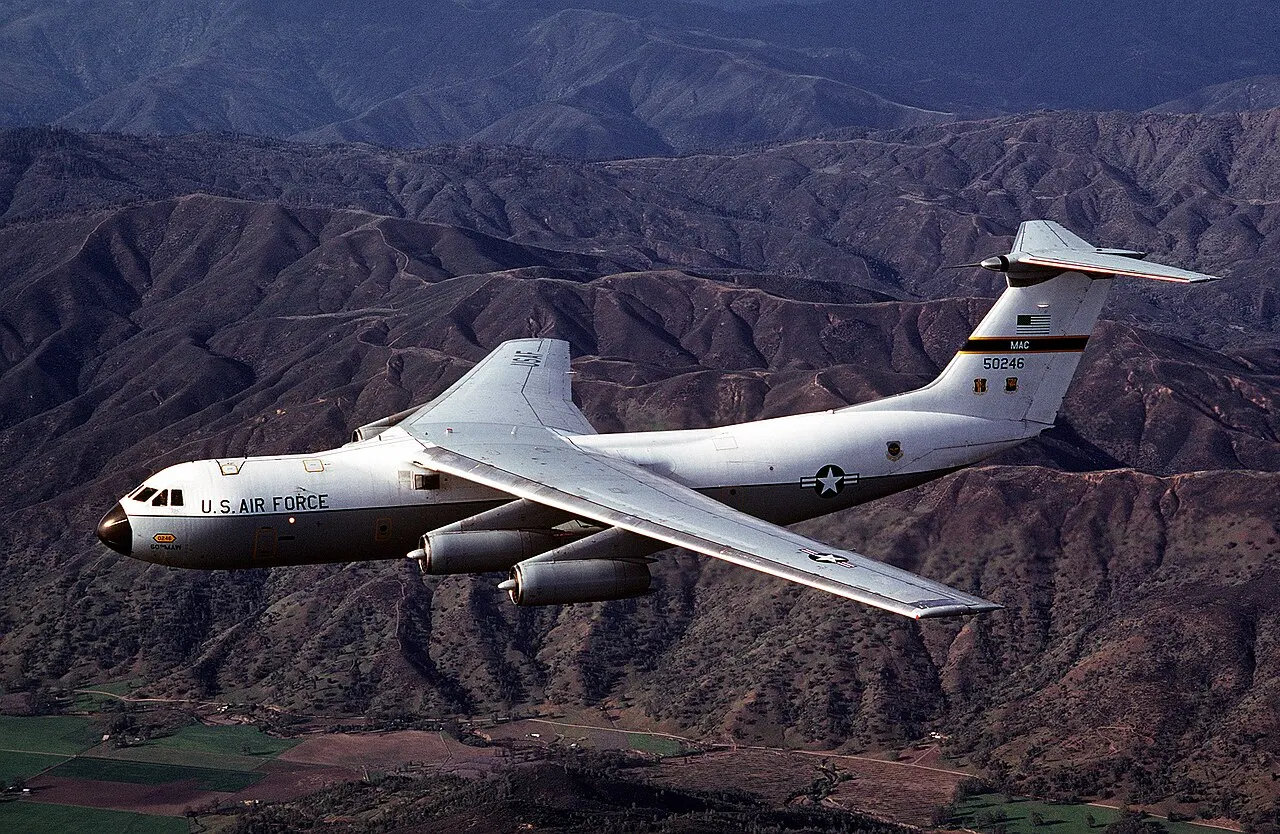
The Lockheed C-141 Starlifter was a US strategic jet transport. The stretched C-141B gained more cargo space and aerial refueling capability.
Development
History
The Lockheed C-141 Starlifter was a four-engine American jet transport built to move personnel and cargo rapidly over long distances. At the beginning of the 1960s, United States military airlift still depended heavily on propeller-driven aircraft. Those types could move substantial loads, but their speed limited the pace of overseas deployments. A new transport needed a large, practical cargo hold, straightforward loading and the flexibility to carry either equipment or people. Lockheed's answer became the C-141, a purpose-built jet freighter for the Air Force.
The aircraft had a high swept wing, a T-tail and four engines mounted in separate pods. This arrangement left a long, relatively unobstructed freight compartment inside the fuselage. A rear loading ramp made it possible to handle vehicles and pallets, while also supporting parachute drops. The prototype first flew in December 1963 and production deliveries followed in the middle of the decade. The Starlifter soon became a central part of American strategic airlift. It connected distant bases and gave military planners a faster way to move units and supplies across oceans.
Experience with the original C-141A revealed an important limitation. For many kinds of freight, the cabin filled up before the aircraft reached its permitted cargo weight. More internal space was therefore more useful than a simple increase in lifting strength. The C-141B program inserted new fuselage sections ahead of and behind the wing, lengthening the aircraft by about 23 feet and four inches. Cargo volume grew by roughly one third. The conversion also added an aerial refueling receptacle, greatly expanding route options. Stretching the existing fleet produced additional carrying capacity without requiring an equivalent fleet of newly manufactured aircraft.
A later C-141C modernization updated the cockpit and other avionics on selected aircraft. The A, B and C suffixes describe stages in the development of the same transport rather than separate aircraft classes. Actual mission range depended on payload, route and whether tankers were available. Starlifters carried troops, heavy supplies, relief material and patients. Their useful combination of speed and cargo space meant that an aircraft could complete an intercontinental trip, unload at a hub and return to the airlift system quickly.
The type served through several decades of military operations. It supported transport missions during the Vietnam War, brought American prisoners of war home, and took part in the large movements of people and equipment associated with the Gulf War. Aeromedical evacuation was another important use: the cargo compartment could be adapted for patients and medical staff. The preserved aircraft known as the “Hanoi Taxi” represents that history in the National Museum of the United States Air Force. The final Starlifters retired in 2006 as newer aircraft, particularly the C-17, assumed their missions. The C-141's career illustrates how jet speed, standardized loading and carefully chosen upgrades reshaped long-range military logistics.