
Military transport aircraft / C-5
Lockheed C-5 Galaxy
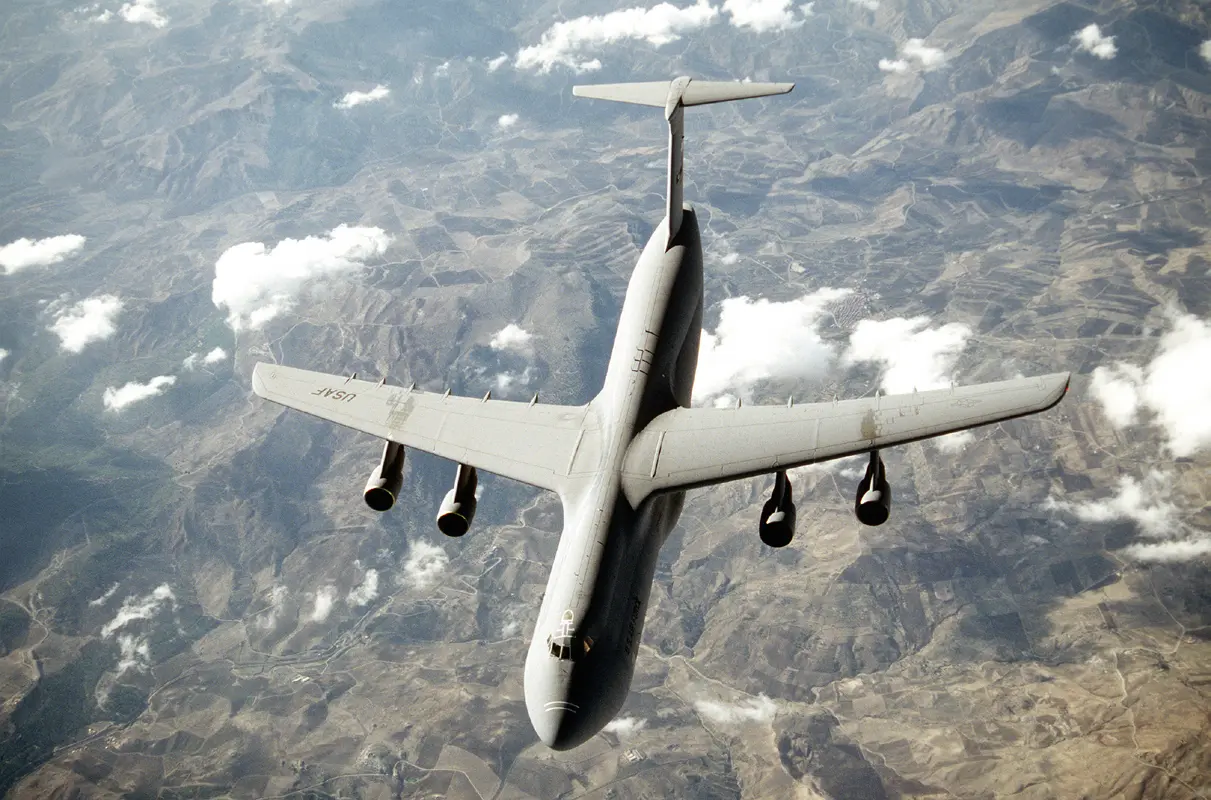
The Lockheed C-5 Galaxy is a US strategic airlifter for oversized cargo over intercontinental routes. Nose and rear cargo openings, a large hold and kneeling landing gear support vehicle loading.
Development
History
The Lockheed C-5 Galaxy is a heavy American military transport designed to move oversized equipment and personnel across intercontinental distances. Its mission differs from that of a small tactical airlifter. A Galaxy can bring a large shipment across an ocean to a major airfield, where smaller aircraft or surface transport can distribute it further. Its high wing, four turbofan engines and enormous fuselage are unmistakable, but the loading arrangement is just as important as the aircraft's size. Openings at both the nose and rear of the cargo compartment allow ground teams to handle freight from either end and move vehicles through the aircraft without turning them inside.
The C-5 programme answered a need to deploy heavy equipment quickly over long distances. Earlier transports could not always accept objects of the necessary height, length or weight. Lockheed therefore designed a transport system rather than an empty volume alone. Ramps, floor strength, landing gear and ground handling all had to work together. The first operational C-5A was delivered to the US Air Force in 1970. That is a delivery milestone for the initial version, not the start date of every later variant. The family changed considerably over the following decades. An early C-5A and a modernised C-5M should not be treated as technically identical aircraft.
The nose lifts to reveal a full-width entrance to the cargo compartment. A separate rear opening and ramp provide another route. When conditions at a base permit, a team can unload at one end while bringing the next load to the other. That can shorten time on the ground, especially for wheeled equipment. The landing gear can also lower the parked aircraft to make loading easier. Yet a large door does not remove the need for planning. The mass and dimensions of every vehicle or container must be checked, along with its restraint points and distribution of load over the floor. Balance remains critical even in an aircraft built specifically for exceptionally large freight.
The C-5 is particularly useful for items that will not fit in a smaller transport. The National Museum of the United States Air Force describes the heavy military equipment and unusual loads that the type can carry. Moving a unit's people separately from the machines they need does not make that unit ready to work. A strategic airlifter must sometimes deliver both elements of an operation. Maximum payload, however, is not a fixed promise of equal range with every load. Fuel, weight, route and airfield conditions affect one another. Each mission needs its own calculations, and a very large aircraft also needs suitable parking areas and ground support.
The initial C-5A formed the basis of the family. The later C-5B included changes intended to improve reliability and maintainability. A small number of C-5Cs were altered for unusually large space-related cargo, with changes to the interior and doors serving that specialised purpose. The A, B and C suffixes are therefore not just production dates for a completely unchanged machine. They identify specific configurations and requirements. Their history also shows how a heavy transport can remain useful for decades when repair and modernisation programmes are available to support the airframe.
The most extensive update produced the C-5M Super Galaxy. The US Air Force modernised avionics, replaced older engines and added improved maintenance diagnostics. More powerful engines improved takeoff and climb performance. These changes extended the usefulness of existing airframes without requiring a completely new aircraft of the same size. Performance figures for the C-5M should not automatically be applied to an early C-5A. Even when a cargo bay has similar dimensions, the engines, electronics and approved operating limits may differ. A careful catalogue separates the original family from the later modernised version.
Strategic airlift depends on a network of bases, refuelling options and specialists. A Galaxy may fly a long route with a heavy shipment, but the operation also depends on preparing and securing that cargo before departure. After landing, a receiving team must unload it and move it onwards. The aircraft's size limits the choice of airfields and requires checks of pavement strength, parking space and room to manoeuvre. A fact sheet's statement that the C-5 can use relatively short runways does not mean that any improvised field will work. Commanders assess the specific destination and apply the aircraft's approved manuals, not a general promotional description.
C-5s have supported major military and humanitarian movements. Their central advantage is the ability to deliver in one flight an item that might otherwise need to be dismantled, split among several aircraft or carried much more slowly by sea. A museum account of one C-5A records an urgent resupply flight in 1973. It illustrates what strategic transport can achieve, but the experience of that airframe is not the entire history of the type. Galaxy missions have differed in route, cargo and political context. A model profile should explain the aircraft's role without presenting one notable flight as a universal pattern.
The C-5 Galaxy occupies a particular place in an air mobility system. It is not the most convenient aircraft for routine deliveries to a small forward strip, where a smaller transport may be better suited. Its purpose is to move large equipment quickly over great distances and make it available for the next stage of an operation. Doors at both ends of the fuselage, the kneeling landing gear and the cargo compartment's volume all serve that purpose. The progression from C-5A and C-5B to C-5M also shows that a heavy transport's longevity depends on updating engines, systems and maintenance as well as on the original airframe design.