
Military transport aircraft / Y-9
Shaanxi Y-9
The Shaanxi Y-9 is a Chinese medium turboprop transport derived from the Y-8 family with updated systems.
Development
History
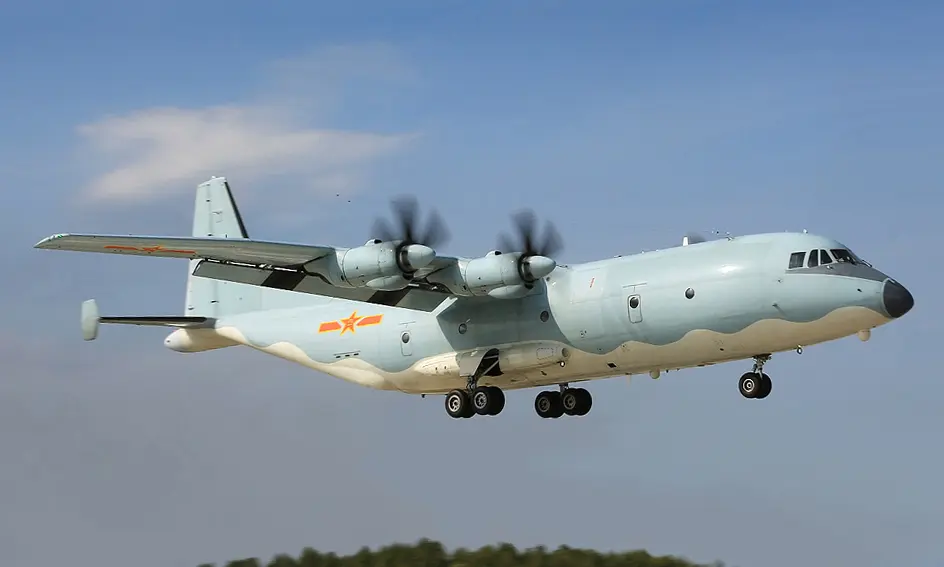
The Shaanxi Y-9 is a Chinese four-engine turboprop transport developed from the Y-8 family. It was intended to move people and freight over medium distances with newer systems and improved capability compared with early aircraft of the preceding type. The design retained the general high-wing layout and rear ramp but revised the fuselage, propulsion and onboard equipment. The first flight took place in 2010, and the aircraft entered Chinese military service early in the following decade.
The Y-9 occupies a space between small utility aircraft and heavy jet transports. Four turboprops allow it to carry personnel, equipment and pallets on routes where a much larger Y-20 would be unnecessary. The rear ramp supports ground loading and airborne delivery. A crew planning a mission considers cabin volume, cargo mass, range, runway condition and weather together. A practical load on a demanding route may differ from the maximum figure quoted under standard conditions.
The connection between Y-9 and Y-8 matters, but the names are not interchangeable. The early Y-8 grew from the Antonov An-12, while the Y-9 is a later reworking of that line. Its cabin arrangement and equipment were updated. An engine specification, crew figure or dimension for one version should not automatically be applied to another. The differences become more pronounced when a standard cargo Y-9 is compared with a specialist aircraft based on the same platform.
Beyond transport work, the family has supported observation and other special missions. In those versions, operators, electronics and communication systems take up internal space, while antennas and fairings alter the external shape. They are not optimized for carrying the greatest possible freight load. This explains why a basic airframe can appear in different areas of military aviation. The distinction between platform and specific modification is essential for an accurate account.
The Y-9 represents the continuing development of Chinese tactical logistics. The heavy Y-20 handles large long-range movements, while the Y-9 supports more frequent delivery of medium-sized loads. Its value lies in routine service between airfields, flexible equipment and the ability to carry a familiar design line into new roles. The aircraft shows how extensive modernization of a transport platform can result in a distinct type rather than merely another label for the old one.