
Military transport aircraft / C-23
Short C-23 Sherpa
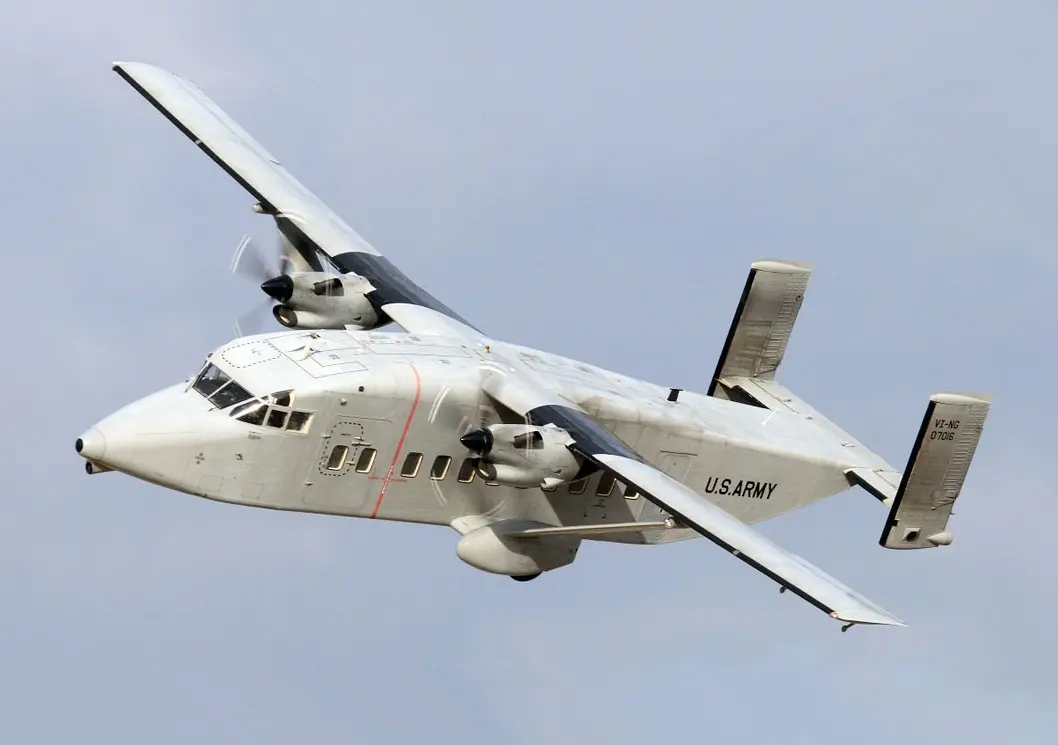
The C-23 Sherpa is a light twin-engine Short Brothers transport for flights within an operational area. Built in Belfast from the Short 330/360 family, it served the US Air Force and Army National Guard.
Development
History
The Short C-23 Sherpa is a family of small military transports built by the British company Short Brothers. It was intended for routes on which a large airlifter could be unnecessarily costly or awkward to use. Its rectangular fuselage, high wing, two turboprop engines and broad rear cargo opening give it an unmistakable appearance. The shape follows a practical aim: useful internal volume and quick access to freight mattered more than the flowing lines of a passenger aeroplane. The Sherpa served with the US Air Force, later with the Army National Guard and with other organisations. C-23 is a family designation, however, and the capacities, cabin arrangements and origins of one version should not automatically be applied to all the others.
The design grew from the civilian Short 330 and Short 360 aircraft. Their high wings and spacious fuselages offered a starting point for a light freighter. In the early 1980s the US Air Force sought an aircraft able to move urgently needed aviation parts among its bases in Europe. Such a job did not always require the capacity of a C-130. A spare component might be small, while using a larger aircraft for every short journey would consume additional resources. Short Brothers developed a transport that retained the utility of the regional design while adding equipment for military freight. The Sherpa's later career reached well beyond the European supply network for which it was originally selected.
Two different first-flight dates belong in the programme's history. A Sherpa prototype associated with the Short 330 development first flew on 23 December 1982. The first C-23A built for the US Air Force made its maiden flight on 6 August 1984. The dates describe separate stages rather than conflicting accounts of the same event. Saying simply that the C-23 first flew in 1982 could give the impression that the production military aircraft was ready at that time. After testing and delivery, the C-23A joined the European distribution system. Later variants were built or converted for other users and different transport requirements.
The basic C-23A was related to the Short 330. Its military freight arrangement included a wide rear opening for bringing equipment into the hold and fittings to manage cargo inside. That door is valuable when a part has to be transferred quickly between an airfield and a vehicle on the ground. The aircraft looks straightforward, but loading still requires careful calculation. An item must fit through the opening, avoid overloading the floor, be restrained securely and keep the centre of gravity within the approved range. Even for a small transport, those factors decide what can actually be delivered on a particular flight.
The C-23B retained the transport role but differed in its cabin and equipment. Accounts of the family note passenger windows and changes associated with Army aviation tasks. The C-23B+ has a more complicated ancestry: it used a Short 360 fuselage combined with a rear cargo section suited to the Sherpa family. Consequently, the claim that the C-23 was built from the Short 330 is true for some aircraft but too broad for the entire line. New-build aircraft and conversions must be distinguished, especially when discussing production totals, structural history or the capabilities of an individual airframe. Similar markings on the outside do not prove that two examples have identical internal arrangements.
The Sherpa was developed with smaller and less elaborate airfields in mind. Its high wing and turboprop engines fit that operating environment, but they do not make every unpaved strip safe. Before a landing, planners need to assess runway length and strength, obstacles and the weather. Available payload also depends on the fuel carried and on conditions such as air temperature. The ability to serve short routes is therefore an operational advantage in suitable circumstances, not a substitute for preparation. Combining compact dimensions with a practical cargo cabin made the aircraft useful for repeated journeys within an operating area. It was never intended to replace every larger transport or to land where no runway exists.
After its initial European work, the Sherpa found extensive use in the US Army National Guard. Units employed C-23s to move personnel, urgent supplies and equipment and to support parachute training. In disaster response an aircraft could help move material among locations where a prompt reaction mattered. These missions are different from intercontinental troop transport. The value of a small airframe appears in frequent, relatively short flights and in the ability to assign a whole aeroplane to a particular urgent load without calling for a heavy freighter. Passenger, cargo and parachute arrangements nevertheless require different cabin preparation and operating procedures.
During US operations in Iraq and Afghanistan, C-23s supported transport within the theatre. An Army account of flights in Iraq describes National Guard units moving freight and passengers between bases. The Sherpa did not replace a helicopter: it still needed a runway. On a suitable route, however, a fixed-wing aircraft could move a load farther with different operating costs from a rotorcraft. The choice among a Sherpa, a helicopter and a larger transport depended on the availability of an airfield, the urgency and size of the load, and the risk along the route. A mission can be important without requiring the largest possible aircraft.
Observation and transport flights in the Sinai form another part of the Sherpa's history. The US Army describes its use in support of the Multinational Force and Observers, including the movement of people and freight among locations in the region and observation of activity. This does not imply that every C-23 carried the same specialised equipment. Communications, working space and route planning depend on the operator and the particular mission. The Sinai work illustrates the flexibility of the small platform: an aircraft that began as a carrier of spare parts could also be useful where regular local flights and an aerial view of territory were needed.
Outside Army service, individual Sherpas were used by civilian and government organisations. Their cargo layout and suitability for varied routes helped make this possible, although cabin arrangements and technical condition differed among airframes. A long career also required maintenance and changes to ageing aircraft. The US Army National Guard ended its C-23 operations in 2014. That date applies to this operator; it does not mean that every member of the family around the world stopped flying simultaneously. Lists of operators should distinguish former service, later transfers and the actual airworthiness of an individual aircraft.
Specifications for Sherpa aircraft may differ between reference books without either book necessarily being wrong. The C-23A has one set of engines and dimensions; the C-23B+ starts with a different airframe. Passenger capacity changes with seats, freight fittings or space for patients. Range varies with payload and fuel. A table that omits the variant and operating conditions can therefore create a false sense of precision. A useful account explains why the aircraft needed its broad rear opening, what place it occupied between helicopters and heavy transports, and how its role evolved among different units. Numbers become meaningful only when attached to the right aircraft and mission.
The C-23 never became a symbol of enormous airlift, but its story shows the value of the final stage of air logistics. A spare part, a small team or a package of urgent material is often needed at a separate base rather than at a major transport hub. The Sherpa helped close that gap. It grew from a civilian platform, was adapted to military requirements, acquired several distinct variants and served far beyond its original European assignment. Its strengths and limits belong together: compact size and an accessible freight cabin widened an operator's choices, while dependence on an airfield and modest load capacity defined the boundaries of its work.