
Business aviation
First production Citation CJ4 Gen3 rolls out
Textron Aviation has rolled out the first production CJ4 Gen3. What the milestone means, how the cockpit is changing, and why rollout is different from delivery.
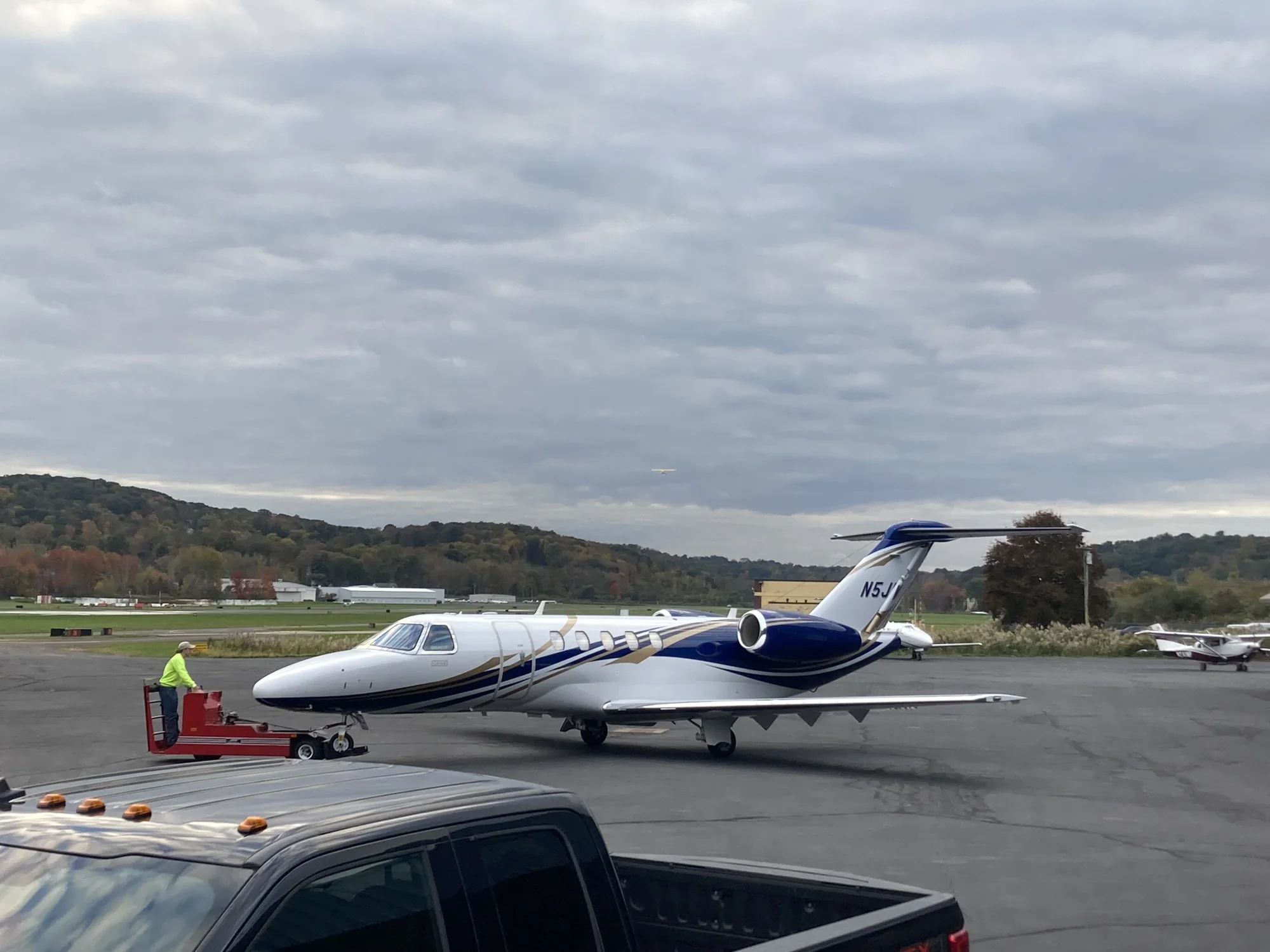
A previous-generation Citation CJ4, registration N5JM, at Danbury in October 2023. An archival family photograph; it does not show the first production CJ4 Gen3.
Textron Aviation announced the rollout of the first production Cessna Citation CJ4 Gen3. The announcement was published on October 20, 2026 and marks the next stage in the preparation of a new generation of light business jet. Among its main features are the Garmin G3000 PRIME avionics complex and the Emergency Autoland system. Rolling out means the appearance of an assembled production aircraft, but does not equal a message about completed certification or the transfer of the aircraft to the first owner.
For the future operator, the news is interesting due to changes in the cockpit operation and the transition of the updated aircraft to series production. Externally, related generations may look similar, while the pilot's interaction with the equipment changes more noticeably. Therefore, judging the CJ4 Gen3 only by the shape of the fuselage or the number of seats is not enough. It is important to separate the confirmed production event, the declared equipment and further stages, after which the capabilities of a particular aircraft will become part of its operational documentation.
What “production aircraft” means
Aircraft development involves different aircraft and different tasks. Pre-production aircraft help validate solutions and collect data, while production aircraft focus on repeatable production for customers. The appearance of the first such specimen shows the progress of the production program. However, the same aircraft may still undergo ground and flight checks, equipment preparation, or other required work. The very fact of leaving the assembly hall does not provide a complete answer to the question of when regular flights with passengers will begin.
It is useful for the reader to keep four different events close together: completion of assembly, first flight of a particular aircraft, necessary approvals, and delivery. They may be close in time, but are not synonymous. The headline about the rollout is easily perceived as the final appearance of the model on the market, especially if accompanied by photographs of the finished interior. A more accurate estimate takes into account what event is announced now and what next steps the manufacturer will confirm separately. This allows you to follow the program without unnecessary expectations from one message.
A new cockpit changes the operating workflow
The avionics complex combines the methods of presenting and processing information with which the pilot works. Its importance goes beyond screen size. The location of the functions, the sequence of data entry, the visibility of the selected mode and how easy it is to check your own action are important. Even a familiar task can be performed differently after a change in equipment generation. Therefore, upgrading the cockpit refers not only to the technical equipment of the aircraft, but also to the training of the people who will fly it every day.
Let's imagine a route change received after the initial preparation. The pilot needs to understand the content of the change, make it and check the result, while maintaining attention to other tasks. A user-friendly interface helps reduce unnecessary transitions between information views. However, the modern screen itself does not exclude incorrect selection or erroneous input. The practical value of the new cockpit is demonstrated by how clearly it shows the current status and how well it supports the established crew check sequence.
Automation requires understanding of modes
The automatic system performs certain functions under specified conditions. To use its assistance correctly, the pilot needs to understand which mode is active, what restrictions apply and what to expect next. This is different from simply knowing the location of the button. A misconception about the current mode can cause surprise even when the equipment is working properly. Therefore, training on new avionics includes the logic of human-system interaction, and not just familiarity with the updated appearance of displays.
The scope of automation also cannot be assessed in one general word. Maintaining flight parameters, helping to prepare a route, and acting in an emergency solve different problems. Their presence in one aircraft does not make all processes equivalent or completely autonomous. For operation, it is important to understand the boundaries of each function and control methods. It is in these details that often lies the difference between the attractive presentation of the equipment and its actual usefulness for a particular pilot and the chosen type of flight.
Emergency Autoland refers to a special situation
The claimed Emergency Autoland system should be viewed in the context of emergency assistance, rather than as a promise of conventional unmanned passenger transport. The name of the function does not replace the requirements for crew training, equipment serviceability and acceptable conditions of use. Specific capabilities are established for the approved aircraft configuration. Therefore, it would be incorrect to transfer a system description from another model to a CJ4 Gen3 without checking the relevant documentation, even if the supplier and commercial name are the same.
Another practical question is important for the owner: how will passengers find out about the presence of such a function and the procedure provided for them. This refers to the flight preparation and approved materials, not the promotional impression of the title. Clear information should help a person navigate without creating the feeling that any unfavorable development of events is automatically solved. The technology complements the overall safety system of the aircraft, and its role is evaluated in conjunction with operation, maintenance and training of people.
Range and speed describe different conditions
The announcement for the CJ4 Gen3 includes expected figures of a maximum range of 2,165 nautical miles and a maximum cruise speed of 451 knots true airspeed. The maximum capacity is also stated to be up to eleven people. These numbers cannot be combined into a promise to transport eleven passengers to extreme distance at maximum speed. First, capacity refers to the people on board, including crew. Secondly, different maximum characteristics correspond to their own calculation and loading conditions.
The actual route includes wind, altitude, weight, fuel capacity and possible airfield limitations. Therefore, the distance between two points on the map does not yet determine the possibility of a non-stop flight on a particular day. For a passenger, this means that it is better to compare planes based on the same task: how many people are flying, what luggage is needed, what are the airports and are stops allowed. Only after this do the catalog numbers turn into a meaningful comparison, and not a competition of individual highest values.
First deliveries require full support to be ready
The introduction of a new generation affects not only the owner of the first aircraft. Technicians need up-to-date materials, tools, and an understanding of the installed equipment. Crews undergo the required training, and the operator organizes maintenance and planning. If these elements are not agreed upon, even a physically completed aircraft may not yet be available for the planned operation. Therefore, it is useful to read news about the development of the program along with subsequent messages about support and the actual start of operation.
Of particular importance is the transition from a familiar model to an updated one. External similarity can create the impression that mastery will be limited to a short acquaintance. But the new interface and additional features require careful consideration of the differences. At the same time, it is impossible to say in advance exactly how much retraining each pilot will need: it depends on the rules, experience, clearance and approved program. The focus of the assessment is important - comparing operating procedures and equipment of specific generations, and not just their generic name Citation.
How to evaluate the following program news
Post-rollout, the most useful messages are those that clarify the milestones actually achieved. Test confirmation answers one set of questions, approvals answer another, and delivery answers a third. For the future customer, the final configuration and applicable restrictions are also important. This sequence makes the development of the program clear: each new event adds a verifiable part of the picture. It is more reliable than trying to deduce the exact date of the start of all commercial operations from a photograph of the first production aircraft.
The CJ4 Gen3 illustrates an upgrade focused on how pilots work with the aircraft and on additional assistance systems. The confirmed milestone is the first completed production aircraft. Subsequent stages require their own announcements, while the stated performance figures still need to be read with the conditions under which they apply.