
Business aviation
Embraer introduces Praetor 500E and 600E with updated cabins
The Praetor 500E and 600E have a new passenger environment. How seating, displays, cabin controls and digital-system support work together.
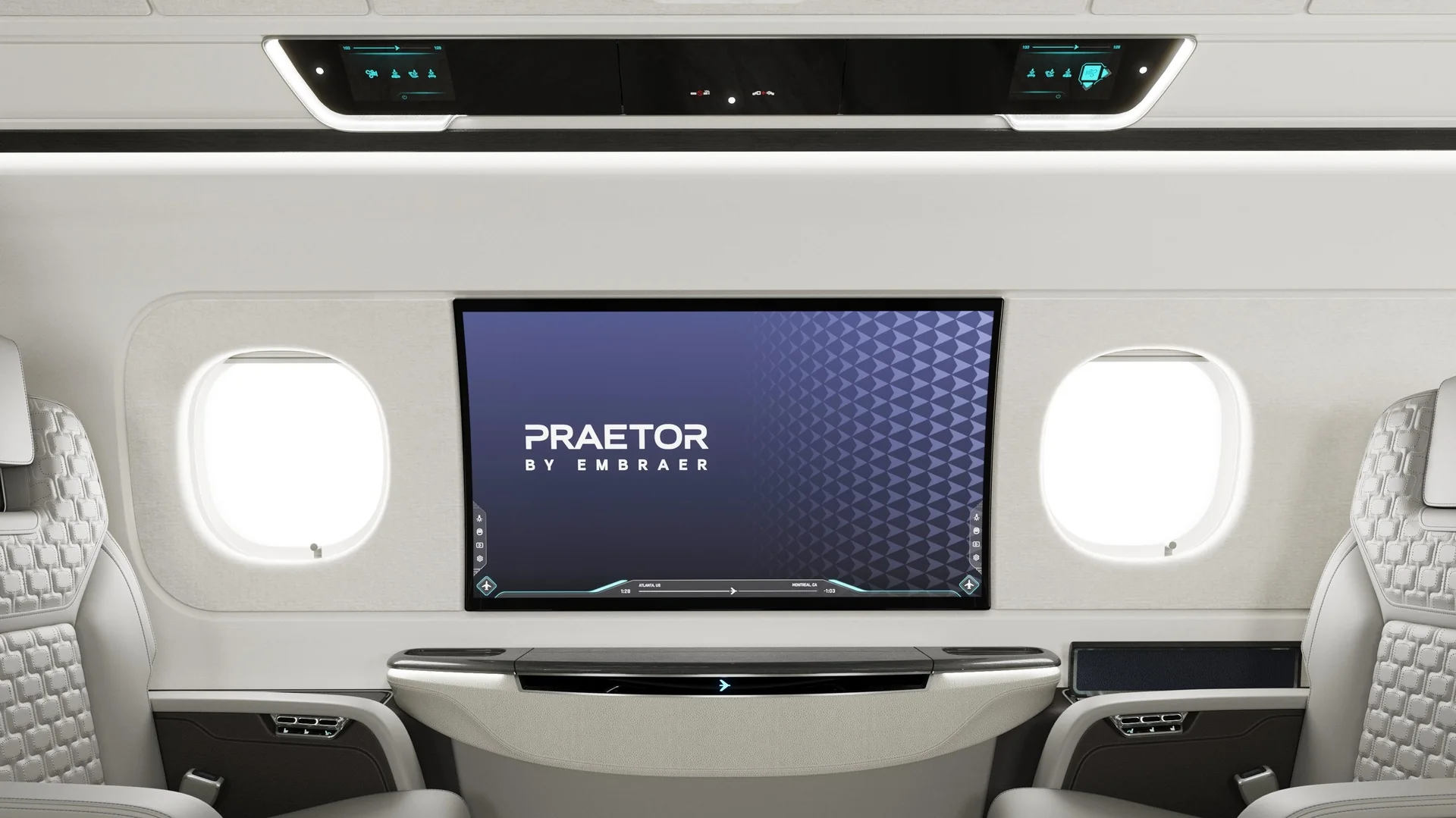
Interior of Praetor 600E with Smart Window.
On February 24, 2026, Embraer announced the Praetor 500E and Praetor 600E, an evolution of the existing family of business jets with a new passenger environment. The update included seats and an interior management system. The Praetor 600E has a separate Smart Window: a large curved touch screen built into the side wall.
The next day, Lufthansa Technik revealed its role in the development of cabin systems. The solution includes integrated entertainment and hardware control, audio devices and an Embraer interface. The Smart Window has a 42-inch diagonal and access to images from three external cameras. These features are specific to the declared configuration; they cannot be automatically attributed to every previously released Praetor.
Why a cabin upgrade changes the flight experience
The passenger spends most of the trip inside the cabin, so comfort is assessed through the actions: sit down, place things, work, eat and relax. New seating and equipment make sense when they help these activities fit together. A separate eye-catching detail does not compensate for inconvenient storage or the need to constantly clear the table to get to your personal bag.
A hypothetical four-hour flight may include a short discussion after departure, individual work and rest before arrival. This alternation requires different seat positions, lighting and surface accessibility. Therefore, the designer considers not one beautiful scene, but a sequence of scenarios. The simpler the transitions between them, the more naturally a person uses the limited aircraft space.
However, different passengers are not required to act in the same way. While one is reading, the other can watch a movie or talk. Local control capability helps reduce mutual interference. But some of the functions remain common, so the system must clearly separate personal settings and changes that affect the entire cabin. This is a task of organizing interaction, and not just the quality of installed screens.
A display built into the sidewall
The large display changes the usual distribution of surfaces. Typically, the side wall is perceived as the boundary of a space with windows and trim. The built-in screen adds an information function to it. The passenger can receive the image without a separate portable device, but this solution requires coordination with the ambient light, viewing angle and the position of the people in the seats.
Smart Window provides access to external cameras. This allows the outside view to be shown electronically, but the screen does not become conventional glazing. It depends on the camera, signal processing and display. The distinction is important to understand the function: the image expands the entertainment and surveillance options, but remains part of the cabin electronics with its own modes of operation.
A large screen also has a spatial side. The image should be convenient to view from the intended locations, and the brightness should correspond to the selected scenario. During general viewing and during the rest of the neighboring passenger, different conditions are needed. Therefore, the usefulness of the technology is determined not only by the diagonal, but also by how carefully it is integrated into the overall environment of the cabin.
Lighting, climate and entertainment control
The interior management system integrates functions that previously might have been perceived as separate devices. For humans, this is the ability to manage multiple tasks through a consistent interface. But simplicity only comes when names, states, and actions remain clear. A large number of settings in itself does not make the trip more convenient.
Good organization starts with frequent tasks. The passenger must quickly find the light, the image source and the desired setting of his seat. Rarer functions can be located further in the structure if this does not prevent their use. This distribution helps avoid a situation where a simple action requires studying a complex menu during each new flight.
Feedback is important. If the system receives a command and executes it, it is useful for a person to see the expected state. Ambiguity forces repetition and creates the impression of malfunction. The interface is therefore linked to the actual response of the equipment: the screen, light or other device must behave in a manner consistent with what the passenger sees in the cabin controls.
Sound takes space even when the speakers are hidden
The acoustic system includes not only the emitters themselves, but also the surfaces around them. Positioning, mounting and interaction with the interior influence how sound is perceived in different places. Therefore, a subtle device may require a lot of engineering work. Hidden installation does not mean there are no requirements for its availability, configuration and maintenance.
For the passenger, it is not just the presence of sound that is important, but its intelligibility and uniformity in the desired area. General viewing and individual relaxation create different challenges. If some people want it louder and others want it quiet, the system must support the intended scenario without constant mutual interference. Acoustic comfort is also related to the isolation of background noise, and not just to the power of the equipment.
The test is performed under conditions appropriate for the intended purpose. An aircraft standing on the ground and a cruising flight create a different sound environment. Therefore, the impression of the interior at the presentation does not reveal all the characteristics of its sound in operation. The final result depends on the coordination of equipment, finishes and the actual conditions in which people will use the system during the trip.
Cabin network and communication with the outside world
It is useful to distinguish between local entertainment system and Internet access. The first can provide functions inside the aircraft, the second also depends on the external network and installed communication equipment. The presence of a large display does not confirm the availability of a certain communication speed. Each element should be evaluated on its own configuration and operating conditions.
This separation helps to troubleshoot problems. If local content is displayed but the external service is not available, the cause may be related to the connection or the remote platform. If the image does not appear at all, another part of the system is checked. Clear architecture and status information allow crews to more quickly communicate useful information to technical support and passengers.
For long-term operation, a history of changes is important. Software and settings updates must remain specific to the aircraft. Externally identical screens can operate in different configurations, which affects the search for the cause of the problem. Therefore, the digital part of the cabin needs support in the same way as physical devices, connectors and interior elements.
What to check for a specific aircraft
The announcement of a new version of the family does not automatically update the entire existing fleet. For an aircraft, you need to know the actual installed equipment and available functions. Also, you cannot transfer a feature of Praetor 600E to Praetor 500E just because of the general presentation day. Smart Window must be considered in the context of the model and configuration for which it is announced.
When choosing an aircraft, it is useful to test scenarios in practice. Is it convenient to work from the chosen location, where are things located, how does the lighting change, and how clear are the basic commands? These questions link technical novelty to the passenger's task. They help to evaluate the real improvement, not limited to the overall impression of the new version name.
The presentation of the Praetor 500E and 600E shows the development of the business aircraft through the passenger environment and its digital functions. At the heart of the update is the coherence of seats, equipment and interface. The practical value will be determined by how naturally it supports normal human activities during several hours of flight, and then remains convenient and maintainable in everyday use.
It is also worthwhile to evaluate the crew’s work with the overall system: how to prepare the cabin for passengers to board, determine the source of the problem and return the equipment to the desired condition. Convenience for the traveler and clarity for the maintenance team complement each other, especially when the aircraft makes several different trips in a row.