
Aircraft
F-47 test complex planned at Nellis
Plans for an F-47 ground-test complex at Nellis: budget estimates, phased construction and the difference between a project and an operational facility.
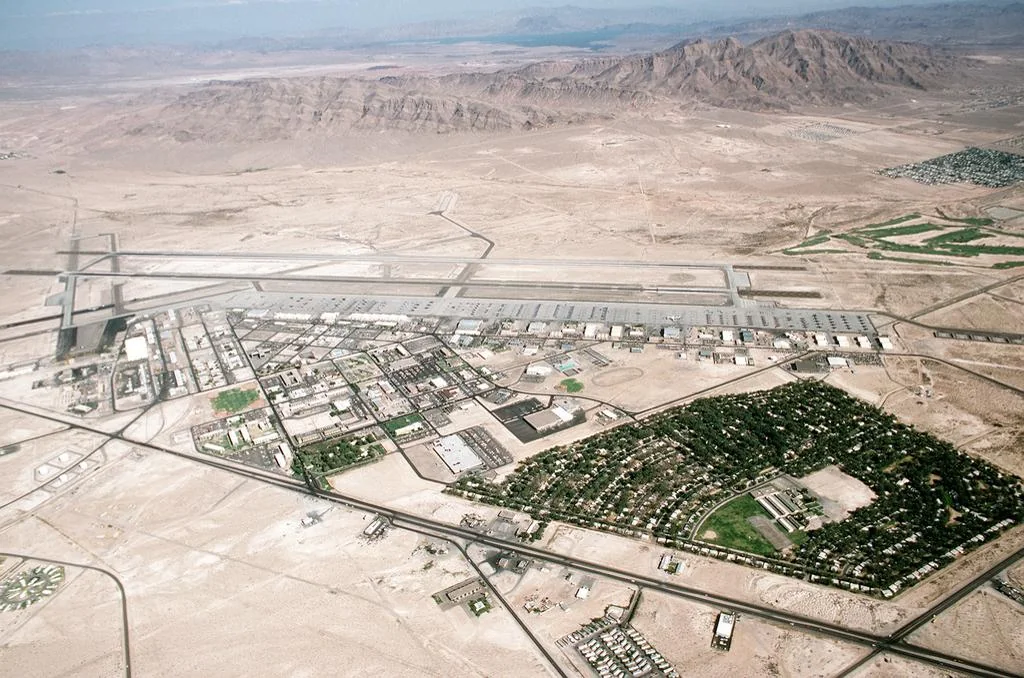
Nellis AFB as seen from the air in 1981. Archival illustration of the site; The future F-47 complex is not shown in the picture.
The US Air Force has outlined a draft procurement process for an F-47 operational-test complex at Nellis Air Force Base, Nevada. Published plans put the estimated cost at about $1.057 billion, with the main construction phase targeted for completion in spring 2031. The announcement concerns infrastructure preparation and contractor selection. It does not confirm completed construction or the start of F-47 operations at the base.
The news relates to the ground part of the aviation program. The aircraft and the facility that will support it have separate schedules, budgets, and availability requirements. Even if they are connected by a common goal, they must be assessed separately. Using the example of such a project, one can understand why the new type requires not just one hangar, but a whole set of coordinated premises and processes, and how the construction plan differs from the actual readiness of the test site.
What is test infrastructure
Aviation testing begins long before departure. It is necessary to prepare the equipment, check the aircraft configuration, agree on the program and organize the recording of the results. After the flight, the data must be processed and compared with the conditions of the mission. These works require different spaces: some are intended for technology, others for specialists and computing facilities. The usefulness of the complex is determined by how consistently preparation, execution and subsequent analysis are connected, and not just by the total square footage of the buildings.
The test site differs from a regular aircraft parking area in the purpose of the equipment. It must support controlled testing of certain properties and maintain a connection between the result and the state of the aircraft. If the configuration changes, this must be taken into account when comparing data. The public news does not disclose the entire technical organization of future work. But the general principle is clear: the infrastructure creates the conditions for repeatable testing, and does not replace the tests themselves or predetermine their results.
Why are different buildings needed?
The hangar provides space for aircraft work, but does not automatically solve the problems of storage, training and analysis. Each function has its own conditions. Somewhere you need free access to equipment, somewhere you need a stable environment for computing systems, somewhere you need a room for joint analysis of materials. Planners need to coordinate these requirements so that objects do not interfere with each other and remain convenient for the daily work of a large team.
A hypothetical example shows the dependency. The aircraft undergoes training in the hangar, and employees simultaneously check the program for the next mission on the simulator. The results are then discussed across multiple specializations. If the premises are located and equipped inconsistently, part of the time is spent on organizational delays. If the connections are well thought out, the work becomes more consistent. This is a common property of complex technical sites; it does not allow one to calculate the future efficiency of a particular complex while the object still exists in the form of a project.
Design and construction
At the design stage, requirements, engineering solutions and the sequence of work are clarified. Involving the construction side at an early stage can help match the design to site conditions and available delivery options. However, this approach does not replace the need to review the design, approve changes and control costs. The choice of procurement model determines the organization of interaction between the parties. In itself, it is not proof that all deadlines and expenses are already definitively known.
After the start of construction, new tasks appear: supply of materials, coordination of contractors, installation of utility networks and acceptance of completed work. On an active air base, neighboring processes and access to the area must be taken into account. In this case, specific restrictions are determined by the project and authorized services. It is important to maintain a level of confidence in the Nellis news: the roadmap for future work has been published and the completion of each stage will require its own confirmation. The target date serves as a guide, not as a message about the finished result.
Budget figure and actual expenses
The cost indicated in the design or procurement materials may indicate an estimate of a certain volume. It is not necessarily equal to the amount already spent. For an accurate reading, you need to understand whether the number refers to the funding request, the overall project, the agreement entered into, or the work actually paid for. These categories are related but not interchangeable. Therefore, the formulation “a plan worth about a billion” is more accurate than the statement that such an amount has already been spent on the constructed complex.
Comparing the cost of different sites also requires the same scope of work. One project may include external networks and equipment, another - only buildings. In one case, the reconstruction of existing infrastructure is taken into account, in the other, construction from scratch. Without opening up the boundaries, simply comparing the total numbers explains little. For Nellis, the published estimate sets the scale of the project. Performance should be assessed later based on confirmed agreements, completed stages, and which specific objects were included in the final result.
Phased readiness
A large complex can be introduced in parts. The premises may be prepared for the initial scope of work first, then other functions can be added. This sequence allows construction to be linked to the development of the main program. But partial readiness does not mean that the entire site already has a full range of capabilities. In messages, it is important to clarify which object was introduced, for what tasks and with what restrictions. One general word “discovery” sometimes hides several different stages.
Once the building is physically completed, utility systems must be inspected and specialized equipment installed. Staff then need to learn operating procedures and ensure that communication between areas actually works. For example, a ready-made laboratory without coordinated data transfer does not yet provide the entire analysis cycle. This organizational stage may be less visible than the construction ceremony, but it is what turns individual facilities into a functioning support system for testing a new aircraft.
Simulator and real plane
The training environment allows you to repeat scenarios under controlled conditions and prepare people to operate the systems. Its advantages are related to repetition and the ability to analyze actions without performing each exercise in the air. However, the model must be fit for purpose. Not all properties of a real aircraft are equally represented in any simulator. Therefore, simulator training and test flight complement each other and do not form a simple replacement of one activity for another.
Version consistency is especially important. If the aircraft system is upgraded, the training materials and associated model should remain applicable. Otherwise, participants will discuss different states of equipment under the same name. Maintaining such consistency is a daily engineering discipline. The exact configuration of future simulators cannot be deduced from the public construction plan. One can only understand why the training space is an independent part of the infrastructure that needs to be developed along with the main program.
How to read the next project news
It is useful to monitor individual confirmed milestones: publication of final terms, selection of contractors, commencement of work, completion of facilities and commissioning of equipment. Each of them answers its own question. The procurement procedure shows the intention and procedure, the construction acceptance shows the physical readiness, and the start of testing shows the use of the prepared environment. This approach maintains accuracy and does not require making assumptions about aircraft performance or missions that are not described in the open communication.
A plan of the F-47 facility at Nellis shows the scale of ground preparation for the new aircraft program. Its significance is associated with the creation of conditions for the future work of people and equipment. For now, this is an infrastructure project with published guidelines, and not a ready-made test base. Future progress will be determined by the milestones completed, the consistency of the equipment, and the ability of the site to support the intended processes. It is these results that will make it possible over time to evaluate how the stated plan turned into a really working complex.