
Business aviation
Gulfstream G700 sets a Los Angeles–Farnborough speed record
The G700 completed the Los Angeles-Farnborough route in 8 hours 27 minutes. What the result shows and how speed, wind and travel time are related.
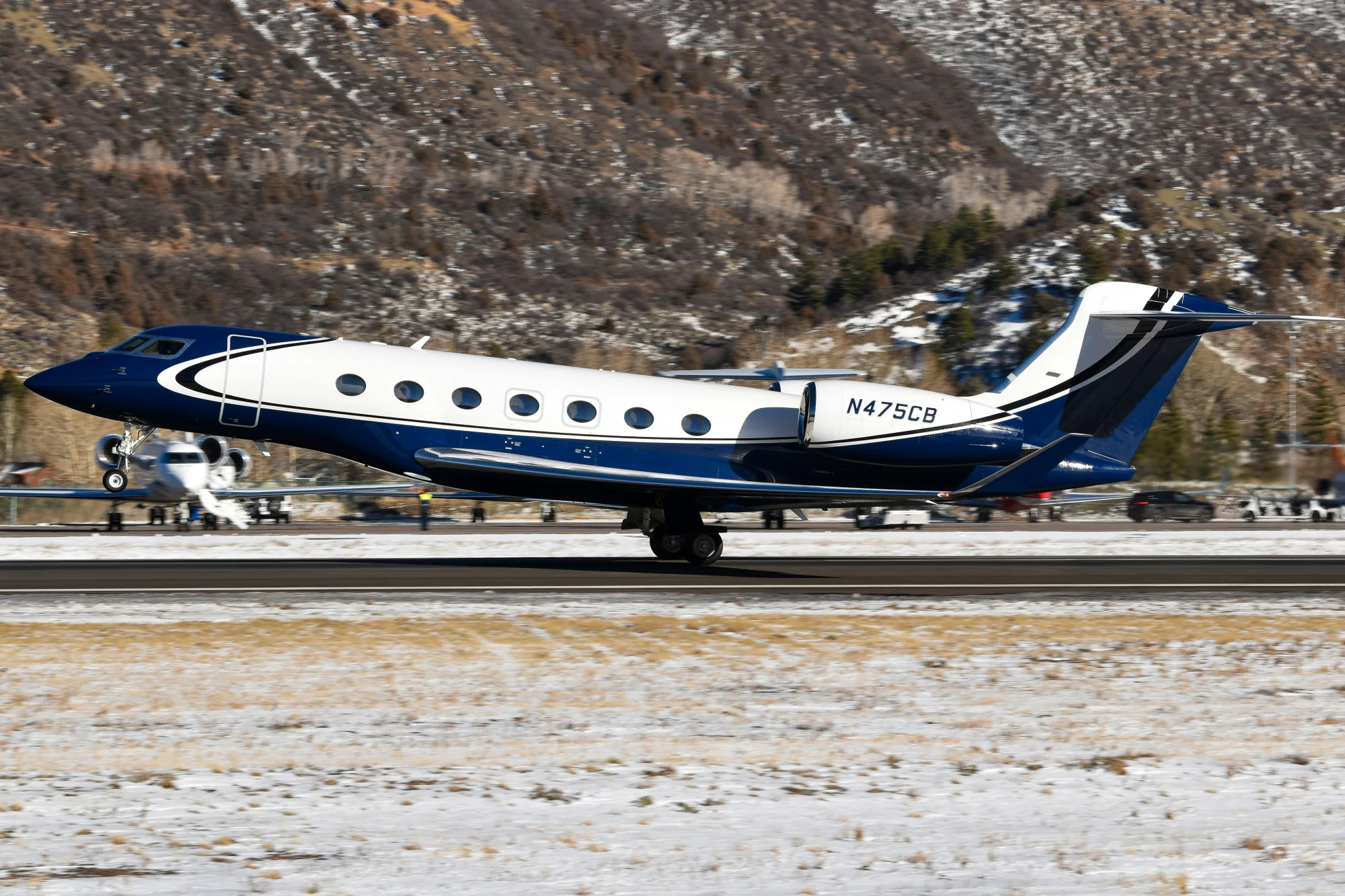
Gulfstream G600 N475CB in Aspen, January 2026. Archival illustration of modern Gulfstream aircraft; The record-breaking G700 is not shown in the photo.
Gulfstream announced a new speed result for the G700 on the route from Los Angeles to Farnborough, UK. According to the announcement dated July 30, 2026, the aircraft covered 4,740 nautical miles in 8 hours and 27 minutes from takeoff to landing. The previous result for this pair of cities was improved by 19 minutes.
This achievement applies to a specific flight and a specific route. It shows the combination of speed and range in the completed task, but does not establish a new permanent schedule for all G700 flights across the Atlantic. To understand the magnitude of the result, it is useful to distinguish between airspeed, groundspeed, actual path, and the time of the passenger's entire trip.
What can be calculated from published data
One nautical mile equals 1,852 metres, so the announced distance is approximately 8,778 kilometres. Eight hours and twenty-seven minutes is 8.45 hours. Dividing that distance by the time gives roughly 561 knots, or 1,039 kilometres per hour. This is an arithmetic average of two published figures, rather than a measured speed at a particular point on the route.
The calculation gives a sense of scale, but its limits matter. The definition of the record distance needs to be known: a distance between two points and the actual path flown can differ. This calculated average therefore cannot automatically be treated as the average groundspeed throughout the recorded flight or compared directly with a published cruise speed.
From the same data it follows that the previous result was 8 hours 46 minutes. The nineteen minute difference is approximately 3.6 percent of the previous time. This is a relative reduction in the duration of a particular flight. It does not mean a similar reduction in fuel consumption, flight cost or travel time from home to the meeting point: each indicator requires its own calculation.
Airspeed and ground movement
The plane moves inside an air mass, and this mass itself moves relative to the surface. Therefore, airspeed and groundspeed answer different questions. The first is related to aerodynamics and flight mode. The second shows how quickly the position of the aircraft on the map changes. A tailwind can increase groundspeed without the same increase in airspeed.
Let's imagine a hypothetical straight section where the airspeed is 500 knots, and the wind is directed strictly along the route at a speed of 50 knots. With a tailwind, the groundspeed will be about 550 knots, with a headwind - about 450. To cover a thousand nautical miles, it will take approximately 1 hour 49 minutes or 2 hours 13 minutes, respectively. The example is simplified and does not describe the record flight.
In reality, the direction and strength of the wind changes with altitude and along the path. Planning takes these differences into account along with aircraft and airspace limitations. Therefore, the same aircraft in the same pair of cities can show different times on different days. Comparing results is meaningful only with an understanding of which conditions are known and which remain beyond the brief announcement.
Why route direction matters
The flight from North America to Europe and the return flight cannot be considered mirror in duration. Atmospheric circulation, available levels and traffic organization can create different conditions. Even if the distances between airports are the same, the chosen trajectories and wind components may differ. This is why the city pair record usually contains a direction and not just two names.
Farnborough also represents a specific destination airport rather than the fictitious point "London". The difference is important for air and ground planning. The passenger's journey after landing depends on his final destination, traffic conditions and service organization. The fastest flight between airports is not necessarily the shortest trip between two specific addresses.
For a real trip, it is useful to first determine the desired points, then calculate the available options. If the event is closer to another airport, some of the gains in the air may be lost on the ground. The record retains its technical significance. Transportability is simply measured over a longer chain than the gap between leaving the lane and touching down at your destination.
What makes up time in the air
The flight duration includes climb, cruise, descent and approach. These steps are performed at different speeds and limitations. Therefore, dividing the distance by one published number gives only a rough estimate. On a long route, the cruising section takes up a large portion of the time, but the remaining parts still affect the outcome.
It is also possible to change the trajectory according to the instructions of the traffic controls. Weather avoidance or airspace occupancy can also increase the distance. Pilots and controllers solve the current problem in a real environment; the original plan is not a fixed line. For a record result, it is important how all these elements came together in the completed flight.
There is also a difference between the flight time and the time from the start of movement from the parking lot to the final stop. Gulfstream's announcement uses the takeoff to landing time span. It would be incorrect to add unspecified ground stages to it or pass it off as the full duration of the passenger service. Accurate definition of the indicator helps to avoid inflated expectations.
Speed is related to other characteristics
Choosing a flight mode affects more than just minutes. The required thrust and fuel consumption change, and therefore the conditions for completing a long-distance route. Maximum speed and maximum range are not usually two independent advantages that can be used simultaneously without reservation. For a specific load and weather, a coordinated plan is needed.
Let's imagine a hypothetical choice between a faster non-stop option and a mode with lower consumption. First, they check which options are generally feasible with the necessary reserves. Then time and other conditions are assessed. A small saving in minutes cannot be considered a sufficient reason to ignore restrictions: speed makes sense within a correctly prepared flight.
For the same reason, the record does not allow us to restore the entire aircraft load. Without published data, it is unknown how many people and luggage were involved in a particular configuration. The result is useful as a confirmed achievement on the route, but does not replace the calculation for another group of passengers. The aircraft, conditions and mission must be considered together.
How to use this news when comparing aircraft
The record flight provides a concrete example of the model's capabilities. When choosing an aircraft, it is worth adding more everyday questions to it: what routes are flown regularly, how many people are flying, how often stopovers are needed and how the support is organized. Then the technical achievement becomes part of the meaningful comparison, and not the only argument.
The G700's Los Angeles to Farnborough result shows that the long intercontinental leg was completed faster than the previous published benchmark. Its value is in the exact pair of cities, the named distance and time. When transferring this example to a future trip, you need to maintain the same precision: separate the measured result from the calculated expectation and take into account the actual conditions of the upcoming flight.
Another useful measure is the airborne portion of the whole travel day. If a hypothetical journey takes twelve hours from leaving home to reaching the hotel, saving nineteen minutes in flight reduces the total by about 2.6 per cent. This example is not connected with the record flight’s passengers. It shows how the value of a notable technical achievement can vary with ground arrangements and waiting time.