
Business aviation
Lufthansa Technik and Designworks unveil The BOW group VIP cabin
The BOW VIP cabin concept: shared spaces, private compartments and adaptable equipment for group travel.
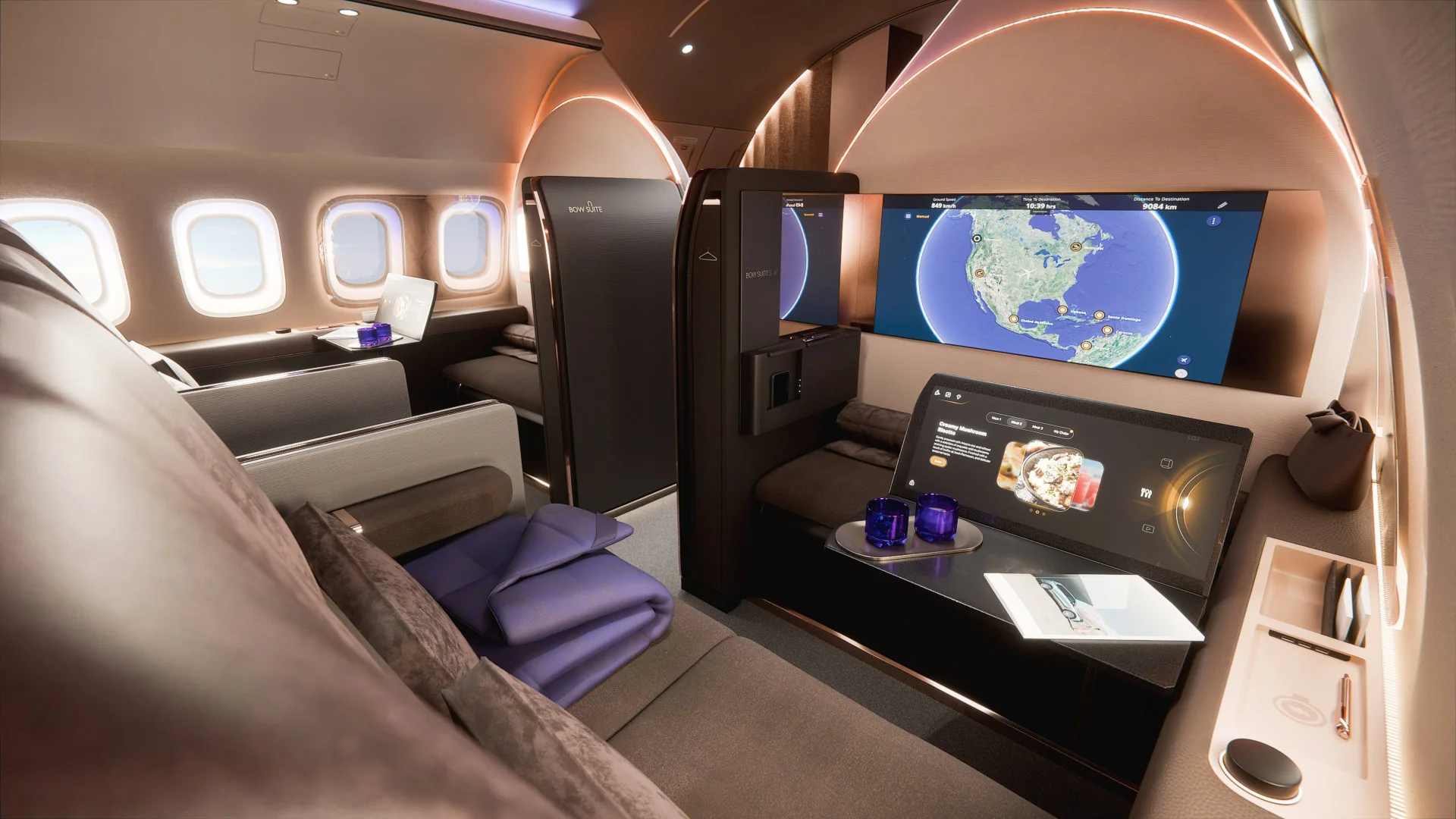
Visualization of The BOW concept.
At the Aircraft Interiors Expo 2026 in Hamburg, Lufthansa Technik presented The BOW, a narrow-body aircraft cabin concept developed in collaboration with Designworks, a BMW Group company. The project is designed for group trips: corporate teams, athletes and artists. The announcement was published on April 13, 2026.
Instead of one main owner's room, there is a combination of entry area, common space and separate compartments. The project allows for different layouts, and the manufacturer indicates the possibility of accommodating up to 28 passengers. This is a concept for further individual development. The images shown do not mean that such a cabin is already installed on a particular aircraft and is available for booking a flight.
The group has several scenarios for one trip
Traveling as a team is different from traveling as a single person, even with the same level of comfort. Some participants need to discuss a work task, others need to relax, and others need to prepare for a presentation. These actions happen simultaneously. Therefore, the common space has to be designed so that joint work does not turn into the mandatory participation of all passengers in one conversation.
The hypothetical sports group shows the differences well. After boarding the plane, the coach may discuss the organization with several colleagues, the players need rest, and the accompanying party needs communication with the host party. This is a fictitious use case and not a customer description of The BOW. It helps to understand why the number of soft seats in itself does not determine the comfort of a group cabin.
The project provides for common and more private areas. The usefulness of such a division depends on how people move between them, where things are placed, and how well the activity areas are differentiated. If the passage to the galley crosses the rest area, a beautiful partition will not solve the whole problem. Comfort comes from a coordinated organization of space, rather than from individual pieces of furniture.
What does modularity mean in aviation?
The word “modular” is often perceived as an opportunity to rearrange the cabin as desired before each flight. In a real aircraft, any significant modification must take into account mountings, weight, centre of gravity, power supply and intended conditions of use. Therefore, it is necessary to distinguish between flexibility at the design stage and permitted transformation of already installed equipment.
The concept may offer the customer several layout options before production begins. Once selected, the engineering team designs the specific interior, associates it with the aircraft, and confirms compliance. Individual elements may indeed have several operating positions, but the permissible states are determined by the design and documentation. The general idea of freedom of choice does not abolish these boundaries.
Let's imagine a table that is divided into several workstations. For the passenger, this is a change in the communication scenario. For the developer, there is also the task of mechanics, fixation, electrical wiring and maintenance. In each permissible position, the equipment must fulfill its intended purpose. Therefore, it is not only the spectacular transformation at the presentation that is of interest, but also how it is implemented in everyday use.
Shared table as a working tool
The central space of The BOW features a large table that can be transformed into several separate sections. This idea meets a clear goal: the same area is needed either for general discussion, then for individual work, or for food. Space saving occurs due to the combination of functions, and not due to the disappearance of requirements for each of them.
For a work meeting, visibility, access to the surface, and the ability to hear the interlocutor are important. For food - placement of dishes and ease of service. For individual work - power supply for devices and suitable lighting. One piece of furniture must take into account all these situations, otherwise versatility will remain only a name. This is why cabin engineering connects appearance with specific actions of people.
There is also a transition between scenarios. While part of the group continues to talk, the crew can prepare food. You need to understand where objects are temporarily placed, how the surface is cleared, and who has access to the desired area. A comfortable interior reduces unnecessary movements and does not require complex explanations every time a passenger wants to perform a simple action during the flight.
Privacy has several layers
A partition helps separate a space visually, but privacy is not limited to what a person can see. Sound propagation, direction of passages and access to shared equipment are all important. Conversations in a closed compartment can still be heard from the outside. Therefore, visual separation and acoustic insulation are related but independent tasks.
The design provides separate compartments for one or two travelers. Their purpose can be assessed through situations: a short conversation, rest, storage of personal belongings. However, the specific configuration must provide clear access and meet operational requirements. The more functions are combined in a small volume, the more important a thoughtful sequence of use is.
For example, a personal bag should be accessible without having to clear the entire aisle. Reading lighting should not interfere with adjacent seating areas. Details like these are rarely the focus of a new concept's announcement, but they shape the passenger's everyday experience. Cabin architecture is useful when it helps solve such small, regularly recurring tasks.
Controlling cabin equipment without unnecessary steps
The BOW integrates cabin functions through the nice system and uses Hidden Touch solutions. The idea of hidden controls allows you to maintain a calm surface appearance when the controls are not needed. It is important for the passenger that the desired function remains easily detectable and understandable. The elegance of the surface must be combined with clarity of use.
A good interface helps you understand not only the location of the touch, but also the state of the system. If the light is already changing or the device is executing a command, it is useful for a person to see feedback. Otherwise, he may press the control repeatedly or assume that it is not working. The consistency between the physical hardware and the display affects usability as much as the shape of the screen.
In the group cabin, distribution of powers is added. One passenger controls his seat, shared settings affect other people, and the crew needs their own capabilities. Therefore, the control logic must take into account the zone boundaries. A simple single-seat system becomes significantly more complex when multiple users simultaneously interact with the same space.
From exhibition project to finished aircraft
The next stage for such a concept is related to a specific customer, the selected aircraft and a detailed implementation program. Layout, equipment, materials and maintenance must be agreed upon. The image helps discuss the idea, but does not reveal the full weight of the structure, access to systems and the scope of integration work. These issues are resolved in the process of developing a real interior.
It is useful to evaluate The BOW as offering a new group travel scenario. Its central idea is the ability to combine teamwork with personal space within one cabin. The practical outcome will depend on how consistently this idea is maintained throughout design, manufacture and operation. This is where the concept transforms from an expressive image into a comfortable environment for people who spend several hours in the air together.
Maintenance of transformable elements is also important for the future operator. The more mechanisms and hidden devices, the greater the access for inspection and repair. The ability to quickly find a fault and return the function to function should be discussed along with aesthetics. Then the interior remains comfortable throughout operation, and not just on the day of the first presentation at an aviation exhibition.
A group should assess the cabin against the sequence of an entire flight: settling in after boarding, working, eating, resting and preparing to leave the aircraft. If those stages do not require constant movement of belongings or disrupt other passengers, the shared VIP space has practical value. The idea succeeds through how people use it, as well as how it looks.