
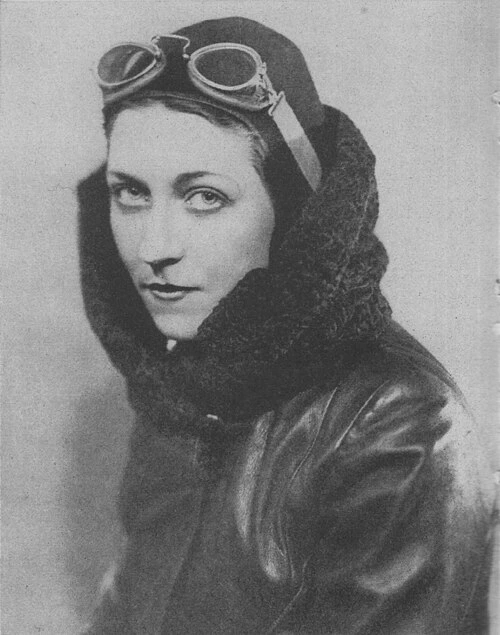
Life and work in aviation
Amy Johnson (1903–1941) was a British aviator known for her solo England-to-Australia flight in 1930. Also qualified as an aircraft mechanic, she combined piloting with technical understanding. Her de Havilland DH.60 Moth Jason symbolised the route. She later made other long-distance flights and worked with the Air Transport Auxiliary ferrying aircraft.
Pilot and mechanic
Johnson grew up in Hull and received her university education. She was engaged in flight training at the London Aeroplane Club, while mastering engine maintenance. Technical knowledge was useful in travel: at a remote stop, you could not always count on the usual support. The condition of the aircraft determined the ability to continue the route, so mechanical training complemented the control skills in the cockpit.
Route to Australia
In May 1930, Johnson flew out of Croydon and reached Darwin. She was the first woman to fly from England to Australia. The journey took place with intermediate landings. Its complexity consisted in organizing numerous stages, orienting and maintaining the performance of a light aircraft over a long distance, rather than in one continuous flight.
The Jason Plane
The DH.60 Moth Jason was a lightweight two-seat biplane. For the trip, it was prepared taking into account fuel and necessary equipment. The preserved machine allows you to imagine the cabin and the size of early record aviation. Johnson's flight did not rely on the infrastructure of a modern passenger flight. She independently controlled the aircraft in different climatic and airfield conditions.
Aircraft distillation
During the war, Johnson served in the Air Transport Auxiliary, which delivered aircraft between airfields. She died in January 1941. Her career connects personal records with the necessary transport work. A trained pilot could apply the accumulated experience to the movement of equipment. The circumstances of the last flight should be described according to the documents, without supplementing them with unproven sensational versions.
How to understand the aviation record
Aviation achievements are recorded on a specific task and category. Speed on a short section, speed on a closed route and range require different conditions. The result with a useful load is not equal to the indicator of an empty machine. Therefore, the comparison begins with a description of the task, the type of device and the registration rules. A simple number without this context can create a false impression, even if the date and surname of the pilot are correct.
For a long-distance route, fuel, mass, and equipment must correspond to the intended stages. Additional tanks can increase the stock, but change the load and interior space. Wind affects the speed relative to the ground and the time of passage of the site. The ocean route also limits the choice of landing sites. Training includes ground stations and communications, so a successful flight is the result of the work not only of the person behind the controls, but also of the organization’s team.
Single flight means one pilot in a flight crew, not lack of assistance on the ground. The non-stop route excludes intermediate landings, but the possibility of refueling in the air requires a separate clarification. The round-the-world journey with stops refers to a different type of achievement than continuous flight. Keeping these differences allows you to honestly describe records of different eras and not attribute to one crew what the other performed under different conditions.
Long-term work affects a person: attention and the ability to make decisions must be maintained throughout the program. In a multi-seat aircraft, duties are shared among participants, and in a single route, training provides affordable ways to reduce the load. The historical record shows the possibilities of a particular project. It does not become a ready-made instruction for modern flight and does not cancel the requirements for equipment, qualifications and planning of normal operation.
Major achievements
- The first among women to fly independently from England to Australia
- Obtained the qualification of an aviation mechanic
- Worked at Air Transport Auxiliary
Aircraft and flying machines
- de Havilland DH.60 Moth Jason
Organisations and events
London Aeroplane Club · Air Transport Auxiliary
- Flight to Australia in May 1930
- Wartime aircraft distillation
Questions about this biography
Why is Amy Johnson in aviation history?
She was the first woman to fly from England to Australia. She qualified as an aviation mechanic. She worked at Air Transport Auxiliary.
With what field of aviation is this biography connected?
Amy Johnson (1903-1941) was a British aviator known for her solo flight from England to Australia in 1930.
What aircraft are involved in this work?
Biography related to: de Havilland DH.60 Moth Jason. Their role and period are described in the main sections.
What events help to understand the professional path?
Major historical episodes: Flight to Australia in May 1930; Wartime aircraft distillation.
What organizations are mentioned in the biography?
The professional path is connected with organizations and communities: London Aeroplane Club, Air Transport Auxiliary.
Was the flight to Australia nonstop?
Oh, no. It was an independent route with intermediate stops.
What is the technical context of this story?
Aviation achievements are recorded on a specific task and category. Speed on a short section, speed on a closed route and range require different conditions. The result with a useful load is not equal to the indicator of an empty machine. Therefore, the comparison begins with a description of the task, the type of device and the registration rules. A simple number without this context can create a false impression, even if the date and surname of the pilot are correct.