
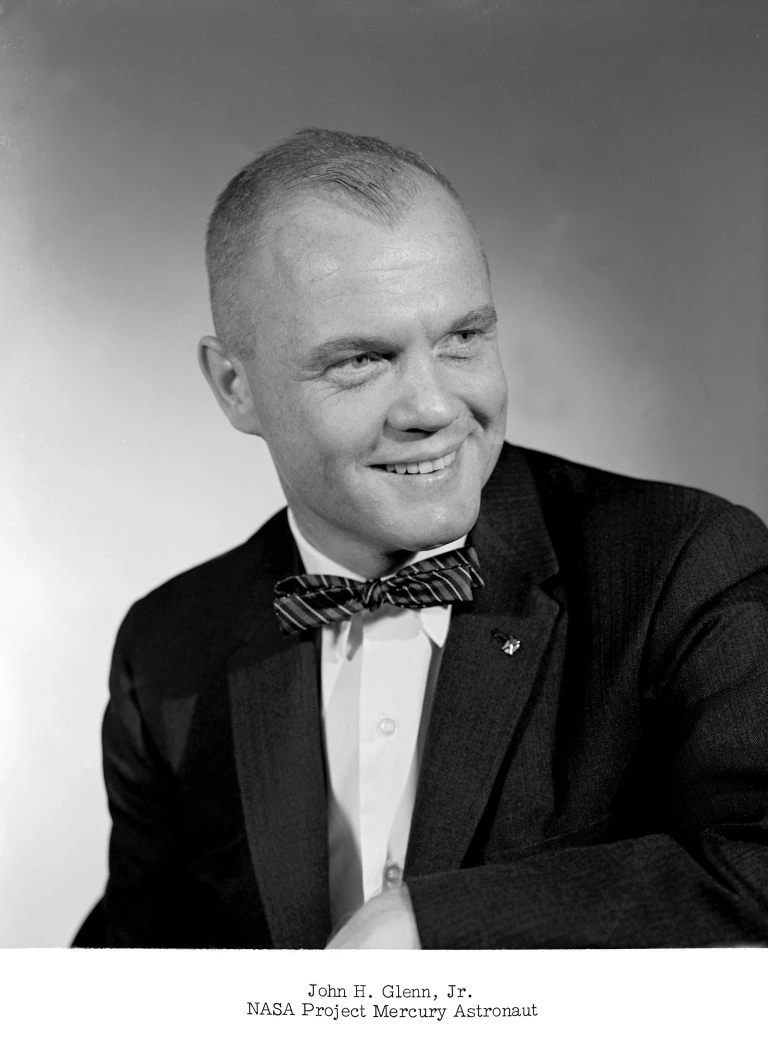
Life and work in aviation
John Glenn (1921–2016) was an American military pilot, test pilot and astronaut. In February 1962, he became the first American to orbit Earth in Mercury Friendship 7. Previously, he flew Project Bullet’s high-speed transcontinental route. He returned to space aboard Discovery in 1998, participating in research into human performance during spaceflight.
Aviation Service
Glenn served in naval aviation and the Marine Corps, then underwent test training. His experience included working with jet aircraft. In the test flight, it was necessary to combine control with the exact execution of the task. Such discipline was useful in Mercury, where the limited space of the ship and the new equipment imposed additional requirements for the work of an astronaut.
Project Bullet
In 1957, Glenn completed a high-speed transcontinental route on the F8U Crusader. The flight connected the test experience with the capabilities of high-speed jet aviation. It was an aviation achievement, separate from the subsequent space program. It cannot be described as a spacecraft flight or as the same vehicle that Glenn later orbited.
Friendship 7
On February 20, 1962, Glenn made three orbits of Earth on Mercury Friendship 7. Alan Shepard has already completed an American suborbital flight, so Glenn's priority is to orbit. During the expedition, it was necessary to monitor the systems and maintain communication. This result was an important step in testing the capabilities of man and ship in a full flyby of the planet.
Discovery in 1998
At the age of 77, Glenn participated in the STS-95 mission on the Space Shuttle Discovery. The crew performed a scientific program different from the early Mercury. Returning decades later did not mean repeating the first route: the ship, the crew and the tasks were different. His biography allows you to compare two generations of manned vehicles through the experience of one trained participant.
Aviation and manned space flight
The aviation experience helped the first cosmonauts and astronauts to work with technology and perform complex procedures. However, the spacecraft is not just a plane at a higher altitude. For orbital motion, an appropriate speed is required, and return is associated with braking and heating protection. Therefore, training programs added new disciplines. The pilot had to understand the ship, the conditions of weightlessness and the operation of the ground support system, which differed from the usual aviation departure.
The suborbital route lifts the device into the cosmic region without a complete orbit around the Earth. Orbital expedition involves movement around the planet. Length alone is not the only difference: the speed and sequence of return change. These concepts help accurately describe the first flights of different countries. The achievement of one participant should not be substituted for another, even when the events occurred close in time and belonged to one generation of space technology.
The ship depends on communication, power, control, and systems supporting human conditions. A separate node can be developed by another organization, so the authorship of the program is collective. The commander, flight engineer and scientific specialist perform different duties, and the composition of the crew changes between missions. The history of a particular flight should preserve these roles. It shows what tasks the participant actually solved, and not just lists the names of people who were near the ship.
Ground training includes the study of equipment and the development of the envisaged actions. Astronauts are trained as a crew, agreeing on the distribution of work. With the development of stations and reusable ships, scientific programs and the duration of stay have expanded. The biography of the participant allows you to compare generations of technology, but does not make him the author of all subsequent missions. To understand the heritage, specific flights, duties and transfer of experience to those who prepared and performed the following expeditions are important.
Major achievements
- Executed Project Bullet in 1957
- He was the first American in orbit.
- Participated in STS-95 at the age of 77
Aircraft and flying machines
- F8U Crusader
- Mercury Friendship 7
- Space Shuttle Discovery
Organisations and events
U.S. Marine Corps, NASA
- Orbital flight February 20, 1962
- STS-95 mission in 1998
Questions about this biography
Why is John Glenn in the history of aviation?
He performed Project Bullet in 1957. He was the first American in orbit. He participated in STS-95 at the age of 77.
With what field of aviation is this biography connected?
John Glenn (1921-2016) was an American military pilot, test pilot and astronaut.
What aircraft are involved in this work?
F8U Crusader, Mercury Friendship 7, Space Shuttle Discovery. Their role and period are described in the main sections.
What events help to understand the professional path?
Major historical episodes: Orbital flight on February 20, 1962; STS-95 mission in 1998.
What organizations are mentioned in the biography?
The professional path is associated with organizations and communities: the US Marine Corps, NASA.
Was Glenn the first American in space?
The first was Alan Shepard on the suborbital route. Glenn was the first American to make an orbital flight.
What is the technical context of this story?
The aviation experience helped the first cosmonauts and astronauts to work with technology and perform complex procedures. However, the spacecraft is not just a plane at a higher altitude. For orbital motion, an appropriate speed is required, and return is associated with braking and heating protection. Therefore, training programs added new disciplines. The pilot had to understand the ship, the conditions of weightlessness and the operation of the ground support system, which differed from the usual aviation departure.