
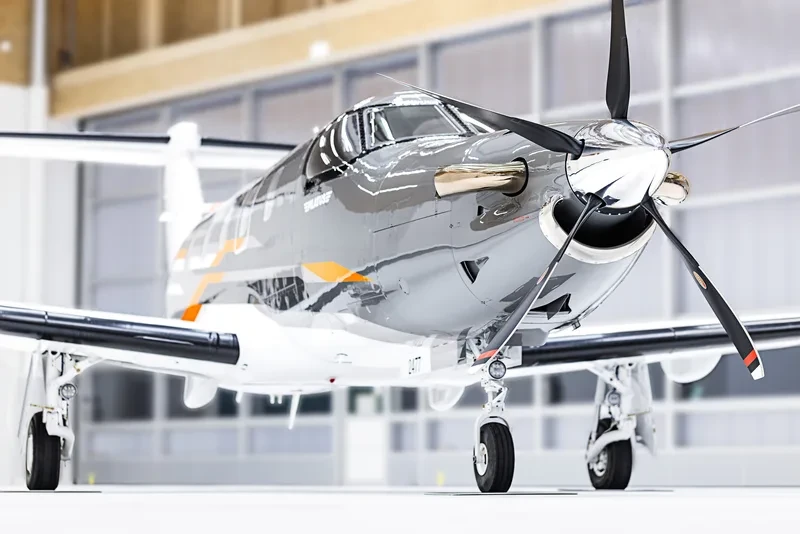
Model profile
PC-12: history and features
The PC-12 first flew in 1991 and became one of Pilatus' major civilian programs. The aircraft is used in business, sanitary and special aviation. Subsequent generations of NG and NGX updated the equipment and power plant.
Programme development
Pilatus developed the PC-12 as a versatile civil aircraft: the NG and NGX generations consistently updated the engine, avionics, and cockpit, maintaining the original practical idea. Therefore, the generation index is important for understanding the equipment, even when the appearance of the machines is similar.
Design
The single-engine turboprop circuit, airtight interior and large cargo door make the PC-12 a universal platform. Unlike the jet PC-24, it solves a route problem with a different speed and cost of operation.
Technical features
The PC-12 received a pressurized cabin, Pratt & Whitney Canada PT6A engine and a large side cargo door. The NGX uses the electronically controlled PT6E-67XP; this is one of the technical differences between the later version and the early PC-12.
Purpose and uses
PC-12 is found in private, sanitary and special operation. A large cargo door allows you to change the nature of the load, and the turboprop scheme is suitable for routes where the speed of the jet is not the main requirement. The conditions of work with a particular runway are determined by the instructions and the condition of the airfield.
Its place in the family
The original PC-12 needs to be distinguished from late NG and NGX by year of release and equipment.
The platform and its development
PC-12 combines a single-engine turboprop circuit, a sealed cabin and a large side cargo door. This design allowed the aircraft to be used for private travel, sanitary transportation and other tasks where loading flexibility is important. Generations of NG and NGX have consistently updated the engine and crew cabin, while retaining the basic practical idea. The presence of a single engine does not cancel the strict maintenance procedures and route planning.
The turboprop aircraft flies slower than the jet, but at short distances, the difference in total travel time may be less than the difference in passport speeds. The availability of the desired airfield, baggage and the organization of the ground part of the flight are important. On the NGX, the electronically controlled PT6E-67XP engine distinguishes the version from the early PC-12s. For a particular strip, the suitability is determined by the weight, coating condition and instruction, rather than the model's reputation as universal.
Space in the salon
The PC-12 has a published cabin height of 1.45 m, a width of 1.52 m, and a length of 5.11 m. Height helps to assess the convenience of movement along the aisle, width - the space between the seats. These are the dimensions of the cabin, not the free passage: decoration, furniture and the location of the seats affect the feeling of spaciousness. For a specific board, it is worth looking at the plan and photos of the interior.
Which means distance.
For the PC-12, the catalogue shows a maximum range of 3,797 km (2,050 nautical miles). Terms of published calculation: early PC-12; long-range cruising mode at very low payload, up to 523 pounds. This is a benchmark for comparison, not a promise of non-stop travel with any number of passengers. The oncoming wind, airspace bypasses, a lot of luggage and a supply of fuel for care at another airfield change the possible route. Maximum capacity and maximum range cannot be automatically added to a single scenario.
Position on the range among the models of the manufacturer
Pilatus Aircraft catalogue for PC-12 shows 2,050 nautical miles. Among the 3 models of the manufacturer of the same type with the published range, the aircraft takes the 3rd place when sorting from a smaller value to a larger one. At the nearest distance PC-12 NGX published 1,803 nautical miles: the difference is 247 nautical miles, or about 14% of the comparable model. This shows the scale of the difference more accurately than the conditional division of aircraft into “medium” and “long-range”. For the current model, this is a comparison of passport values; a separate flight is planned according to the actual mass and weather conditions.
Proportion of salon in comparison
The PC-12 published a cabin length of 5.11 m, a width of 1.52 m and a height of 1.45 m. These three sizes describe different properties: length determines how many separate groups of furniture can be placed, and width and height affect the convenience of each zone. For comparison, the PC-12 NG published a length of 5.16 m, a width of 1.53 m and a height of 1.47 m. The difference in length is 0.05 m; it can affect the ability to separate the working group of seats from the rest area. The width differs by 0.01 m, which is important for the arrangement of seats and passage. The comparison relates to the dimensions of the empty cabin, and not to the available area after installing the kitchen, partitions and seats.
Capacity and payload
For PC-12, the maximum passenger capacity is up to 9 people. The PC-12 NGX carries up to 9 passengers. Equal declared capacity leaves the main question of the size and arrangement of the cabin, as well as the ability to use all the seats on the selected route. There is no separate confirmed luggage compartment volume for this version in the catalog; the number of seats does not allow you to calculate it automatically. When comparing aircraft, a combination of passengers, fuel and luggage should be checked: the maximum figure for each of these parameters usually describes different design cases. It is this combination that determines how much the published range fits a group with a specific number of things.
Close to Model Capabilities
The PC-12 is part of the PC-12 line. When sorted by published range, the closest are PC-12 NGX (1,803 nautical miles, up to 9 passengers), PC-12 NG (1,560 nautical miles, up to 9 passengers). These options differ not only in the route: the number of seats, cabin proportions and the generation of equipment have to be compared separately. If you need another passenger or more luggage, the close range of two aircraft does not mean equal suitability for the trip. If the decisive is the airfield, additionally compare the runway restrictions of specific modifications. For the released board, the year of manufacture, installed avionics and the actual interior are significant.
The history of Pilatus: Swiss aviation from Stans
Pilatus was founded in Stans on 16 December 1939. Its initial activities involved maintaining Swiss Air Force aircraft; it later developed its own designs. Trainers and utility aircraft established its reputation for practical operation and the ability to work beyond major airports.
The PC-12 became an important civil programme: development began in 1987, the first flight took place on 31 May 1991, and certification and initial deliveries followed in 1994. The next step, the jet-powered PC-24, extended the brand’s speed capabilities. The first customer deliveries began in February 2018.
Engineering philosophy: getting closer to the destination
For Pilatus, convenient travel is about more than time in the air: access to the final destination also matters. The PC-12’s large cargo door and flat-floor cabin allow it to combine passenger and transport roles. Flexible layouts are useful for business flights, equipment transport and special missions.
The PC-24 brought some of that versatility to the jet class. It also has a large cargo door and is certified to operate from certain types of unpaved runway. The Pilatus approach expresses Swiss precision through attention to design, manufacturing and continuous model improvements. Access to a smaller airfield can shorten the ground journey and make the whole trip more convenient.
PC-12 and PC-24: different solutions to a route requirement
The PC-12 is a single-engine turboprop; the PC-24 is a twin-engine jet. Compare them in terms of speed, route length, load and operating cost. PC-12 generations, including the NG, NGX and PRO, differ in flight deck equipment and cabin features.
Special airfield capabilities do not mean a Pilatus can use any landing site. Runway length and condition, aircraft weight and permitted surfaces must meet the limitations of the specific version. The brand’s advantage is most useful when a suitable regional airport really is closer to the journey’s destination.