
Fighter aircraft / F-106
Convair F-106 Delta Dart
Convair's F-106 Delta Dart grew from the F-102 programme but changed so extensively that it became a separate model.
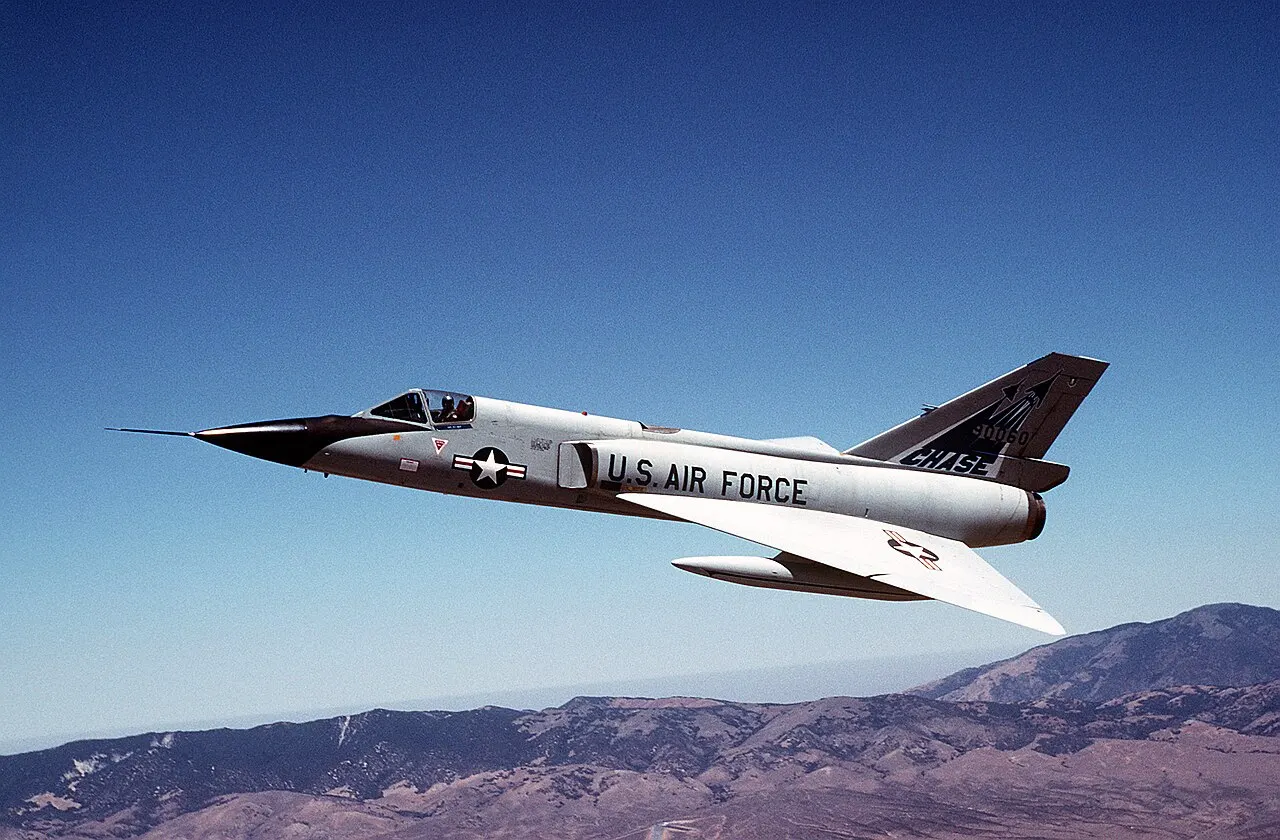
Development
History
Convair's F-106 Delta Dart grew from the F-102 programme but changed so extensively that it became a separate model. The future aircraft was initially called the F-102B. A new engine, revised structure, and more elaborate interception system distinguished it from its predecessor. The first F-106A flew on 26 December 1956, and deliveries to the United States Air Force began in 1959. It was built to defend airspace against bombers in all weather, not to serve primarily as a general-purpose aircraft for attacks on surface targets.
The Hughes MA-1 electronic system was central to the design. It combined the aircraft's equipment with guidance from the ground and could fly the interceptor toward a calculated attack position after takeoff. The pilot supervised the mission and took control for landing. This level of automation reflected a period when an interception might need to occur rapidly at night or inside cloud. Its value depended on functioning electronics, reliable communication, and accurate information from the wider defence network.
The F-106 used a delta wing and a single Pratt & Whitney J75 engine. Unlike many tactical fighters, its weapons were intended for aerial targets and carried in an internal bay. An original load could include AIM-4 Falcon missiles and the unguided nuclear AIR-2 Genie rocket, intended for use against bomber formations. That weapon arrangement belongs to the strategic context of the Cold War; it should not be mistaken for the normal equipment of a later multirole fighter.
Delta Darts served with American air-defence units, where alert duty and practice interceptions accounted for much of their activity. The single-seat F-106A was joined by a two-seat F-106B used for training and other assignments. The fleet received equipment changes as requirements evolved. Despite its high speed, the aircraft's specialised nature limited its usefulness in very different roles. New fighters gradually replaced it as threats, weapons, and the organisation of air defence changed.
The F-106 represents a high point of the specialised American interceptor of its era. Compared with the F-102, it was a much deeper redesign than the connection between their original names might suggest. Its purpose becomes clear only when considered alongside radar stations, command centres, and trained alert crews. Evaluating the Delta Dart therefore requires more than a maximum-speed figure: the meaningful question is how quickly the entire system could detect a threat, pass instructions, and complete an interception.