
Fighter aircraft / F-8
Vought F-8 Crusader
The F-8 Crusader was developed for the United States Navy in the early 1950s, when a new carrier fighter was expected to fly supersonically in level flight.
Development
History
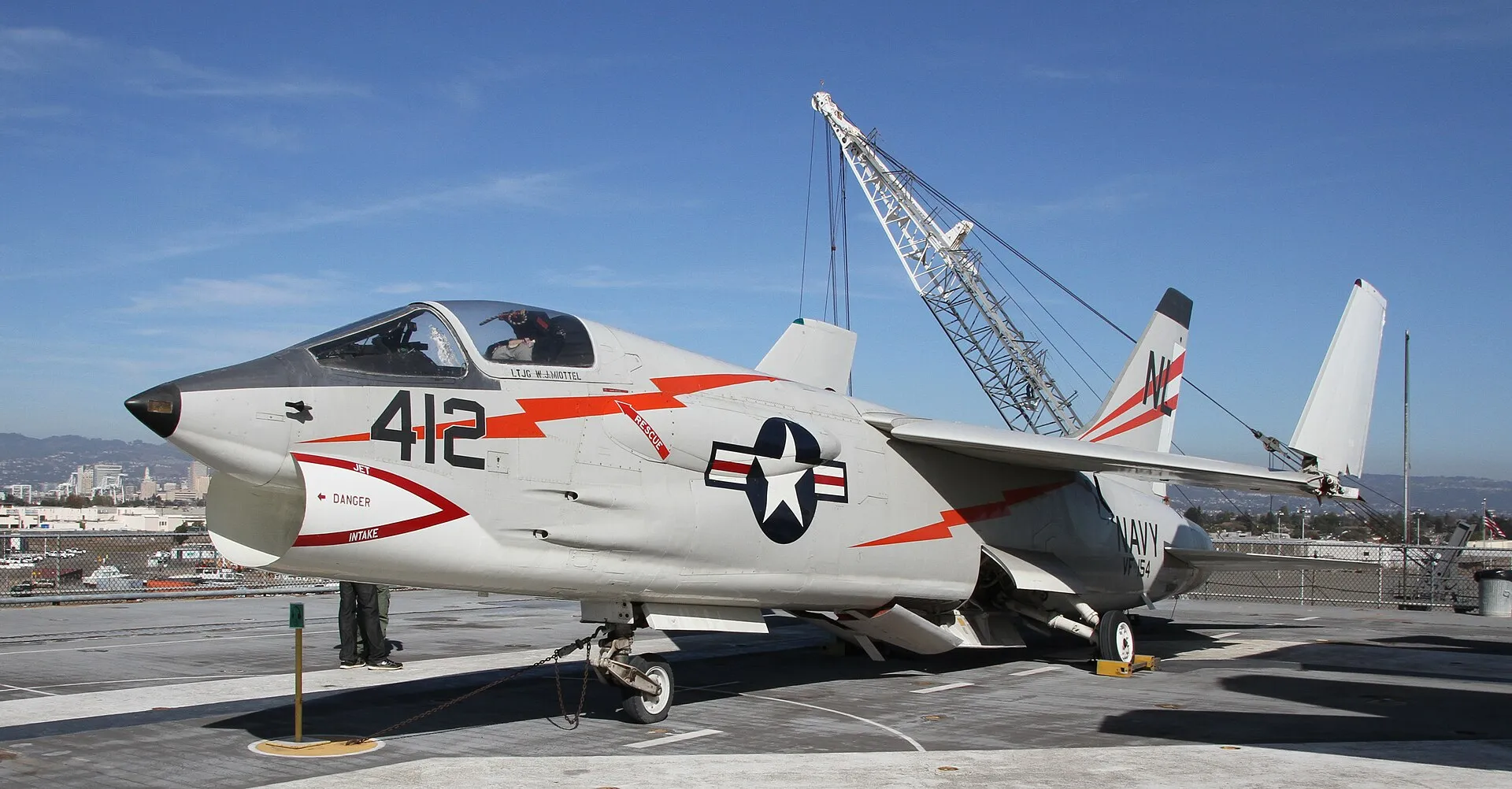
The F-8 Crusader was developed for the United States Navy in the early 1950s, when a new carrier fighter was expected to fly supersonically in level flight. Chance Vought won the competition. The aircraft made its first flight in March 1955, initially under the F8U designation before becoming the F-8. It was a single-seat, single-engine fighter intended for carrier operations, replacing earlier naval types during a period of rapid change in aircraft speed, equipment, and weapons.
Its most unusual feature was the variable-incidence wing. For takeoff and landing the pilot could raise the wing relative to the fuselage, improving low-speed lift while keeping a useful forward view. This mattered especially on an aircraft carrier, where a precise approach to a short deck is essential. The wing returned to its normal setting in faster flight. Variable incidence should not be confused with variable sweep: the wing's outline did not pivot back and forth like the later F-14's.
The Crusader retained four 20 mm cannon at a time when many new fighters were moving toward missile-centred armament. That decision helped give it the nickname Last of the Gunfighters, although it also carried Sidewinder missiles. Weapon fits depended on the version and mission. Later models differed in engine and radar equipment, while RF-8 reconnaissance aircraft carried cameras for a distinct mission. The type demanded skilled carrier flying, particularly during approach and recovery, and its equipment evolved as operational needs changed.
During the Vietnam War, F-8 units flew combat air patrol, escort, and other assignments, and their pilots fought opposing fighters. Reconnaissance versions photographed important sites and remained useful after the fighter squadrons began to shrink. The war's lessons cannot be expressed as a contest between guns and missiles alone: tactical position, pilot training, aircraft support, and identification all affected the result. As carrier aviation changed, the Crusader gradually yielded its frontline fighter role to newer multirole aircraft.
The type also served with the US Marine Corps and French naval aviation; French carrier fighters of the family remained in use longer. American RF-8 reconnaissance aircraft continued into the late 1980s. The F-8 is noteworthy less for any single record than for an engineering answer to conflicting carrier requirements: fast flight and a slow, controllable approach. Its history connects wing design, air-combat tactics, and the changing composition of carrier air groups in the early jet age.