
Military helicopters / AH-1Z
Bell AH-1Z Viper
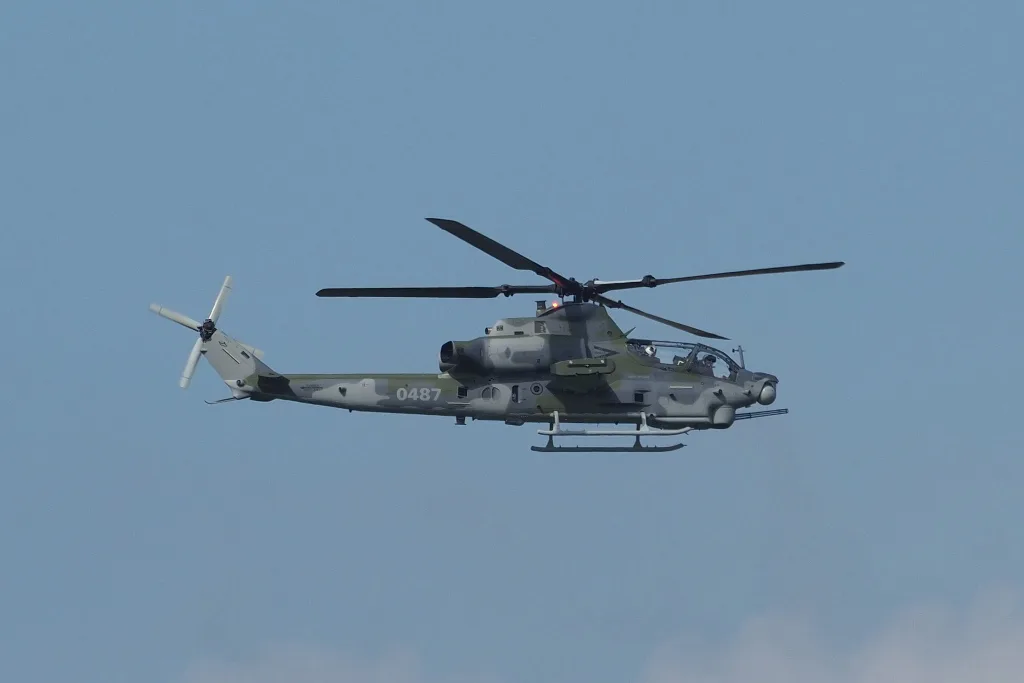
The Bell AH-1Z Viper is a modern twin-engine attack helicopter for the US Marine Corps. It develops the Cobra family with a four-blade rotor, digital cockpit, and shared components with the UH-1Y.
Development
History
The Bell AH-1Z Viper is a US Marine Corps attack helicopter developed from the long AH-1 Cobra lineage. It was created through the H-1 upgrades programme alongside the UH-1Y Venom utility helicopter. The Viper builds on experience with the twin-engine AH-1W, but its changes are extensive enough that the older Super Cobra's specifications cannot automatically be assigned to it. The programme aimed to improve fire support and simplify the supply of two helicopter types operating within the same expeditionary aviation force.
One central change was a four-blade composite main rotor in place of the earlier two-blade arrangement. The transmission, cockpit, control equipment, and targeting systems were also revised. Two crew members sit in tandem and divide flying and weapons duties. Digital displays help them manage information, but their presence alone does not reveal every sensor capability. The equipment of a specific aircraft should be described according to its approved configuration.
NAVAIR defines AH-1Z missions as offensive air support, armed escort, and coordination of supporting fires for Marine forces. These functions are performed with ground units, transport helicopters, and other aircraft. The helicopter can carry different weapons combinations, but the load selected depends on the mission, fuel, and limits of a particular sortie. It would be incorrect to assume that every possible weapon is fitted to every aircraft at once.
The Viper's relationship with the UH-1Y has a practical purpose. NAVAIR reports a high degree of component commonality between the two types, simplifying maintainer training, parts supply, and deployed support. Their missions nevertheless differ. The UH-1Y is a utility helicopter, while the AH-1Z is primarily an attack platform. Shared components do not give them identical cabins, weapons, or operating methods. The pair demonstrates how industrial commonality can coexist with distinct combat roles.
Initial AH-1Z operational capability dates to the early 2010s, with further service involving the adoption of new systems and procedures. Progress from testing to full readiness took years because crews needed training, spare parts had to be available, and operations from ships and forward locations required practice. Official initial and full capability dates describe separate stages. They should also be kept apart from the prototype's first-flight date.
The Viper illustrates how far a successful attack-helicopter concept can evolve. It retains the Cobra's narrow fuselage principle and two-person crew arrangement, while adding new mechanical and electronic systems. A precise account compares the AH-1Z with the AH-1W and UH-1Y without confusing their roles, and distinguishes the documented abilities of production aircraft from possible future upgrades.