
Military helicopters / AW159
Leonardo AW159 Wildcat
The AW159 Wildcat is a British twin-engine helicopter for maritime reconnaissance, anti-surface missions, and battlefield support.
Development
History
The AW159 Wildcat was developed in Britain from the Lynx family for army and naval service. The family resemblance is visible, but the newer aircraft has revised systems, equipment, and engines. Its designers retained a compact size useful on ships and close to ground units while expanding surveillance capability. Wildcat exists in different service versions, and the army and maritime aircraft should be described separately.
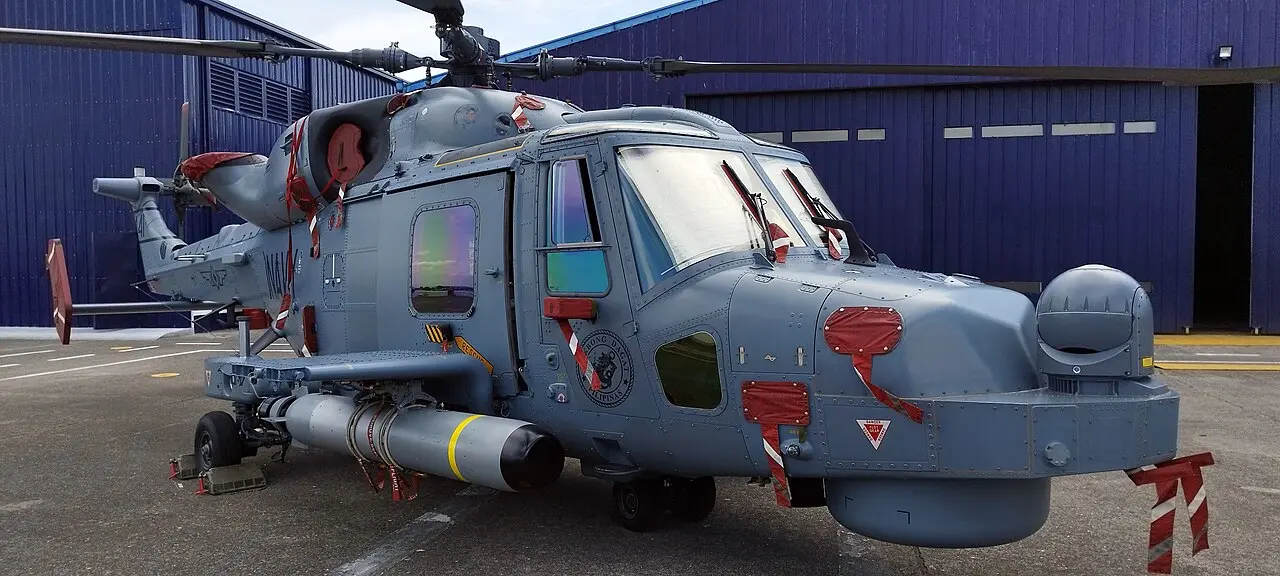
The British Army uses Wildcat Mk1 for reconnaissance, command and control, movement of small groups, and force protection. A nose-mounted electro-optical unit helps its crew observe terrain by day and night. Its task is wider than finding targets for weapons: information about routes, movement, and obstacles can help commanders before they decide what to do. The aircraft's value also depends on communication with personnel on the ground and the ability to transmit reliable observations.
The naval Wildcat operates from ships and conducts patrols, surface-target searches, and other fleet tasks. Equipment choices must account for restricted deck space, the salty maritime environment, and the need to prepare quickly for a sortie. Anti-submarine and anti-surface missions place different demands on the aircraft. Calling it a maritime helicopter alone does not specify the installed equipment on a particular example.
Leonardo describes AW159 as a networked platform. Crews can collect information and share it with other participants in an operation. Radar, optical sensors, a tactical processor, and displays help combine separate observations into a wider picture. This is valuable at sea, where a helicopter may see an object beyond a ship's direct horizon. Electronic systems nevertheless remain subject to weather, range, maintenance, and crew-training limits.
The newer CTS800-4N engines improve Wildcat's capability compared with the earlier Lynx, particularly in demanding conditions, according to the British Army. Comparing the two only by top speed would miss much of the development. Sensors, maintainability, and how the aircraft is employed also changed. Operators select different weapons and avionics, so a photograph or performance claim for one national version may not fit another.
AW159 illustrates how a proven compact helicopter concept can be adapted to current land and naval requirements. Its importance lies in finding information, distributing it, and supporting other forces, rather than in one striking performance figure. A useful model profile distinguishes the operator, the army or shipborne version, and the equipment actually carried. Those distinctions also help readers understand why two Wildcats may look similar but perform different missions.