
Military helicopters / Ми-28
Mil Mi-28
The Mi-28 is a two-seat Mil attack helicopter; later Mi-28N and Mi-28NM variants introduced upgraded night capability and systems.
Development
History
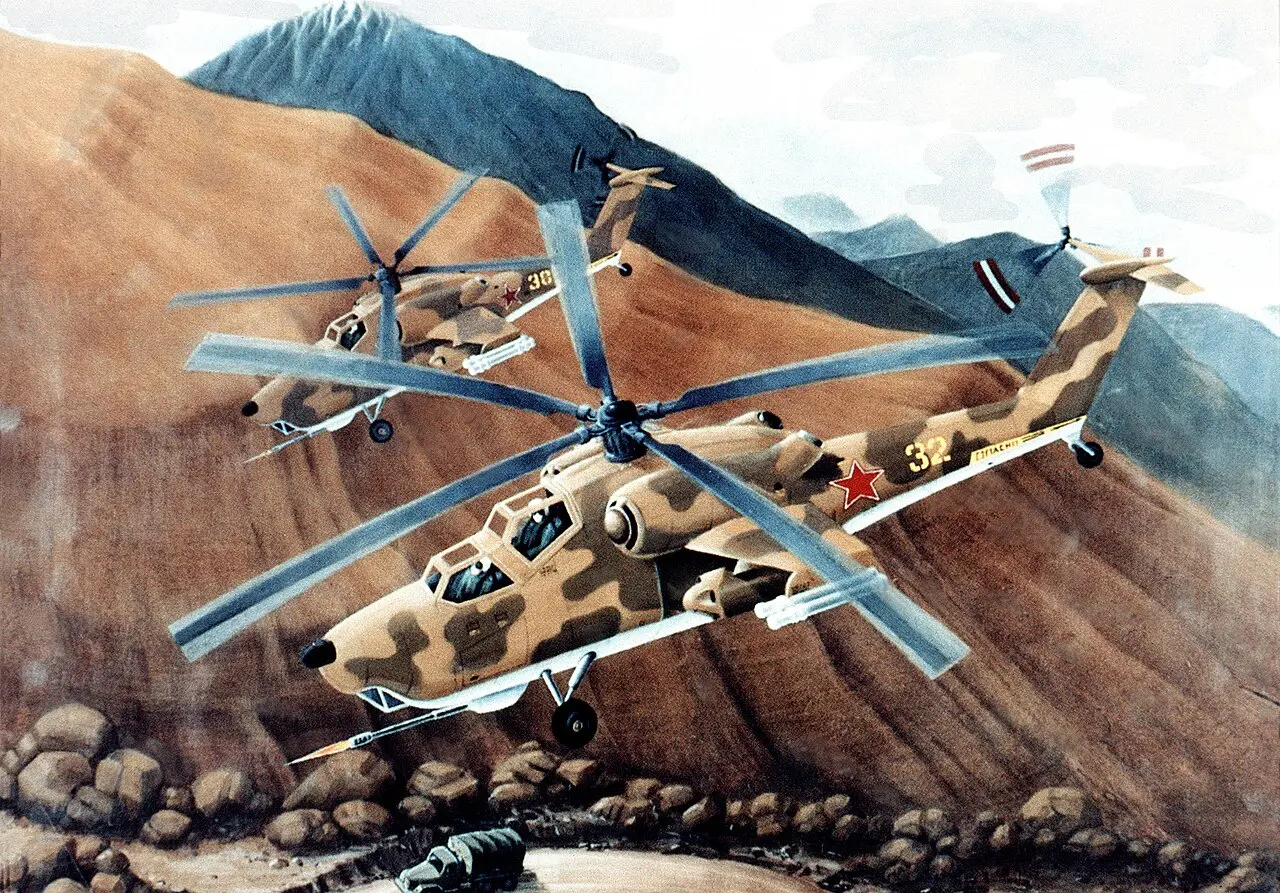
The Mi-28 was developed by Mil's bureau as a new-generation dedicated attack helicopter. Unlike the Mi-24, it was not primarily intended to combine heavy weapons with a troop compartment. Its central role is supporting ground forces by finding and attacking targets. Two crew members sit in tandem. The general Mi-28 name covers prototypes and production variants with different sensors and capabilities.
Development took place in a competition that also involved Kamov's program, later known as the Ka-50. The first Mi-28 flew in 1982. Testing and refinement continued for many years: a prototype flight did not mean immediate large-scale service. The later Mi-28N was developed for operation at night and in more demanding conditions. The still later Mi-28NM introduced another set of updates.
The aircraft has two turboshaft engines, a protected cockpit, and weapons suited to the attack task. Protection improves resistance to some threats but does not make the helicopter invulnerable. Sighting systems help find and track targets, while outcomes still depend on visibility, the situation, and coordination with other forces. A list of external stores or a nominal engine rating alone cannot describe operational capability.
The Mi-28N acquired the name Night Hunter. Its differences from the early Mi-28 concern equipment and employment, not merely paint. Crew training required its own solutions, leading to dual-control training versions. The exact suffix matters in a photograph because sensor housings and cockpit systems changed over the life of the program.
The Mi-28NM continues the line with updated electronics and powerplant features. Claims about it should not automatically be assigned to the 1982 prototype or early production helicopters. The type's history is a succession of changes in which night work, communications, and weapon control became increasingly important. Operators and production batches could also have different equipment standards.
The Mi-28's attack role makes most sense in conjunction with ground troops, reconnaissance, and other aviation assets. Its effectiveness depends on prepared crews, maintenance, and a suitable mission. A trustworthy profile distinguishes the basic program, Mi-28N, and Mi-28NM rather than giving one version's capabilities to all the others. This is particularly important for performance and electronic equipment.