
Military helicopters / SH-60
Sikorsky SH-60 Seahawk
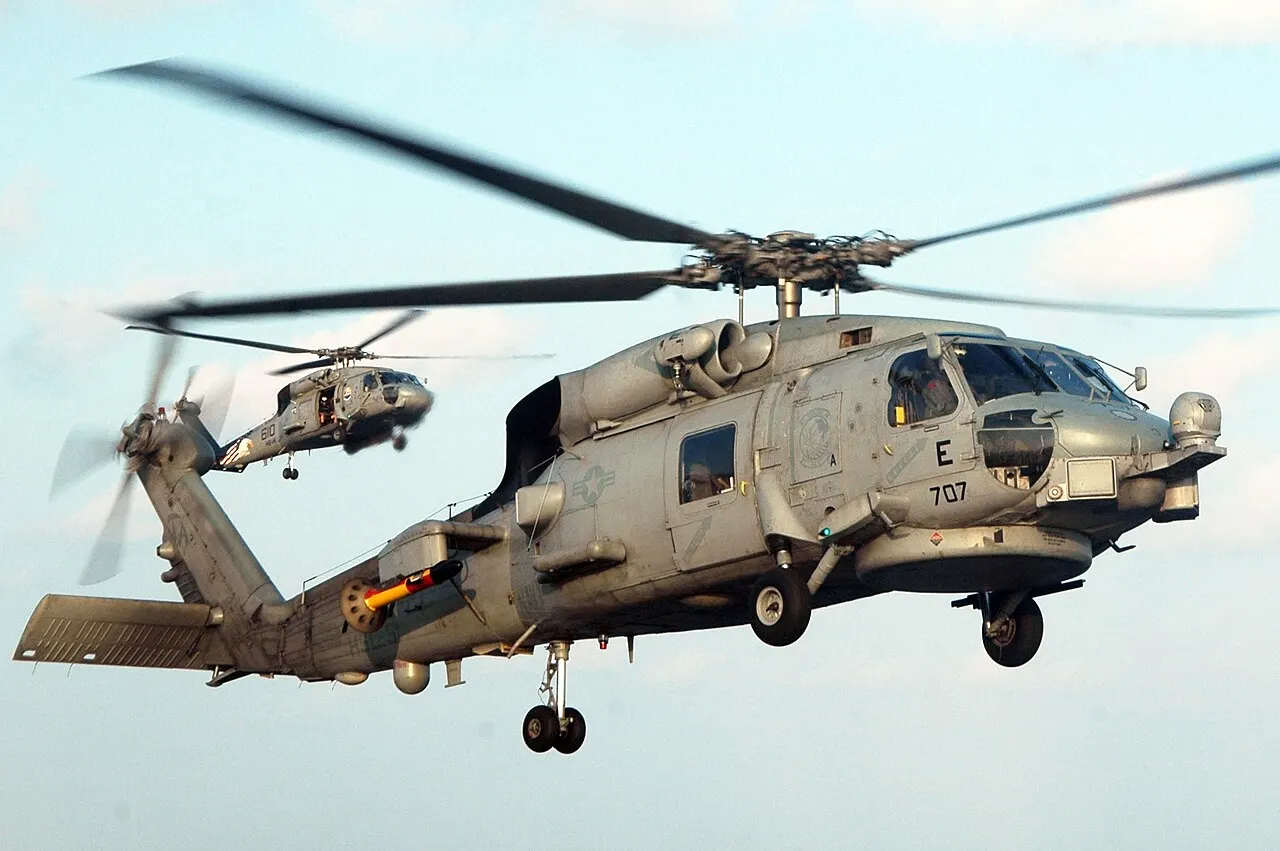
The SH-60 Seahawk is a shipboard Sikorsky S-70-family helicopter adapted for anti-submarine and other naval missions.
Development
History
The Sikorsky SH-60 Seahawk was developed as a shipboard helicopter for the United States Navy. It drew on the Army's Black Hawk platform, but naval service imposed different demands on equipment, stowage, and crew operations. The early SH-60B's central role was protecting a ship group beyond its immediate surroundings, especially through submarine search and awareness of surface contacts. Later members of the family took on their own sets of missions.
After the Army selected Sikorsky's helicopter, the Navy launched a competition for an aircraft suitable for shipboard use. Sikorsky received a full development contract in 1978. The YSH-60B prototype first flew in December 1979. The first production SH-60B flew in February 1983 and entered service in 1984. These dates belong to the specific naval line, not to the first flight of the Army S-70 prototype.
Putting a land-based helicopter on a ship is not enough to create a naval aircraft. Designers must account for limited deck space, the ship's movement, saltwater exposure, and communication with ship systems. Seahawk incorporated structural changes and equipment for maritime work. A system was developed to secure the helicopter on deck in difficult sea conditions. Cockpit arrangements, sensors, and weapon fit could vary with the version.
The SH-60B operated as an extension of its ship's sensors. It could investigate contacts beyond the reach of a ship's immediate observation and pass information back to the crew. Such work required coordination among pilots, equipment operators, and the ship's combat information center. Airborne support did not remove limits imposed by weather, sea state, range, or flight endurance.
The later SH-60F was oriented toward close anti-submarine protection of a carrier group and used a dipping sonar system. Rescue and multi-mission versions also developed within the wider family. The US Navy subsequently moved to MH-60R and MH-60S aircraft. They continue the Seahawk line but differ from the original SH-60B in equipment and division of roles. The Seahawk name thus covers more than one unchanging configuration.
SH-60 history illustrates how a common helicopter platform can be adapted to a specialized environment. The meaningful difference between a naval helicopter and an Army aircraft is not paint or insignia, but the ability to operate from a moving ship and perform integrated search, communication, and support tasks. An account of an individual aircraft should identify whether it is an SH-60B, SH-60F, or a later model. Otherwise, it is easy to assign the equipment of a new variant to an earlier helicopter.