
Military transport aircraft / G.222
Aeritalia G.222
The Aeritalia G.222 was an Italian tactical turboprop transport designed for short runways and rear-ramp loading.
Development
History
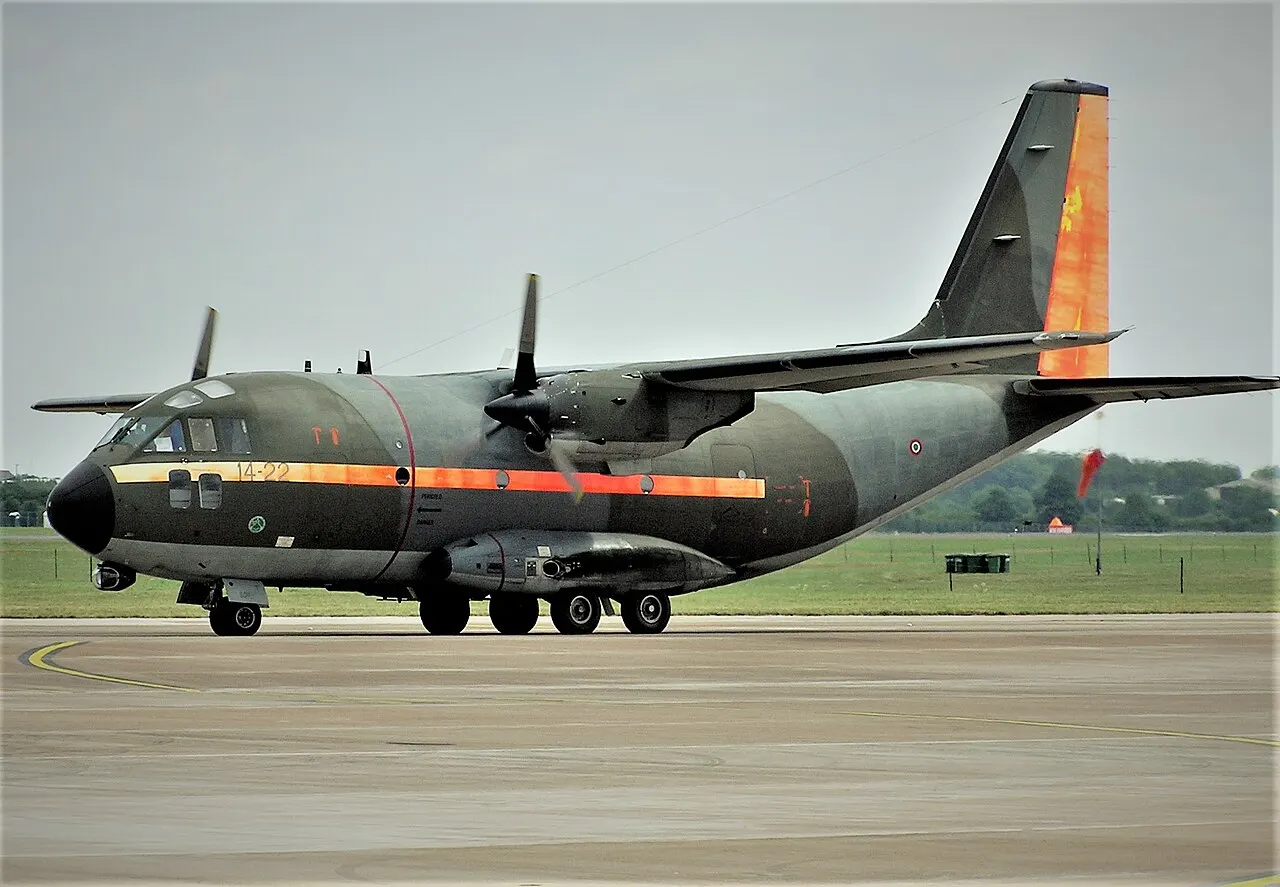
The Aeritalia G.222 was an Italian twin-turboprop transport designed for short takeoffs and landings. The project grew from interest in moving people and freight to small airfields close to an operation. Early requirements even considered vertical lift, but production aircraft adopted a more conventional arrangement without lift engines. The first prototype flew in July 1970. The resulting transport placed practical access to restricted runways ahead of high cruise speed.
The G.222 has a high wing, two engines and a rear loading ramp. This layout helps with vehicles, supplies and airborne delivery. Its landing gear and wing high-lift devices were intended to support operations from relatively short strips. Whether a particular runway can be used still depends on its surface, obstacles, weather and the aircraft's current weight. In tactical transport work, distance to the destination and speed of ground handling matter together: cargo must be unloaded, the aircraft checked and the next sortie prepared.
The Italian Air Force introduced the G.222 during the second half of the 1970s. It carried personnel, equipment and relief supplies. For Italy it filled a useful space between small utility aircraft and larger freighters. Several other countries bought versions of the type. A limited number acquired by the United States received the C-27A Spartan designation. The C-27A should not be confused with the later C-27J. The newer aircraft developed the same basic platform but introduced different engines, systems and substantial changes.
Humanitarian flights showed the G.222's strengths clearly. After a disaster, supplies are needed quickly, while the nearest usable runway may be short or lightly equipped. The aircraft did not remove the need for ground support, but it reduced dependence on a large airport. The same qualities helped military units supplying remote positions. Actual carrying capacity depended on cabin equipment and the shape of the freight. A bulky item might occupy the available volume before the weight limit was reached.
Newer aircraft gradually replaced the G.222, and the Italian Air Force ended operation of the type in 2005. Its historical place rests on a useful combination of moderate size, ramp loading and access to demanding airfields. The aircraft demonstrated that a tactical transport could serve not only military deployments but also relief operations where time and runway availability were decisive.