
Military helicopters / CH-46
Boeing Vertol CH-46 Sea Knight
The Boeing Vertol CH-46 Sea Knight is a twin-engine tandem-rotor helicopter used to move Marines and cargo.
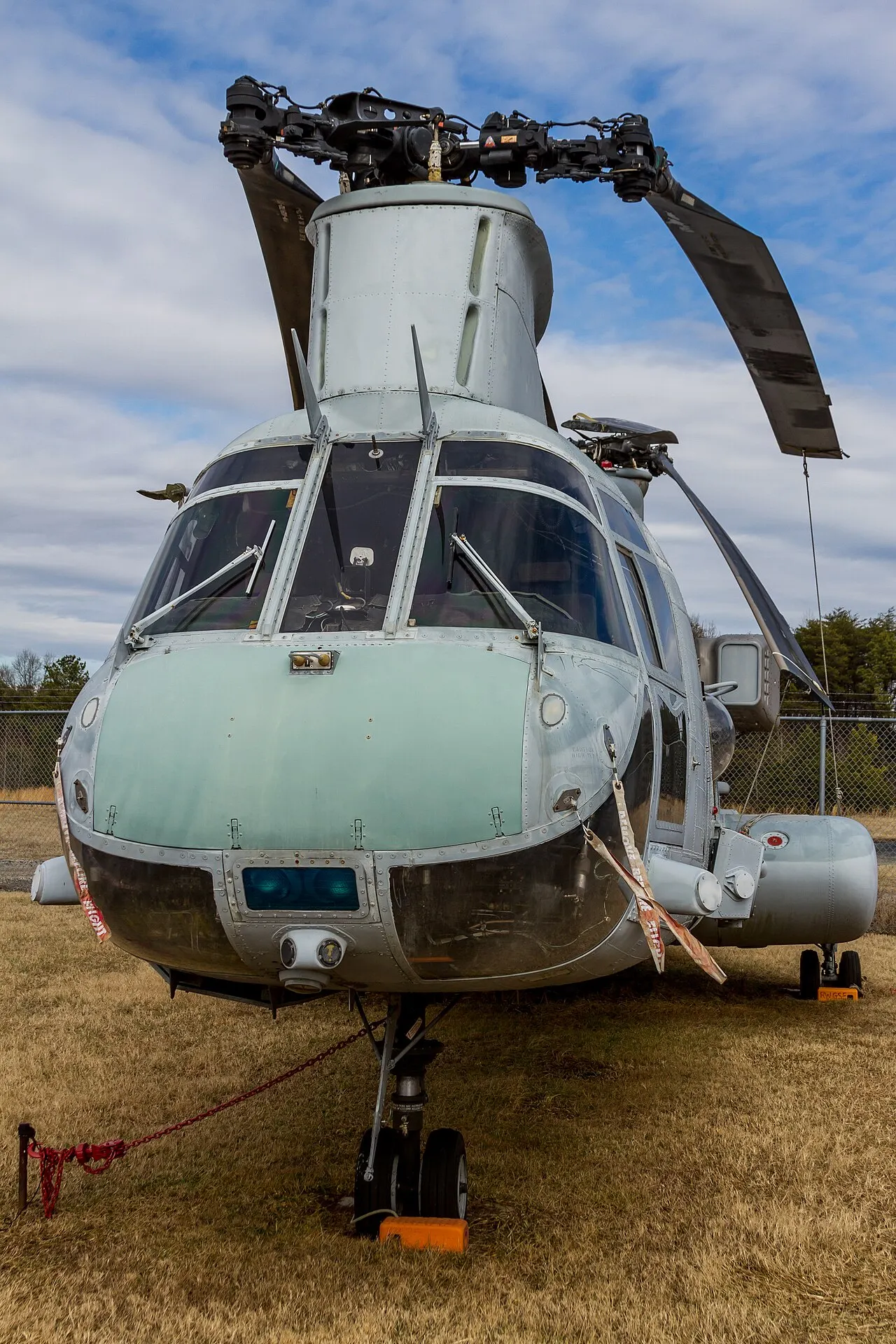
Development
History
The Boeing Vertol CH-46 Sea Knight is a transport helicopter with two lifting rotors arranged in tandem. It was built to move Marines and supplies from ships to operations ashore. Its resemblance to the larger CH-47 Chinook reflects a shared approach to rotor layout, but the Sea Knight is a separate type with its own size and mission. In naval aviation it also performed support and rescue flights.
Vertol proposed the design in a competition for a medium assault helicopter in the early 1960s. Development continued after Vertol joined Boeing. The CH-46A first flew in August 1962. Initial helicopters reached the Marine Corps in 1964 and soon served in Vietnam. They moved people and cargo between ships and shore locations where a fixed-wing aircraft would have needed a prepared runway.
The tandem layout left useful space inside the fuselage and allowed a rear loading ramp. Crews could change the cabin's contents from passengers to equipment or stretchers. As with any helicopter, useful load depended on fuel, temperature, altitude, and landing conditions. Figures published for a CH-46D or CH-46E should not automatically be assigned to an early CH-46A. The letter suffixes reflect changes in structure and equipment.
In Vietnam, Sea Knights became part of the Marine Corps' regular airborne transport network. They delivered reinforcements and supplies and helped remove wounded personnel. Such flights relied on coordination among the aircrew, ship, ground forces, and protective assets. Over-water work added navigation and changing-weather concerns, while landing in restricted spaces demanded precise crew action.
CH-46s received upgrades and served in different regions over the following decades. The Navy used some aircraft for supply and rescue duties. A long service life did not mean a frozen design: engines, instruments, and maintenance procedures changed. Even after modification, the medium helicopter retained load and range limits that separated it from heavier transport types.
Within the Marine Corps, the CH-46 was gradually replaced by the V-22 Osprey. Boeing places the Marines' final service flight in 2014. The Sea Knight remains an important chapter in ship-based transport aviation. Its value was the repeated movement of people and materials between vessels and the shore. An accurate account of an individual helicopter needs its variant and role rather than relying only on the general nickname.