
Helicopters
Airbus H140 completes US hot-and-high flight tests
H140 testing in the desert and mountains: assessing hover performance, weight and operation in less-dense air.
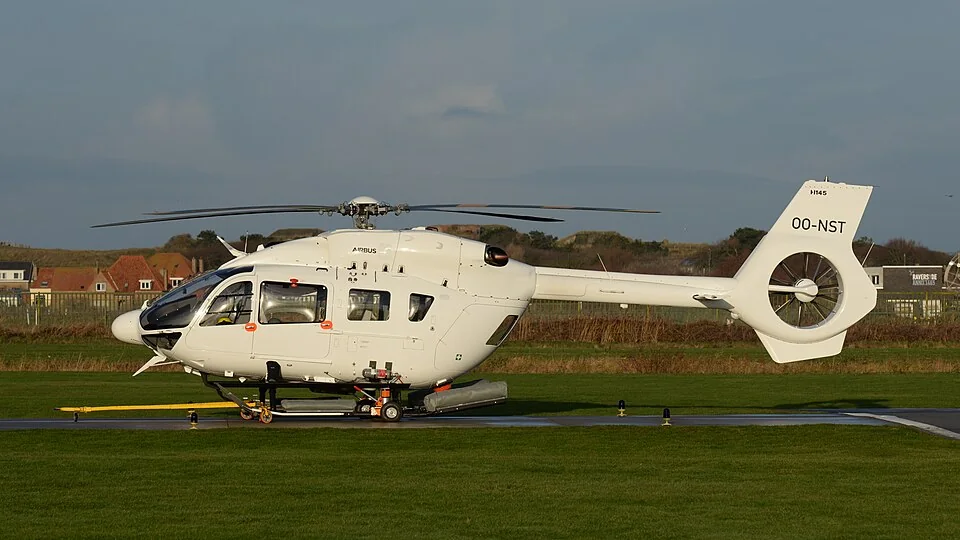
Airbus H145. Archival illustration of the Airbus Helicopters family; the test H140 is not shown in the picture.
Airbus has reported the results of the H140’s US test campaign, which covered desert heat, high-elevation sites and intermediate conditions from 13 June to 8 October 2026. Temperatures at Lake Havasu reached 45 degrees and above before the helicopter moved to the Leadville and Albuquerque areas. The manufacturer reported more than 130 flying hours and over 800 test landings. First customer deliveries remain planned for 2028, with certification work continuing.
The main result of such a trip is not a beautiful shot of a helicopter over the mountains, but measurements that relate the weight of the aircraft, atmospheric conditions and available characteristics. It is important for the future operator to understand what task the helicopter can perform in a particular location. The ability to take off from a flat airfield on a cool morning does not answer the question of working at a mountain site on a hot day. It is this gap between the general description of the model and the real situation that the tests close.
Why altitude and heat enhance each other
As altitude increases, atmospheric pressure usually decreases. When air is heated, it also becomes less dense. For a rotor, this means changing the conditions under which the blades produce aerodynamic force. To keep the same mass hovering, the system requires a different operating mode. At the same time, the environment influences the engine. Therefore, the two effects can work together: the power needed to complete a task increases, and the available power from the propulsion system becomes the limiting factor.
In aviation, the concept of density altitude is used: it describes what standard altitude the actual density of the surrounding air corresponds to. This is not the distance from the helicopter to the ground or the reading of the satellite navigator. The airfield physically remains in the same place, but as the temperature rises, the conditions for the aircraft change. Hence the apparent paradox: the same site in the morning and in the afternoon may have different requirements for permissible weight and performance reserves.
Three regions instead of one record flight
The American H140 program included significantly different conditions. Lake Havasu was tested in extreme heat, Leadville in high altitude, and Albuquerque in the intermediate range. This choice is important for building the overall picture. Checking only at one extreme point would leave many questions about the behavior of the aircraft between it and a regular airfield. The test program must cover a range that will then have practical operational significance.
At the same time, high-altitude flight should not be perceived as establishing a universal ceiling. The height achieved is relative to a specific mass, temperature, wind and task. Flight at forward speed differs from hovering motionless, and a short check differs from long-term operation. Therefore, the message about the end of the campaign cannot be turned into a promise of the same carrying capacity at all sites. The final limitations are determined by the approved documentation of the specific aircraft and the conditions of the task.
Why hover performance is tested separately
In horizontal flight, the rotor interacts with the oncoming flow, and while hovering, it itself forms an air flow through its swept area. These modes differ in power requirements. Near the surface, the influence of the ground additionally arises, which, under certain conditions, reduces the power consumption to maintain hover. Therefore, the characteristic of hovering near the surface is not equivalent to the characteristic of hovering far from it. For a helicopter operating near obstacles or over an area, this is a significant difference.
It is useful to imagine two helicopters of equal mass in the same weather. One is located low above a flat, open surface, the other should be held higher, where its influence is much weaker. Even without changing the engine and load, conditions are already different. Testers must record these differences with measurements, and manual writers must present them in such a way that the operator does not confuse the modes. A single maximum weight number on an advertising page does not replace such information.
Wind cannot be considered a free supply of power
Air movement changes the flow around the rotor and can affect the power required. But the wind also creates demands on controllability, especially when changing direction and gusts. Therefore, for testing it is important not just the presence of wind, but its magnitude, stability and position relative to the aircraft. To compare the results of different flights without this information would be to confuse the influence of design with the influence of the environment.
For this reason, the weather convenient for measurements does not always coincide with convenient working hours. Sometimes the right combination of temperature and wind only exists in a short window. The flight program adapts to it to achieve comparable results. This is one of the reasons why several months of testing cannot be assessed only by the total flight time. Preparation, waiting for conditions, checking equipment and analyzing measurements take up a significant part of the work between flights.
Weight determines more than just the number of passengers
For testing, the total mass of the helicopter is needed, and not just the mass of the payload. It includes the aircraft itself, the crew, fuel, installed equipment and everything that is transported in the cabin. The same helicopter with different amounts of fuel ends up in different conditions. Medical equipment, additional equipment or layout changes also affect the available load. Therefore, the question “how many people can you take” cannot be separated from the specific task.
Centre of gravity matters as well as weight. Two loads with the same mass can be distributed differently around the cabin, producing different handling conditions. Tests assess the combination of weight, centre of gravity and environment within the intended operating envelope. Operators subsequently use approved data rather than transferring a result from one test flight to a different aircraft configuration.
What measurements provide for future operation
The developer compares actual results with calculations and gradually refines the characteristics. The obtained data becomes the basis for operational documentation after the necessary checks and approval. In this sense, the test campaign links the engineering model to everyday work. The customer needs not only promises of capabilities, but also reproducible evaluation rules: how the permissible task changes at a different temperature, altitude, weight and flight mode.
For air ambulance or transport work, such certainty is especially important. The destination site may differ from the departure airfield in altitude and weather, and the return flight may differ in load. The route has to be considered as a whole. Sufficient supply in one area does not guarantee sufficient supply in another. This is why data on unfavorable combinations of conditions is of practical value even to an operator who spends most of his time flying in milder climates.
One stage is complete, rather than the whole programme
Successful completion of the US campaign means advancement of the H140 program, but not automatic approval for operation in all conditions. Checks in heat and high altitudes answer a certain group of questions. Other stages evaluate other modes and systems. Certification comes from a body of evidence, not from one long prototype journey or an impressive number of landings.
Until the final operational data becomes available, it is more correct to talk about the completed measurement program and the stated delivery dates. The next step is important for the future owner: what characteristics and restrictions will be included in the approved configuration. Tests in the United States bring this result closer, since they test the aircraft in areas where the combination of thin air and heat has a particularly noticeable effect on the helicopter's capabilities. They turn design expectations into data suitable for further engineering assessment.
The next contrast for the H140 will be cold conditions: the prototype returned from the USA is being prepared for winter testing in Finland and Norway. This movement has a clear engineering logic. Hot and cold environments have different effects on startup, materials, and equipment performance. The reliability of a future helicopter must be confirmed in the range intended for it, and not just in the climate where the first flight took place. At the same time, the timing of individual inspections remains part of the developing program, and not a guarantee of the date of delivery of a specific aircraft to the customer.