
Technology
TRU introduced a VR simulator for the Cessna Grand Caravan EX
TRU has announced a Veris training device for the Grand Caravan EX. How a physical cockpit works with VR, and what makes a professional training device useful.
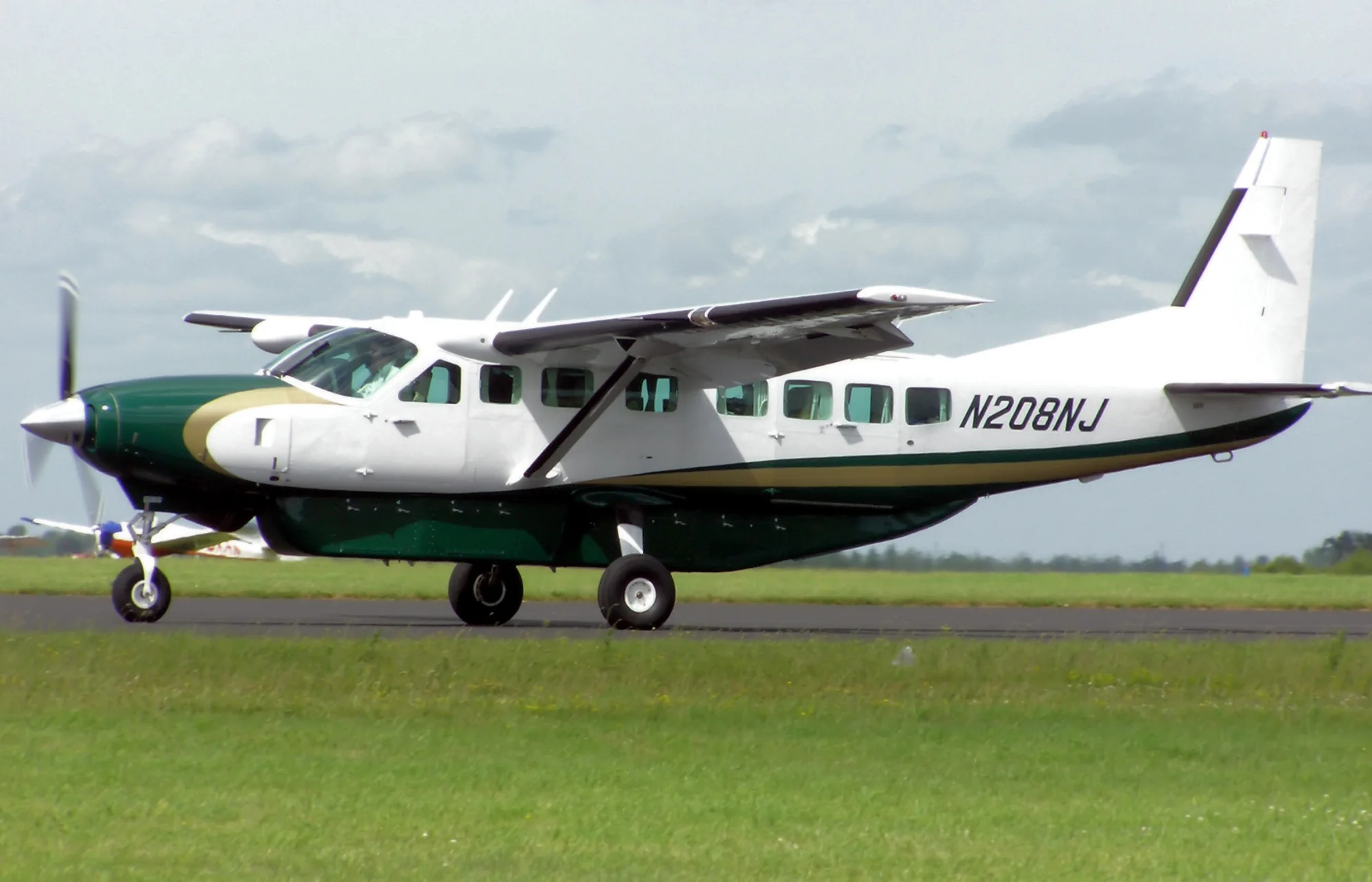
Cessna 208B N208NJ, 2005. Archival illustration of the Caravan family; the new Veris trainer is not shown in the photo.
On October 20, 2026, TRU Simulation announced the Cessna Grand Caravan EX pilot training device on the Veris platform. It combines virtual reality with a physical cockpit that replicates the aircraft's controls and avionics, including the Garmin G1000 NXi. The configuration provides two seats; You can work with or without a VR headset.
The new product extends the use of Veris to the Caravan family. For regional and special aviation, this is an interesting example of how visualization technologies are combined with the usual training organization. However, the name Flight Training Device should not automatically be equated with any full-featured simulator: the scope of training credits and acceptable training tasks depend on the specific approval of the device and training program.
Why is one realistic picture not enough?
In everyday life, a good flight simulator is often associated with beautiful graphics. For professional training, it is much more important that the system response corresponds to the real aircraft and the assigned training task. The pilot must receive the expected result after working with the controls, see the correct modes and understand the consequences of his actions. The external world helps create the environment, but does not replace its internal logic.
The physical cockpit provides constant reference points for the hands and eyes. The switch is located where the learner expects to find it; the movement to the desired control can be repeated. This is especially useful when practicing a sequence of actions. If everything looks convincing in a virtual scene, but the arrangement of elements or the operating logic is different, there is a risk of reinforcing an inappropriate habit.
Therefore, the device is evaluated not by one general impression, but by a set of tasks. To get acquainted with the avionics menu, you need one level of playback, to study the spatial situation - another, for a skill test - a certain compliance with the established requirements. One tool can perform several tasks well, but this needs to be proven in relation to each of them.
What does the combination of VR and real controls give?
Virtual reality helps show the space around the cockpit without a large complex of external screens. Rotating the head changes the viewing direction, making the image related to the user's movement. At the same time, real controls retain tactile contact. The pilot interacts not only with the drawn buttons, but also with the physical elements of the workplace.
This combination requires precise coordination of image and movement. If a virtual object is displaced relative to the real one, the hand may look for it in the wrong place. If the image lags, the sense of movement becomes worse. Therefore, the quality of a professional system is determined not only by the resolution of the headset, but also by the latency, tracking stability and consistency of the entire package.
The ability to study without a headset is useful for organizing a lesson differently. The instructor can explain the procedure, show the sequence on the instruments, and only then move on to the spatial exercise. Not every learning phase requires maximum immersion. Sometimes it's easier to first master the logic of the system in a quiet mode, and then add movement, communication and external reference points.
Two seats and shared training tasks
The two-seat configuration allows you to organize your activity in different ways. One place can be occupied by the trainee, the other by the instructor or the second participant in the exercise, depending on the program. This does not automatically change the requirements for the crew of a real aircraft. The design of the simulator only provides opportunities that the educational organization uses in accordance with its objectives and permissions.
To work in a crew, it is important not only to correctly perform individual actions, but also to coordinate them. Who monitors the trajectory, who works with radio communications, who checks for route changes? When roles are clear, participants are less likely to duplicate each other and are less likely to leave a task unattended. The simulator allows you to stop the exercise and analyze the moment at which the distribution of responsibilities was violated.
During individual training, the second person also helps to see what the trainee himself does not notice. For example, a pilot may perform all the actions correctly, but spend too much attention on a secondary task. The instructor evaluates not only the final result, but also the path to it: sequence, load and ability to maintain the overall picture of the flight.
What a meaningful exercise might look like
Let's imagine a hypothetical lesson upon arrival at an unfamiliar airfield. First, the trainee reviews the diagram, sets up the avionics, and explains the expected actions. Then he performs the exercise in a calm environment. The instructor then adds a change in conditions: another instruction, the need to revise the route, or an additional task. The goal is to test understanding, not the speed of mechanical button pressing.
Repetition is useful when it becomes clear what exactly has changed in the pilot's performance. You can compare the first and second passes, discuss premature actions and missed checks. If you simply perform one familiar scenario indiscriminately, the result risks turning into memorizing a sequence. Real training should help transfer the skill to similar, but not identical situations.
The simulator also allows you to stop when you make a mistake. During the actual flight, the situation continues to evolve, so a detailed explanation has to be postponed. In a learning environment, you can return to the original state and separately analyze the incomprehensible element. It is this controllability of the activity, and not just the time savings in the air, that makes simulation a valuable training tool.
Aircraft data and model reliability
Any model has boundaries. It describes the behavior of an aircraft with a certain accuracy and in a certain range of conditions. For educational use, it is important to understand which modes have been reproduced and tested. The beautiful movement of a virtual aircraft outside the confirmed area should not create false confidence that it corresponds to a real aircraft.
Avionics configuration is also important. Equipment, software versions and available functions may differ on different aircraft. If a trainee is preparing for a specific aircraft, these differences must be taken into account. A general familiarity with the family of instruments is useful, but it does not replace an understanding of what is installed on the operating aircraft and how this is reflected in its documentation.
Updating the simulator requires careful maintenance. A change to a software component may affect the display or operating sequence. The training organization must understand what configuration it is using and what exercises are being performed on it. This order ensures comparability of classes and helps to distinguish a student's error from a feature or malfunction of the device itself.
What a training organisation needs
The arrival of new equipment is only part of the preparation update. We need instructors, scenarios, evaluation criteria and the place of the device in the overall program. If an activity does not have a clear goal, even a technically advanced complex may be used ineffectively. In contrast, a well-designed exercise allows you to take advantage of a specific simulator capability and link it to subsequent performance in the aircraft.
Practical planning includes the timetable, equipment maintenance and debriefing time. An hour wearing a headset is not the same as an hour of completed training: an exercise needs a briefing beforehand and a discussion afterwards. Those stages connect the result to further practice. Cutting them indefinitely to increase session numbers would reduce the substance of the training.
The announcement of Caravan EX Veris shows that professional virtual reality is becoming part of a broader set of training tools. The value of a solution will be determined by how accurately it supports the missions of specific operators and training centers. For the pilot, the main result remains the ability to confidently understand the aircraft and the environment, and not just successfully navigate through a familiar virtual scene.
Therefore, as you continue to develop the product, it is useful to monitor published approvals, lists of supported exercises, and the experience of training organizations. This information will show the practical place of the device in preparation better than general promises of realism. Technology becomes useful when it helps measurably improve a specific skill and maintain it during the transition to real flight.