
Airlines
Finnair launches Melbourne service via Bangkok
Finnair has launched its own flights to Australia using the Airbus A350. How the Helsinki - Bangkok - Melbourne route works and what the intermediate stop means.
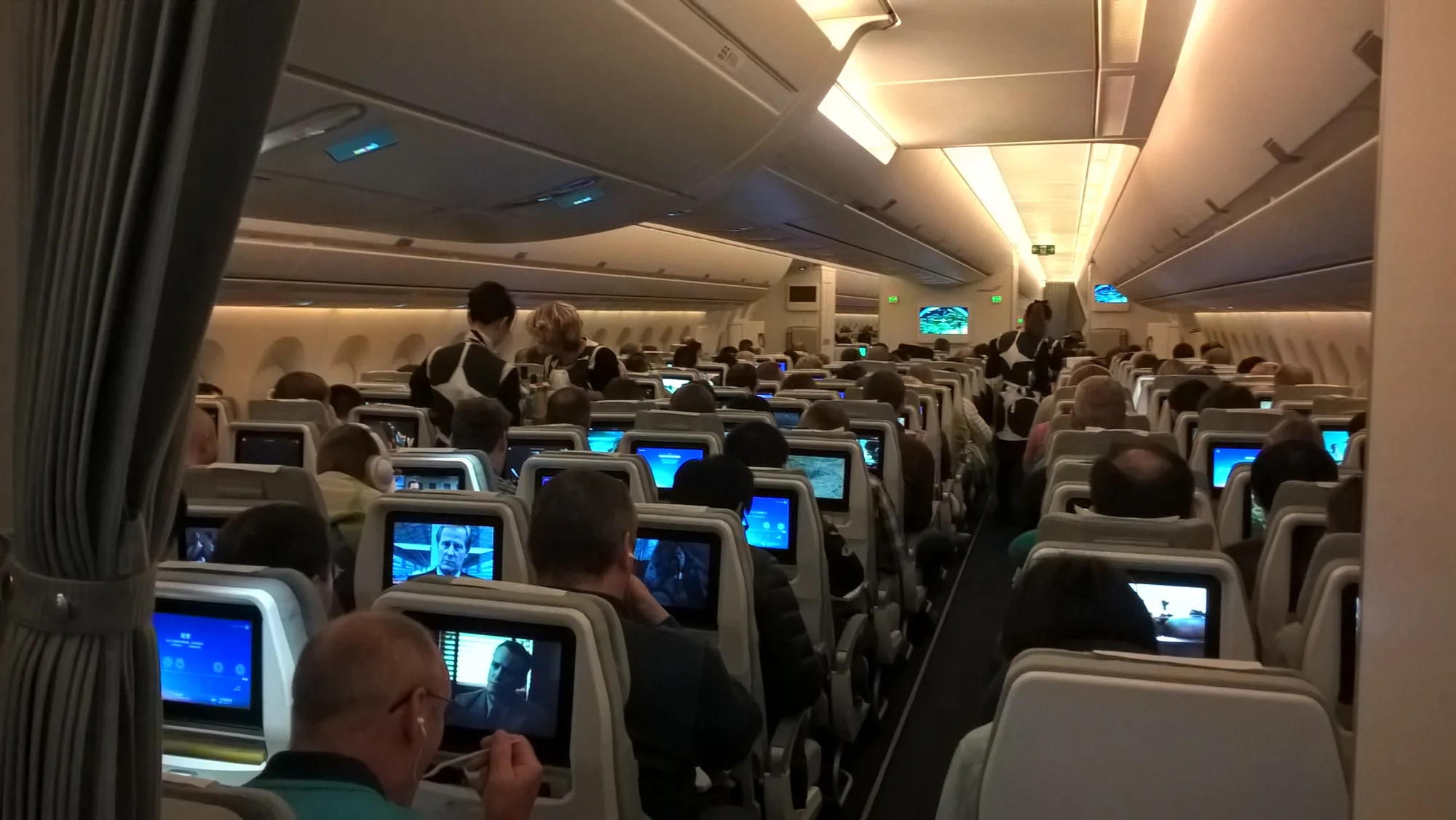
Finnair Airbus A350 economy cabin, April 2016. An archival photograph; the cabin fitted to a current Melbourne flight may differ.
Melbourne Airport announced the arrival of its first Finnair flight from Helsinki via Bangkok on 26 October 2026. The carrier began serving Australia for the first time with its own aircraft under its own code. The route has a daily program on the Airbus A350. For the passenger, the key feature is the travel arrangement: between Finland and Australia there is a stopover in Thailand, so the flight is not non-stop, although it follows a single route program.
The new line connects three different markets and makes it possible to continue travel through Helsinki on Finnair's European network. At the same time, the carrier sells flights between Melbourne and Bangkok. This combination differs from the usual route, on which the aircraft only refuel without local passengers. To understand what changes for the traveler, it is useful to separately consider the flight segments, stopovers, European connections and the time it takes for the entire journey.
One route consists of two long sections
The route from Helsinki to Melbourne via Bangkok includes two flights and a ground interval between them. Their sum forms the total duration of the trip. Therefore, you need to compare the new option with other offers based on the time from the first departure to the final arrival. The duration of just one leg or the absence of a plane change does not describe the entire trip. On a long journey, even a relatively short stop affects the passenger’s rest, nutrition and perception of the road.
Finnair says a single Airbus A350 operates the complete route, linking the two sectors without an aircraft change. That does not mean passengers remain in their seats throughout the stop. The published arrangement requires them to leave the aircraft and reboard after the prescribed procedures. The familiar idea of a refuelling stop while staying in the cabin therefore does not apply. Check the specific itinerary rather than relying on an everyday interpretation of “direct”.
What Happens During a Stopover in Bangkok
In the published description, the carrier envisages a stop lasting just under two hours. Passengers disembark with all personal belongings and hand luggage, undergo security screening and return to the desired boarding gate. At this time, the plane is being prepared for the next section, and the flight attendants are being replaced. Before re-boarding, documents and hand luggage are checked. This information relates to the declared route organization; instructions from staff on a particular flight remain important if the order or gate changes.
For a traveler, this is more of a short transition between two parts of the road than a free walk around the city. Available times are subject to actual arrival, security screening and boarding commencement. Therefore, you should not perceive the entire ground interval as time for shopping or visiting the lounge. It is more convenient to first establish the desired output and sequence of actions, and only then evaluate the remaining stock. This way, the stop is perceived as an understandable stage of the trip and does not create unnecessary rush before continuing the flight.
Bangkok serves as both a stopover and a destination
Some passengers will fly between Melbourne and Thailand without continuing to Finland. For them, the same plane performs an independent task: a regular international flight between two cities. For a passenger from Europe, it becomes the second half of a long route. This explains why the new line is of interest to several groups of travelers at the same time. A shared flight can combine people with different origins and destinations, even when everyone is in the same cabin on the same leg.
From a network planning point of view, this structure makes it possible to combine demand on different parts of the route. But it also requires a consistent schedule: the arrival time in Bangkok must be suitable for the continuation of the flight, the preparation of the aircraft and the work of the crews. For the passenger, this complexity is usually hidden behind one itinerary in the booking. Understanding it helps explain why a change in one section can affect the others, and why a long line schedule cannot be created independently for each pair of cities.
Helsinki adds onward European connections
Passengers traveling further than Finland will need to evaluate a connection in Helsinki. In this case, the full journey includes not only a stop in Bangkok, but also a transfer to the next flight. The ability to buy such a combination does not mean the same waiting time for all European cities. Some departures coincide better with arrivals from Australia, while others operate later or not every day. Therefore, the total number of destinations on the network is less useful than the specific schedule of the desired trip.
A hypothetical traveler from a small European city compares a new option with a route through another hub. The time of the first departure, the reserve for transfers and the moment of arrival in Melbourne are important. The way back may turn out differently, so it’s worth checking both directions. This approach allows you to see the real benefit of the line for your own route. The mere fact that an Australian city is on Finnair's network expands the choice, but does not automatically make the new route the shortest from anywhere in Europe.
The calendar date is more important than the usual time of day
On an intercontinental flight, local clocks at airports show different values. In the schedule, the arrival may refer to the next calendar day, although the passenger perceives the journey as one journey. This is especially important when booking a hotel, meeting at the airport and planning your first day of work. It is better to check the date directly in the confirmed route, separately from the time. The usual designation “morning arrival” alone is not enough if a person is expecting a passenger a day earlier.
Different seasons also change local time relationships in cities that use different clock changing rules. Therefore, calculating the duration yourself using the dials can be confusing. It is more reliable to compare the indicated duration of each section and the entire route, and schedule meetings according to the local date of the final airport. For a long line with a stop, this makes the plan more transparent: you can see where one stage ends, how long the next one takes, and when the land part of the journey begins.
The A350 cabin and ticket conditions must be assessed separately
The new route includes business class, premium economy and economy classes. This structure provides several seating options, but the choice depends on the needs of the passenger for the entire long journey. For some, the opportunity to work is important, for others it is space to relax, for others it is the cost of traveling with their family. At the same time, photographs of early cabins of the same family do not confirm the current configuration of a particular flight. To select a seat, it is more useful to see the current scheme and description of the offer in the booking.
The terms of the tariff complement the characteristics of the seat. Baggage, rescheduling and other services should be compared with your schedule. On a route with several stages, it is especially difficult to detect differences after purchase. Therefore, the purpose of the selection is to obtain a consistent journey with clear conditions at all stages. A more comfortable seat solves part of the problem, but the calendar, transfers and ticket change rules can be no less significant for the overall travel experience.
Regular service matters more than an inaugural flight
The first arrival confirms the start of the program, but the quality of the new message will be evident in regular work. Compliance with the schedule, clear organization of stops and agreed continuations are important for passengers. The long-distance line connects multiple airports, crews and ground teams; the result depends on their teamwork. Therefore, the opening should be perceived as the beginning of a new transport offer, and further sustainability should be assessed by its actual operation during the season.
Finnair has added its own service to Australia on the Helsinki-Bangkok-Melbourne route. Its main difference for the traveler is the continuation on the same plane after the intended stop, and for the network it is a combination of European and Asian connections. It is useful to compare the new option along the entire route, including both land parts and a possible transfer in Finland. Then it becomes clear for whom the daily line gives a more convenient route, and for whom the usual route still better suits the dates and destination.