
Technology
Pratt & Whitney Canada introduces the certified PT9 turboprop engine
The new PT9: certification, stated performance and its place in future aircraft powerplants.
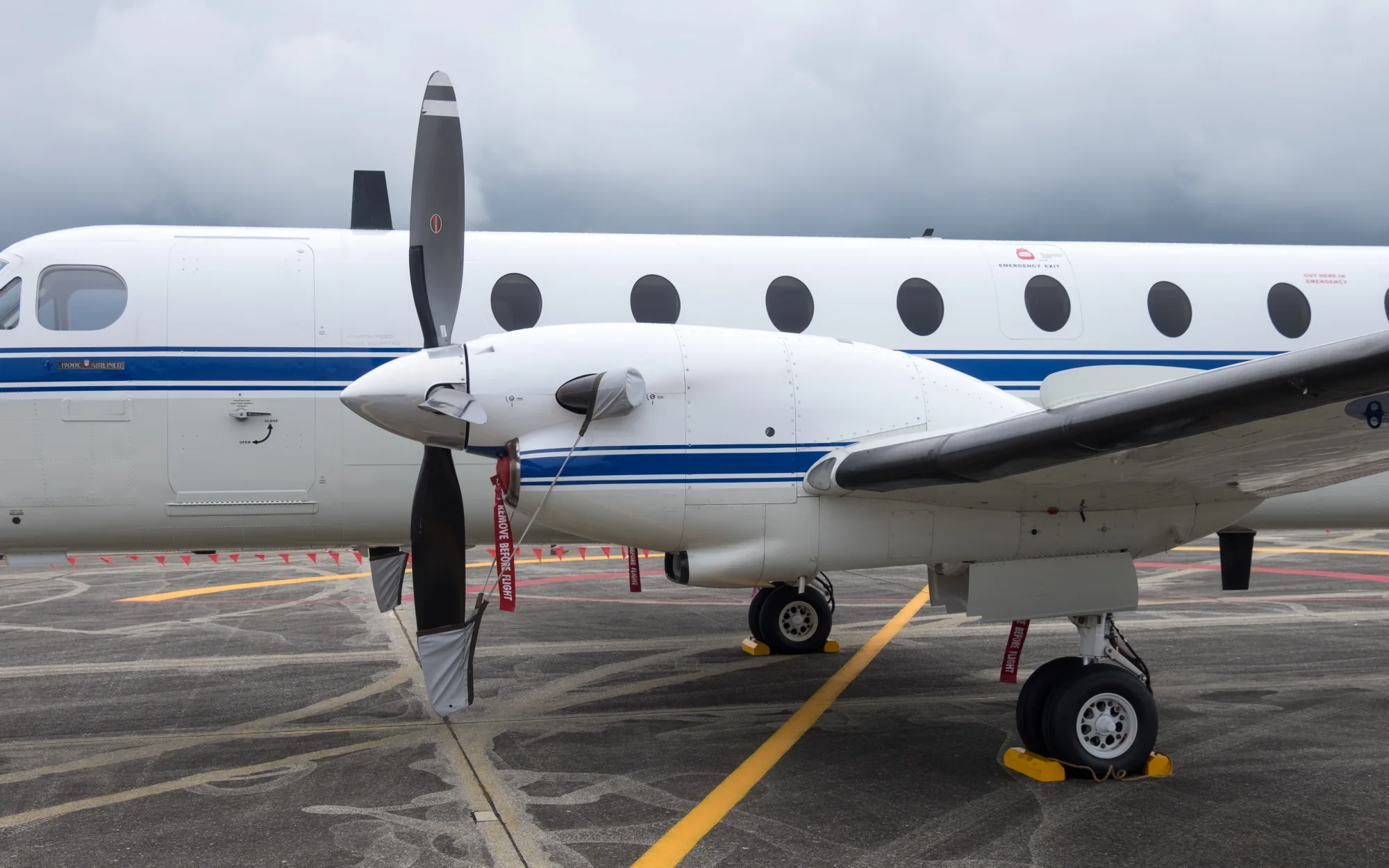
PT6A-65B turboprop on a Beechcraft 1900C, 2016. Archival illustration of the former engine family; the new PT9 is not shown in the picture.
Pratt & Whitney Canada introduced the new PT9 turboprop engine on October 21, 2026. It has already received Transport Canada certification and has accumulated more than 14,000 hours in its development program, the company said. Production is planned in Lethbridge, Alberta, Canada. The developer claims a 33 percent increase in power at altitude and a 20 percent decrease in fuel consumption compared to the previous generation engines. These are manufacturer's comparative figures: without detailed comparison conditions, they cannot be automatically transferred to any future aircraft.
The news is interesting primarily because of the appearance of a new basic design. Updating the engine may be limited to individual units or the control system, but the creation of a new family makes it possible to reconsider the relationship of the main components. At the same time, the engine is not yet a finished aircraft. Installation on a specific airframe, coordination with the propeller, cooling, maintenance and limitations of the entire power plant are important to the bottom line. Therefore, the PT9 announcement should be viewed as the beginning of a new phase of application of the technology, and not as a ready-made table of characteristics of future flights.
What exactly does a turboprop engine do?
In a turboprop power plant, the gas turbine provides the main useful power to the propeller. The compressor compresses the incoming air, fuel is added to the combustion chamber, and the hot gas does work on the turbine stages. Some of this work is required for the engine itself, the rest is used for external loads. The propeller accelerates the surrounding air and creates thrust, which moves the aircraft. Therefore, the presence of a gas turbine does not turn such an aircraft into an ordinary jet airliner.
Between the rapidly rotating elements of the engine and the propeller there is a gearbox. It matches their rotation speeds: large blades do not have to rotate at the same speed as compact turbine parts. The selection of gear ratio, propeller characteristics and operating modes is related to the overall design. This is why a comparison based only on shaft power is incomplete. The same number of horsepower can produce different results on aircraft with different propellers, weight and aerodynamics.
Why is power at altitude separated?
Air at altitude becomes less dense. For a gas turbine engine, this changes the conditions for air supply and the ability to obtain useful power. Limitations are determined not only by the amount of fuel that can be supplied, but also by permissible temperatures, rotational speeds and loads on parts. It is impossible to increase the fuel supply without taking these restrictions into account. Therefore, maintaining power in rarefied air represents an independent engineering challenge.
For an aircraft, the additional available power can potentially be used in a variety of ways: to gain altitude, carry a load, or maintain a selected mode. But these opportunities do not add up automatically. The designer distributes them taking into account the airframe and the purpose of the aircraft. If the limitation is not set by the engine, but, for example, by the structural mass or characteristics of the propeller, part of the potential advantage does not turn into additional load. The result must be assessed at the level of the entire installation.
What does a twenty percent reduction in consumption mean?
Any comparison of consumption requires the same basis. You can compare consumption per hour, per route, per unit of power or per passenger transported. These indicators answer different questions. An aircraft with higher power is able to burn more fuel at a given moment, but complete the task faster. Conversely, a small consumption per hour does not guarantee less consumption for the entire trip if the flight time has increased significantly.
Therefore, the claim of a twenty percent improvement is for now useful as a characterization of the direction of development, and not as a promise of specific savings to the owner. For practical comparison, you will need mode conditions and information about the installed power system. A hypothetical flight includes launch, taxi, takeoff, climb, cruise and descent. Their shares differ on the short and long routes. An improvement in one mode can have a different impact on the bottom line of two flights.
The new engine must work with a specific aircraft
Installation begins with mechanical and spatial constraints. The engine requires suitable mounting points, air intake, exhaust, fuel supply and electrical equipment. Its mass and location affect the centre of gravity of the aircraft. The system must be able to withstand the intended loads and provide access for maintenance. Even a successful engine design requires careful integration before its benefits can be realized in operation.
Flight-control and engine-control integration matters just as much. The crew needs clear indications and warnings, and aircraft systems must interact correctly with the powerplant. Operating settings cannot be described only by the lever’s position: engine and propeller limitations also apply. An engine certificate does not replace evidence that the complete installation is suitable.
Why does the developer emphasize modularity?
Modular design divides the system into functional parts that can be developed and maintained within the overall architecture. For the manufacturer, this helps to create options for different tasks. For the operating organization, the potential benefit is related to access to components and organization of repairs. However, the word “modular” itself does not say anything about the cost of maintenance, the duration of repairs, or the admissibility of replacing a specific unit at the airfield.
Maintenance documentation, the service network and parts-supply arrangements determine these issues. Engines of similar size may have different removal requirements and post-repair checks. Evaluating a new family therefore continues after launch: the maintenance programme and actual support availability both matter. For a small fleet, a long wait for a part may outweigh a small difference in published fuel consumption. Overall value extends beyond test-bench performance.
Hybrid architecture remains the direction of development
The company attributes the new design to the possibility of future integration of electric and hybrid solutions. This is a description of the architecture's potential, not a message that every PT9 is already a hybrid powerplant. In such a system, it is necessary to determine the role of the electrical part: where the energy is generated, where it is used and how the load is distributed. Different schemes may have fundamentally different tasks and limitations.
Adding electrical equipment brings its own mass, heat dissipation and control requirements. For an aircraft, it is important whether they are compensated by the advantages of a particular design. Increasing the number of components does not in itself make flight more efficient. Therefore, it is reasonable to separate promising compatibility from the finished product with proven characteristics. Moving from architectural feasibility to operational capability will require separate engineering work and associated audits of the entire system.
What does engine certification provide?
Certification confirms compliance with specified requirements in a specific configuration and within certain limitations. It does not constitute permission to use the engine in any aircraft of suitable power. Installation on a new type of aircraft is considered separately. In addition, the certification status does not automatically tell how many copies have already been manufactured, which customers they have been transferred to, and when a particular aircraft will enter the production line.
In the case of PT9, the manufacturer has already passed an important milestone, but the practical picture will become clearer as applications are announced. For future operators, aircraft performance, service availability and proven operating conditions will be key. The new family expands the range of technical solutions for turboprop aircraft. Its real benefits will appear where the engine, propeller and airframe are matched to a specific transport task, and comparative percentages are given a clear operational context.
It is also useful to distinguish between manufacturer continuity and product interchangeability. The accumulated experience of the PT6 family helps to understand the industrial context, but does not prove the same design of the PT9 and does not allow the limitations of the old engine to be transferred to it. The designations of the two families do not constitute replacement instructions. For a technical solution, you need documents specifically for the new model, its variant and permitted installation. This boundary is especially important when discussing the modernization of an existing fleet: the introduction of a new engine does not in itself create an approved re-equipment program.