
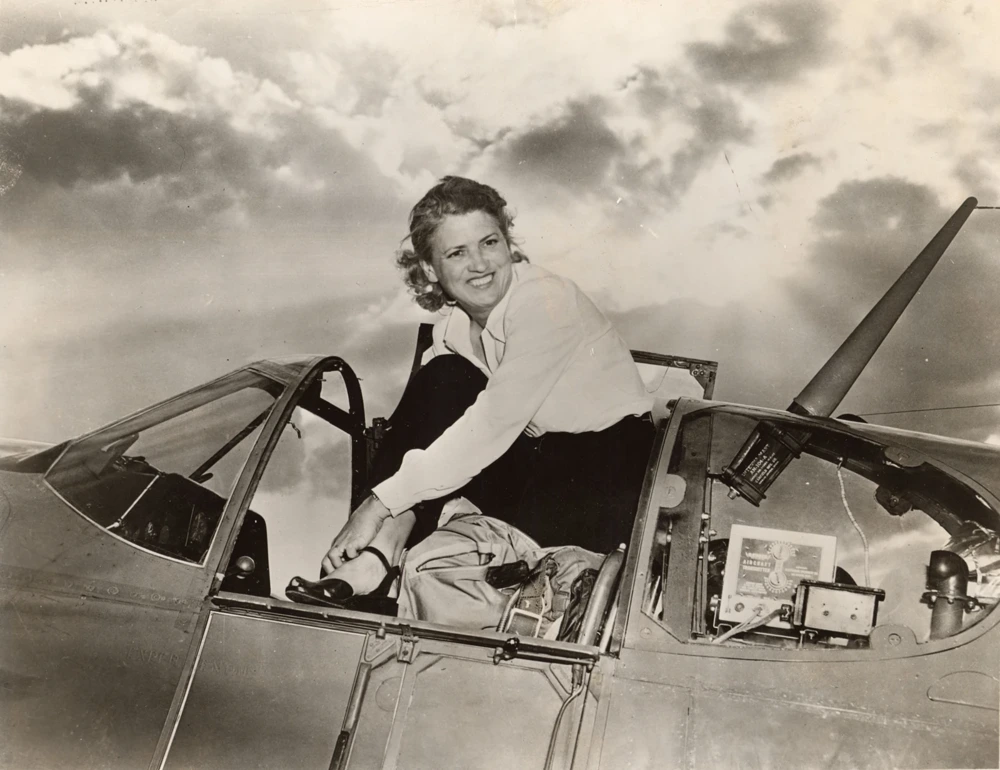
Life and work in aviation
Jacqueline Cochran came to aviation, already engaged in entrepreneurship. Her flying career led her to competitions, records, and training for female pilots. In 1938, she won the Bendix Prize race, becoming one of the notable participants in pre-war American aviation.
During World War II, Cochran ran the Women Airforce Service Pilots, WASP. The program participants performed aircraft distillation and other tasks, freeing military pilots for combat work. This was an important organizational part of its activities, which should be considered separately from personal record flights.
On May 18, 1953, Cochran became the first woman to exceed the speed of sound. Canadair Sabre, a variant of the F-86 family, was used for the flight. Chuck Yeager helped her with her training. Access to jet aircraft opened up new opportunities, but required the development of technology and test flights.
In 1961, Cochran set a series of records for the Northrop T-38 Talon. In 1964, it achieved new high-speed results on the Lockheed F-104G Starfighter. Its activities combined sports achievements, test work and the organization of aviation programs. Cochran died in 1980, leaving a significant mark on the history of women in aviation.
Pilot career and organization of work
Cochran combined personal record flights with organizational activities. Such a career requires different skills: independently perform a difficult route and create a training program for other people is not the same task. Its place in aviation is connected with both sides of the work.
When reading a biography, it is useful to separately consider sports achievements, participation in military aviation programs and social activities. The record shows a specific technical result, and the organization of training affects how many specialists can perform the necessary tasks.
What Wasp Meant
During World War II, female pilots performed various non-combat aviation tasks in the United States as part of WASP. Cochran co-organized and directed the programme. The work involved the practical use of trained pilots, not just public recognition of women's ability to fly.
Distillation and other auxiliary tasks require knowledge of aircraft, procedures and route features. They can not be considered a simple application to combat aviation. Through the history of WASP, we can see how the distribution of responsibilities and training support the operation of a large aviation system.
Supersonic flight and the jet age
On May 18, 1953, Cochran became the first woman to exceed the speed of sound. The achievement refers to a particular jet-powered flight and has its own place in record history. It occurred after the flight of Chuck Yeager on the X-1 and is associated with the further development of high-speed aviation.
The transition to jet technology changed the nature of training. High speed reduces the time for decisions, and new modes require understanding the behavior of the aircraft. Therefore, a record flight should be considered together with the preparation and device of the device, and not as a simple result of courage.
Records on different aircraft
Cochran's subsequent achievements on the T-38 and F-104 show that her career did not end with one known date. Different cars gave different possibilities in terms of speed and height. To compare records, it is important to maintain the conditions, distance and category of the result.
A list of records without context easily turns into a competition of loud numbers. A more useful question is which boundary investigated a particular flight and why the selected aircraft was suitable for the task. Such a prospect connects Cochran’s personal achievement with the development of aviation technology and professional training of pilots.
Major achievements
- Winning the 1938 Bendix Prize Race
- The first speed of sound by a woman in 1953
- Record flights on the T-38 and F-104G
Aircraft and flying machines
- Canadair Sabre
- Northrop T-38 Talon
- Lockheed F-104G Starfighter
Organisations and events
WASP · Ninety-Nines
- May 18, 1953 - Supersonic flight
- 1961 - T-38 records
Questions about this biography
When did Cochran break the speed of sound?
18 May 1953.
What plane?
On the Canadair Sabre, a variant of the F-86 family.
Who helped her prepare?
Chuck Yeager.
What program did she run during the war?
Women Airforce Service Pilots, WASP.
What jet training plane did she set records on?
On the Northrop T-38 Talon.
Was her work limited to records?
Oh, no. Cochran was also involved in the training and work of female pilots. Personal flights and the management of the aviation program are different but related parts of her career.
How did the WASP program differ from a record flight?
It provided aviation tasks to trained female pilots during the war. Its importance is associated with the professional organization of the work of a large number of specialists.