
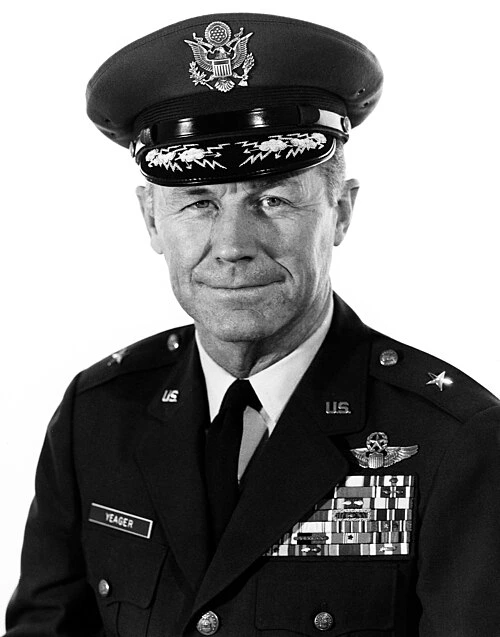
Life and work in aviation
Charles Elwood Yeager was born on February 13, 1923 in West Virginia. He enlisted in the U.S. Army Air Force and underwent flight training. In World War II, he flew fighter aircraft; after the war, his activities were associated with the testing of new aircraft and the study of high speeds.
The most famous flight of Yeager took place on October 14, 1947. The experimental Bell X-1 had a rocket engine and was intended to explore a velocities region near Mach 1. The aircraft was launched in the air from the carrier B-29, after which the tester dispersed the apparatus according to the program.
Yeager exceeded the speed of sound in horizontal flight. The value of the result is associated not only with personal achievement, but also with data for engineers: the program allowed to study the controllability, load and operation of the structure in previously little mastered conditions. The training involved the collaboration of pilots, designers and researchers.
For his flight, Yeager received aviation awards, including MacKay and Collier prizes. Later he continued his service and testing work. In the history of aviation, his name is primarily associated with the confirmed supersonic flight of the X-1. The wording "in horizontal flight" preserves the conditions of achievement and helps not to mix it with other experiments.
What we know about the sound barrier
As you approach the speed of sound, the flow behavior around the aircraft changes. There are shock waves and new features of control and resistance. For mid-20th century researchers, it was important to get in-flight data and understand whether it was possible to work sustainably in this mode.
The expression "sound barrier" is convenient for a story, but does not mean a material wall in the sky. This is an area of complex aerodynamic phenomena. The task of the testers was to consistently study the aircraft and compare observations with the expectations of engineers.
Bell X-1 as a research vehicle
The X-1 used a rocket propulsion system and was created to study high speeds. Its task was different from the daily transportation of people or cargo. The aircraft allowed to test the behavior of the design in the conditions for which a special test program was organized.
The launch system from the carrier aircraft freed the research apparatus from part of the tasks of a normal airfield departure. Therefore, the speed of the X-1 can not be directly compared with the convenience of operating a passenger liner. For aviation history, it is important what data the program received and how they helped the next generation of technology.
Why flight conditions are important 14 October 1947
Yeager's achievement is usually described as the first confirmed manned supersonic flight in horizontal mode. Refinement keeps the distinction between controlled research and other ways of briefly achieving high speed. The historical result includes not only the number on the device, but also the conditions for its receipt.
Mach's number links the speed of the aircraft to the local speed of sound. Therefore, the same value in different atmospheric conditions does not necessarily correspond to one speed in kilometers per hour. This principle helps to read record data without mixing different measurements.
The tester as a member of the engineering team
The test pilot collects information on which further work with the design depends. The accuracy of describing the behavior of the machine, compliance with the task and the ability to distinguish between observation and assumption are useful. Personal training is important, but flying is part of the work of engineers, technicians and test organizers.
The story of Yeager shows precisely this connection between man and program. Success does not mean the absence of risk or the opportunity to repeat the experience without appropriate training. His contribution should be considered through the development of new regimes and obtaining confirmed results for the development of aviation.
Major achievements
- The first speed of sound in a horizontal flight, October 14, 1947
- Test work in the program Bell X-1
- McKay and Collier Aviation Awards for Supersonic Flight
Aircraft and flying machines
- Bell X-1
- B-29 - X-1 carrier aircraft
Organisations and events
U S Air Force
- October 14, 1947 - Supersonic flight X-1
Questions about this biography
How did Jaeger exceed the speed of sound?
On the Bell X-1 rocket.
When did the flight take place?
14 October 1947.
How did the X-1 start its flight?
After separation from the carrier aircraft B-29.
What was the power plant of the X-1?
The rocket engine.
Why is achievement important?
It is about the speed of sound in horizontal flight.
Is the sound barrier a physical wall?
Oh, no. This is called the region of aerodynamic changes near the speed of sound. Research flights help to understand flow behavior, design, and control in these conditions.
Was the X-1 an ordinary jet?
This is a special research vehicle with a rocket propulsion system. Its method of application and purpose differed from the operation of a transport aircraft.