
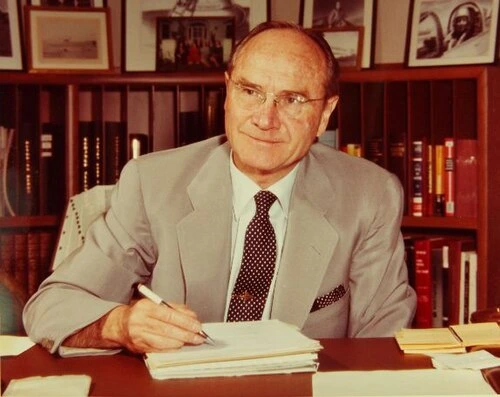
Life and work in aviation
James McDonnell (1899–1980) was an American engineer and entrepreneur who founded McDonnell Aircraft. The company developed jets and helped create the early American Mercury and Gemini crewed spacecraft. His role combined engineering experience with complex programme organisation, linking aircraft manufacturing and early spaceflight through teams, equipment and project management.
Education and engineering
McDonnell was educated at Princeton and MIT, then worked in the aviation industry. He founded his own company in 1939 in St. Louis. For the new company, it was necessary to form an engineering and production team. The manager had to ensure the fulfillment of orders, training of specialists and the transition from calculations to a tested product with specified characteristics.
Jet aircraft
Among McDonnell's designs were the FH-1 Phantom and the later F-4 Phantom II. These are different types, despite the similar name. Working with jet aircraft required new engines, aerodynamics and equipment. The company learned to create complex machines, where the result depended on the interaction of systems. The founder managed the programs, but did not replace all the specialists involved in the design.
Mercury and Gemini
McDonnell participated in the creation of the Mercury and Gemini ships. Space technology used part of the aviation production and engineering experience, but had its own requirements for return, protection, and life support. Mercury was a single-seater ship, Gemini was a double-seater. These programs prepared the procedures and experience used in the further development of American manned flights.
Merger with Douglas
In 1967, McDonnell and Douglas merged. The subsequent history of McDonnell Douglas became a new corporate era. The founder's biography refers to the creation of an enterprise and the development of early programs. It can not be attributed to any American spacecraft company: for example, the Space Shuttle orbiters were built by Rockwell. The exact indication of the manufacturer helps to understand the real distribution of work in the industry.
How an aviation company is formed
Aviation production combines the design, manufacture, testing and supply of equipment. The entrepreneur can determine the direction and collect the team, but does not perform all the calculations personally. Power plant, devices and materials often come from individual organizations. Therefore, the history of the company is a network of interrelated works. The name of the founder helps to trace the beginning of the enterprise, and the exact indication of engineers and programs shows how the idea turned into a real serial product.
For the carrier, the aircraft is part of the route and operation economy. Capacity, fuel consumption and maintenance conditions affect the choice of type. The contracting authority may set requirements that guide the manufacturer's work. The order does not make the head of the airline a designer. The difference in roles is especially noticeable when creating large liners: the technical program and the organization of future flights are developing in parallel and must be agreed before the regular transportation of passengers begins.
Serial production requires repeated quality of parts, documentation and training of people. An experienced aircraft tests a technical idea, but a successful first flight does not automatically ensure the production of hundreds of machines. Need suppliers, workshop equipment and the ability to maintain the product after delivery. These challenges explain the importance of industry organizers. Their contribution may be to create a sustainable system through which many specialists work on the overall result for a long time.
Businesses change names, merge and continue to operate after the departure of the founders. The late aircraft may retain a well-known brand, but belong to a different engineering era. The biography should be built on specific dates of human participation. This preserves the distinction between personal contribution and corporate heritage. Through such a story, it is clearer why the development of aviation depends simultaneously on technical solutions, the organization of production and the real needs of passengers, carriers and other operators.
Major achievements
- Founded McDonnell Aircraft in 1939
- Developed the production of jet aircraft
- Organized the company's participation in Mercury and Gemini
Aircraft and flying machines
- FH-1 Phantom
- F-4 Phantom II
- Mercury
- Gemini
Organisations and events
McDonnell Aircraft · McDonnell Douglas
- Company founded in 1939
- Mercury and Gemini Programs
- Association of 1967
Questions about this biography
Why is James McDonnell in the history of aviation?
He founded McDonnell Aircraft in 1939. He developed the production of jet aircraft. He organized the company's participation in Mercury and Gemini.
With what field of aviation is this biography connected?
James McDonnell (1899–1980) was an American engineer and entrepreneur who founded McDonnell Aircraft.
What aircraft are involved in this work?
Related: FH-1 Phantom, F-4 Phantom II, Mercury, Gemini. Their role and period are described in the main sections.
What events help to understand the professional path?
Major historical episodes: The founding of the company in 1939; Mercury and Gemini programs; The 1967 Merger.
What organizations are mentioned in the biography?
Professional path is connected with organizations and communities: McDonnell Aircraft, McDonnell Douglas.
McDonnell built the Space Shuttle orbiters?
Oh, no. The orbiters built Rockwell. McDonnell's space programs are primarily associated with Mercury and Gemini.
What is the technical context of this story?
Aviation production combines the design, manufacture, testing and supply of equipment. The entrepreneur can determine the direction and collect the team, but does not perform all the calculations personally. Power plant, devices and materials often come from individual organizations. Therefore, the history of the company is a network of interrelated works. The name of the founder helps to trace the beginning of the enterprise, and the exact indication of engineers and programs shows how the idea turned into a real serial product.