
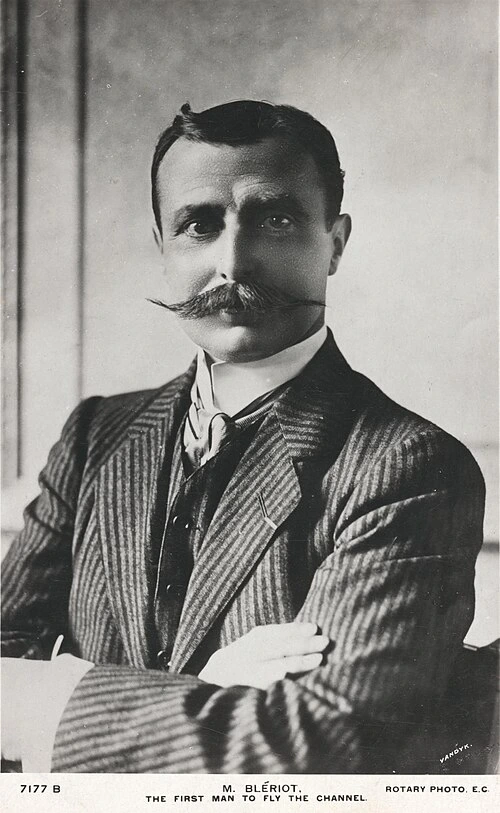
Life and work in aviation
Louis Blériot was born in 1872. Before aviation, he was engaged in the production of automobile headlights, and at the beginning of the 20th century he became interested in aircraft. The path to a successful design included experiments with different schemes and tests, which gradually clarified the requirements for the aircraft.
For a historic flight across the English Channel, Blériot used the Type XI. It was a small monoplane with a three-cylinder Anzani engine with a capacity of 25 horsepower. The simplicity of appearance did not mean the ease of the task: flying over water required reliable engine operation and the right choice of conditions.
Early on the morning of 25 July 1909, Blériot flew off the French coast near Calais and reached Dover. The flight brought him a prize announced for the first crossing of the strait by plane. Before that, there were already longer flights, but overcoming the water border was an event with a strong social and symbolic significance.
Blériot XI gained fame and was used in different countries. The surviving museum aircraft of the family are not necessarily the same specimen that crossed the strait in 1909: the date and history of each side must be checked separately. Blériot's contribution is related to personal flight, the creation of the design and the development of early aviation production.
The English Channel as a practical border
The flight of Blériot showed that the plane is able to connect the shores of the strait. Geography made the result understandable to the public: the aircraft overcame the water space, which previously required other transport. At the same time, the task included the preparation of the apparatus, the choice of conditions and the search for the landing site.
Short by modern standards, the path could be a serious test for an early aircraft. Engine capabilities, navigation and reliability of the design limited the pilot's decisions. Therefore, the value of the flight of 1909 is determined by the conditions of the era, and not by comparison with the range of today's airliner.
Blériot XI and monoplane scheme
The Blériot XI was an early monoplane. One main wing distinguished it from numerous biplanes of the period. This layout has become a recognizable part of the family, but the outer silhouette does not describe all the engineering features of a particular machine.
For early design, mass, strength, engine, and control had to be reconciled with limited materials and production capabilities. The aircraft was the result of consistent development, not just a bold decision to cross the water. The history of the type helps to see the technical side of the famous flight.
Pilot, designer and manufacturer
Blerio combined personal flights with the creation of aircraft. The public achievement drew attention to the design and helped the development of its production. In early aviation, such roles often overlapped: the one who built the device himself demonstrated its capabilities.
It is important for the industry not only to fulfill the record, but also to make the car available to other pilots. Production requires reproducibility of design and transfer of knowledge about operation. Therefore, Blerio's contribution is associated with the transition from a separate experiment to the distribution of aircraft.
How to study preserved machines
The name Blériot XI refers to the family and does not certify the participation of any surviving specimen in the flight across the English Channel. The museum aircraft has its own history of manufacture, operation and restoration. This information allows you to understand what exactly the exhibit represents.
Such a distinction is important for the entire history of aviation: the original, another serial board and a modern replica tell about the technique in different ways. Studying Blerio, it is useful to link the biography with the date of the flight and a specific apparatus. Then photographs and museum objects complement history, and do not create the wrong impression about it.
Major achievements
- Crossing the English Channel by plane on 25 July 1909
- Development of Blériot XI with designer Raymond Solnier
- Development of early aviation production and distribution of Blériot XI in different countries
Aircraft and flying machines
- Blériot XI
Organisations and events
Blériot Aéronautique
- July 25, 1909 - Flight across the English Channel
Questions about this biography
When did Blériot cross the English Channel?
25 July 1909.
What was the name of the plane?
Blériot XI, or Type XI.
Where did the flight end?
In Dover, England.
What engine was used?
Three-cylinder Anzani with a capacity of 25 horsepower.
What did he do before the flight?
Production of automobile headlights.
Any Blériot XI - the same aircraft of 1909?
Oh, no. The name means family. Each museum board is checked for its own history; the original participant of the flight, the other instance and the replica have different status.
Why did the relatively short flight become famous?
For the early machine, crossing the water border was a serious practical task. The value of the result is determined by the capabilities of technology and the conditions of 1909.