
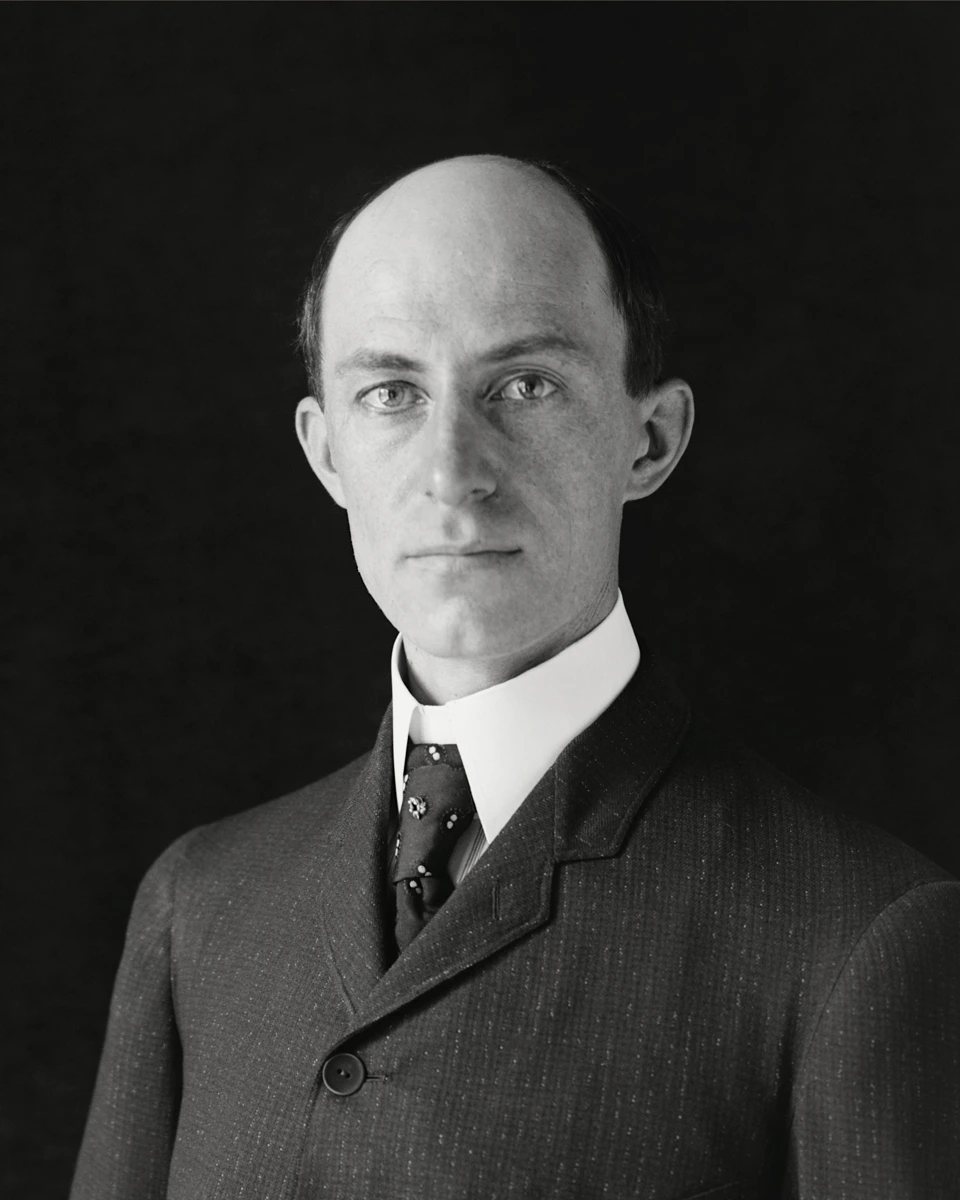
Life and work in aviation
Wilbur Wright was born on April 16, 1867 near Millville, Indiana. Together with his younger brother Orville, he was engaged in the printing business, and then the repair and production of bicycles in Dayton. Practical work with the mechanisms and their own workshop gave the brothers the opportunity to build and test experimental designs.
In aviation, the Wrights viewed lift, control, and thrust as related tasks. First they tested the gliders. When early calculations did not coincide with the results, the brothers used an aerodynamic tube to obtain their own data. They paid special attention to the control of the roll, pitch and direction of flight.
On December 17, 1903, the brothers performed four motor flights on the Flyer near Kitty Hawk in North Carolina. Orville was the first to fly; Wilbur also piloted the aircraft that day. Therefore, it is important to separate the history of the joint invention from the question of who was in control during the first flight.
Further tests turned the experimental machine into a practical aircraft. In 1908, Wilbur demonstrated flying in France, introducing the public to the possibilities of design. He died in Dayton on May 30, 1912. His contribution is related to the joint engineering work of the brothers and the consistent testing of solutions in flight.
Workshop as a research laboratory
Bicycle business gave the brothers not only income. It taught them how to make parts, work with lightweight structures and observe the behavior of the mechanism in motion. Wilbur and Orville could go from idea to model inside their own workshop without waiting for the creation of a large industrial enterprise.
In early aviation, this independence was of particular importance. Reliable reference data was not enough, and the finished chain of suppliers of aircraft components did not yet exist. For success, it was necessary to combine calculation, manufacturing and experiment. The Wrights’ work was an example of how a small team gets results by asking precise questions.
Why management has become a major issue
The aircraft should not only create a lifting force, but also maintain a controlled position. The Wrights investigated the change in roll, pitch, and direction as part of a single task. Their approach allowed the pilot to interfere with the movement of the device, and not rely solely on its natural stability.
The distinction between sustainability and management is also important for the modern reader. A stable machine strives to maintain a certain state; a controlled one allows it to be deliberately changed. For a practical aircraft, both qualities are needed in a suitable combination. The contribution of the brothers is especially noticeable when comparing their decisions with earlier gliding experiences.
From the first few seconds to demonstrations in France
Flights 1903 confirmed the workability of a combination of wing, control and propulsion. But the short successful experiment was not yet a transport system. The following tests were to show that the aircraft was capable of repeating maneuvers and staying in the air long enough for a practical task.
Wilbur's demonstrations in France in 1908 made the result visible to the general public. Observers could assess the controlled flight with their own eyes. Therefore, this stage is important not only as an episode of glory: it connects the work of a closed workshop with public recognition and the development of aircraft production.
What remains of Wilbur's method today
In Wright's engineering history, it is useful to consider the sequence of verification: read previous studies, build a model, measure the result, and correct initial assumptions. The discrepancy of the calculation with the experiment for them was the reason to get their own data, and not proof of the impossibility of flight.
Wilbur did not work alone, so the biography should not separate him from Orville and the people involved in the manufacture of the machine. Personal contribution is clearly seen in management research and public demonstrations, and joint - in the creation of a complete aircraft. The story of the brothers helps to understand the difference between an idea and a replicable technical result.
Major achievements
- Joint development of controlled motor flyer
- Wing research in wind tunnel
- Demonstration flights in France in 1908
Aircraft and flying machines
- Wright Brothers Planners
- Wright Flyer 1903
Organisations and events
Wright Cycle Company
- 17 December 1903 - Flyer flights
- 1908 - Demonstrations in France
Questions about this biography
Who did Wilbur Wright work with?
Orville Wright's younger brother.
Where did the brothers run the workshop?
In Dayton, Ohio.
When did the Flyer fly?
17 December 1903.
Who flew the first flight that day?
Orville Wright; Wilbur piloted on subsequent flights.
What was the wind tunnel used for?
To get your own data about the wings.
What was the Wright engineering method?
They consistently combined the study of previous works, measurements, fabrication and testing. If the calculation did not coincide with the experience, the brothers refined the data and design, and then checked the solution again.
Why are the 1908 demonstrations important?
They allowed observers to see the guided flight and confirmed that the result is not limited to a single short experience. This helped public acceptance of the new technique.