
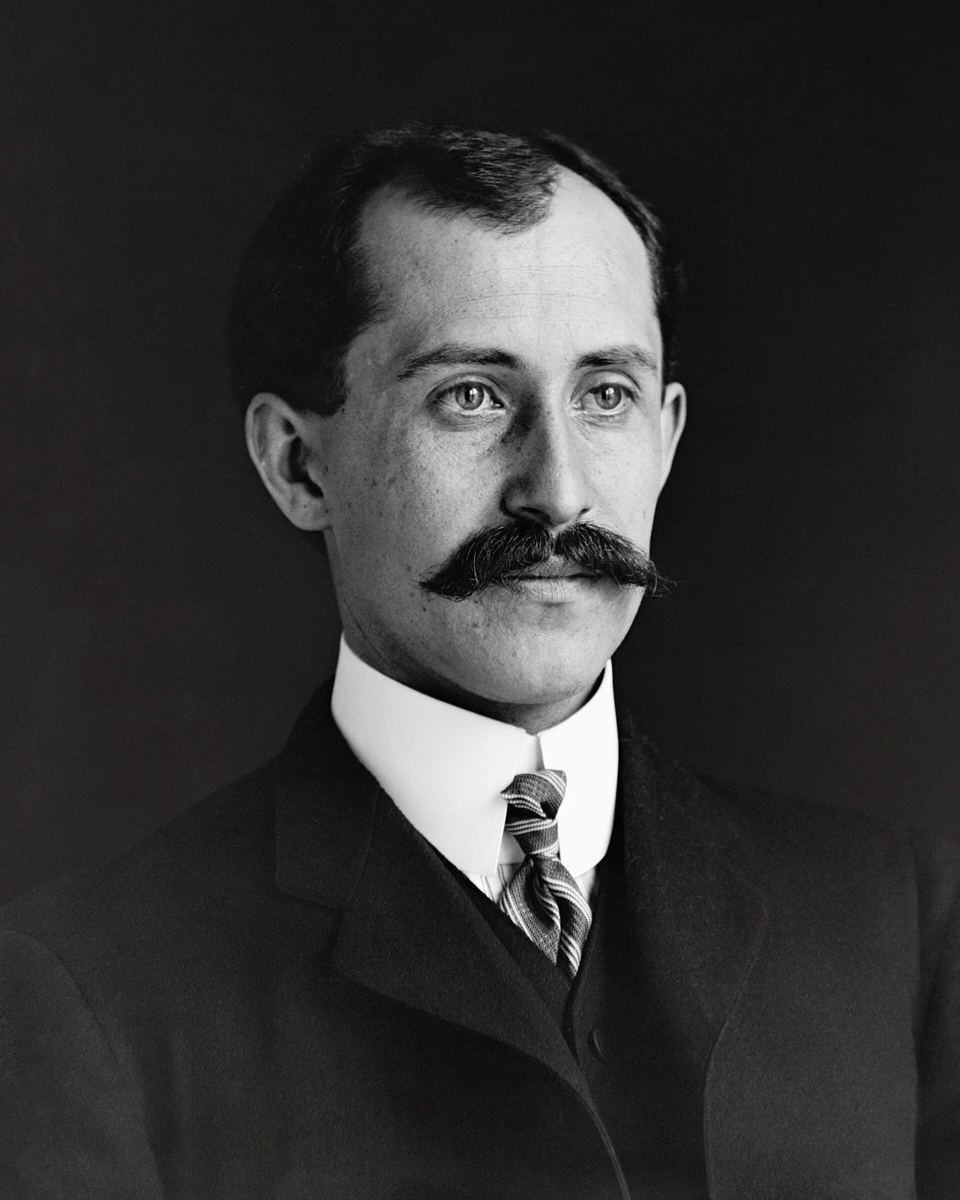
Life and work in aviation
Orville Wright was born on August 19, 1871 in Dayton, Ohio. In his youth, he started a printing business and attracted his older brother Wilbur to him. Later, the brothers opened the Wright Cycle Company, where they repaired and produced bicycles. The workshop became an important part of their experimental work.
Interest in the flight led the brothers to study their predecessors and test their own gliders. They did not limit themselves to searching for a powerful engine: controllability became one of the central tasks. Work with models in the wind tunnel allowed to clarify the parameters of the wing after the discrepancy of calculations with early experiments.
On December 17, 1903, Orville was in control of the Flyer during its first flight near Kitty Hawk. During the day, the brothers took four flights in turn. The aircraft and its systems were the result of collaboration, so this episode should not be presented as a separate invention of one brother.
After the first flights, the Wrights continued to improve the device and show its capabilities. Their history links ground research, parts production and testing in a single sequence. Orville survived Wilbur for many years and died on January 30, 1948 in Dayton. His name is associated primarily with the creation of a controlled motor aircraft and the first piloting of the Flyer in December 1903.
First pilot of the Flyer and co-author of the aircraft
Orville is known as the pilot of the first motor flight on December 17, 1903. However, his role was broader than one historical moment. He participated in the research, manufacture and testing of devices with Wilbur. The first flight was the result of this joint work, and not random luck behind the control of the finished machine.
Separating the author of the design and the pilot is useful for accurate reading of the story. In the case of the Wrights, the roles overlapped: both brothers explored and flew. Therefore, Orville's photograph on the Flyer tells of a specific departure, while the aircraft's history spans years of work by two inventors.
What was Wright Flyer?
The 1903 car was a biplane with an engine and two propellers. It was different from the usual passenger plane. The pilot operated the machine in an open position, and numerous design elements remained in sight. It was an experimental machine built to test a principle solution.
The screw can be represented as a wing moving in a circle and creating thrust. This view connects the study of lift with the task of the driver. For Flyer, it was important that the engine's limited power was used efficiently; the approach to propellers became part of the overall calculation, along with the wing and control.
Why a short flight was important
The main thing in the December experience is a combination of motor thrust, controllability and continuing flight. To fly for a moment is not enough for practical aviation: you need to maintain the ability to control the device after separation. The following machines and tests by the Wrights developed precisely this ability.
The length and timing of an individual flight describe a specific outcome, but not the entire maturity of the design. It is useful to distinguish between the first confirmed experience and subsequent refinement. This approach helps to understand why later tests and demonstrations appear next to the 1903 date in the history of aviation.
Life After the First Aircraft
Orville lived until 1948 and saw aviation evolve from an experimental occupation into a major industry. During this time, powerful transport aircraft, jet engines and fundamentally new speeds appeared. The biography of the man who piloted the early Flyer connects several completely different technical eras.
His story shows that the practical invention does not end with the first successful launch. We need production, training of pilots, demonstration of opportunities and preservation of knowledge. It is useful to read about Orville's legacy with Wilbur, the gliders, and the Flyer device, rather than being limited to a single date.
Major achievements
- Piloting the first flight of the Flyer on December 17, 1903
- Joint development of gliders and aircraft Wright brothers
- Aerodynamics and Control Research
Aircraft and flying machines
- Wright Flyer 1903
- Planer Wright 1902
Organisations and events
Wright Cycle Company
- 17 December 1903 - First flight of the Flyer
Questions about this biography
Where was Orville Wright born?
In Dayton, Ohio.
Who was his work partner?
His older brother Wilbur.
What aircraft did he fly on December 17, 1903?
Wright Flyer.
How many flights did the brothers make that day?
Four.
What did their workshop do before the planes?
Repair and manufacture of bicycles.
Orville just piloted a ready-made plane?
Oh, no. Together with Wilbur, he participated in the research and creation of devices. The first flight of the Flyer was part of many years of joint engineering work.
How was the flyer different from the glider?
It had a propulsion system and air screws that created thrust. At the same time, control and a suitable wing remained necessary for the continued controlled flight.