
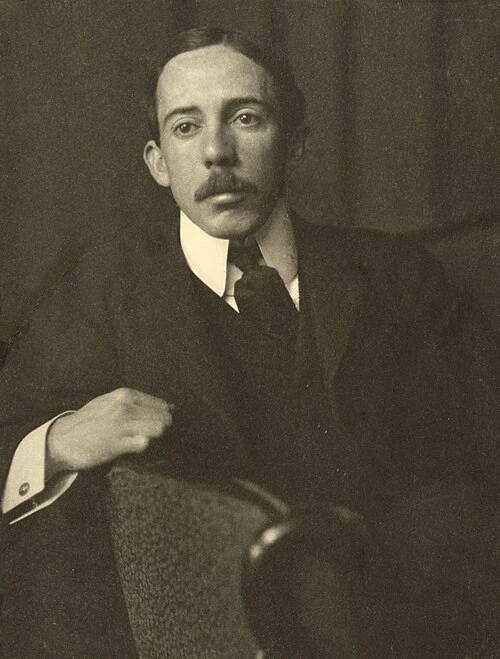
Life and work in aviation
Alberto Santos-Dumont (1873–1932) was a Brazilian aviator and inventor working mainly in France. His career combined controlled lighter-than-air flight with early aeroplanes. He demonstrated technology publicly through an airship flight around the Eiffel Tower, the 14-bis and the light Demoiselle. His history illustrates the varied paths towards practical powered flight in the early twentieth century.
Airship over Paris
In 1901, Santos-Dumont flew airship No. 6 from Saint-Cloud around the Eiffel Tower and back, completing the course for the Deutsch de la Meurthe prize. For aeronautics, it was crucial to be able to control the direction of movement and return to the starting point. This airship was different from a free balloon, the route of which was mainly determined by the wind.
Public flights 14-bis
In the autumn of 1906, Santos-Dumont demonstrated in Paris the heavier-than-air 14-bis. His flights took place in front of witnesses and played a major role in the recognition of the aircraft by the European public. Formulations about primacy require clarification of the conditions: public demonstration, registration of the result and earlier controlled motor flight of the Wright brothers relate to various historical issues that should not be confused.
Easy Demoiselle
The next direction was Demoiselle - a small monoplane with an open pilot's seat and a very light design. Unlike the bulky 14-bis, this machine represented a different scale of aviation: a compact device for individual piloting. The comparison of the two projects shows how quickly the early designers revised the layout, mass and method of control, relying on new flight results.
Why his role is bigger than one record
Santos-Dumont made flying part of city life and a public technical experiment. Its activities are important at the same time for the history of airships and aircraft. In the biography, it is worth distinguishing between specific devices: No. 6 was kept in the air thanks to the gas in the shell, and 14-bis and Demoiselle - thanks to the wing in the moving stream. It is the transition between these areas that makes his career particularly revealing.
How the wing, stability and design are related
The aircraft must simultaneously create lift, overcome resistance and maintain control. A good wing does not solve all problems by itself. Suitable controls are required, and the structure and distribution of the mass is strong enough. Therefore, the history of the aviation project is useful to consider as the coordination of several functions. Changing one element affects the rest: a heavier vehicle requires different flight conditions, and a new engine can change the layout and behavior of the machine.
The glider helps to explore the flight without its own power plant. It uses altitude stock and movement relative to air; duration depends on design and atmospheric conditions. Early experiments allowed us to study the stability and actions of the pilot before the advent of a suitable engine. At the same time, a small model does not automatically confirm the behavior of a full-size machine. To go to the apparatus with a person, separate strength calculations, manufacturing and practical verification under the appropriate load are needed.
The material is selected taking into account the mass, strength, manufacture and maintenance. Wood, metal alloys and composites have different joining properties and technologies. The new design may be promising, but its advantages need to be confirmed by tests. The name of the material is not a guarantee of safety or economy. Important are the power kit layout, the quality of the parts and how the body perceives real loads during operation, including repeated takeoffs and landings.
The design result consists of calculations, manufacture, ground inspection and flight observations. The engineering school passes on ways to solve problems to the next generation, not just the appearance of the aircraft. When studying the biography, it is useful to associate projects with their purpose: the training machine, transport and experimental glider require different compromises. So it is clearer why two apparently similar designs can have a completely different operational role and history of development.
Major achievements
- In 1901, he completed the famous Paris route on airship No. 6.
- In 1906, he publicly demonstrated the flights of the 14-bis aircraft.
- Developed a light monoplane Demoiselle
Aircraft and flying machines
- Airship No 6
- 14-bis
- Demoiselle
Organisations and events
Aéro-Club de France
- Paris Demonstrations of 1901
- Flights 14-bis in 1906
Questions about this biography
Why is Alberto Santos-Dumont in the history of aviation?
In 1901, he completed the famous Paris route on airship No. 6. In 1906, he publicly demonstrated the flights of the 14-bis aircraft. Developed a light monoplane Demoiselle.
With what field of aviation is this biography connected?
Alberto Santos-Dumont (1873–1932) was a Brazilian aviator and inventor who worked mainly in France.
What aircraft are involved in this work?
Related to the biography: Airship No. 6, 14-bis, Demoiselle. Their role and period are described in the main sections.
What events help to understand the professional path?
Main historical episodes: Paris demonstrations of 1901; Flights 14-bis in 1906.
What organizations are mentioned in the biography?
The professional path is connected with organizations and communities: Aéro-Club de France.
Santos-Dumont and Wright made the same first flight?
Oh, no. Historians separately consider the Wrights' controlled motor flight in 1903 and the Santos-Dumont public European demonstrations in 1906. The description of achievement shall include the conditions and the date.
What is the technical context of this story?
The aircraft must simultaneously create lift, overcome resistance and maintain control. A good wing does not solve all problems by itself. Suitable controls are required, and the structure and distribution of the mass is strong enough. Therefore, the history of the aviation project is useful to consider as the coordination of several functions. Changing one element affects the rest: a heavier vehicle requires different flight conditions, and a new engine can change the layout and behavior of the machine.