
Life and work in aviation
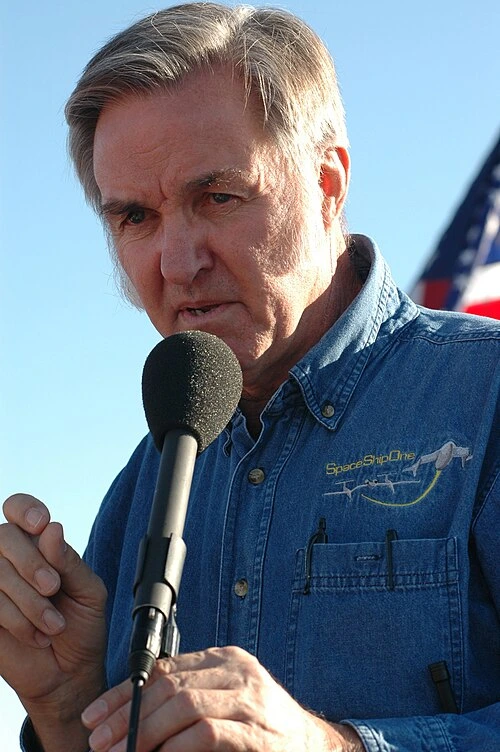
Bert Rutan is an American aircraft designer born in 1943, the founder of Rutan Aircraft Factory and Scaled Composites. His designs are known for unusual layouts and extensive use of composite materials. VariEze and Long-EZ are associated with amateur aircraft manufacturing, Voyager with a round-the-world non-stop flight, and SpaceShipOne with a manned suborbital vehicle. Rutan showed how a relatively small team can consistently build and test bold technical solutions.
Test experience to your own office
After his aviation engineering education, Rutan worked at Edwards Base and was involved in the study of aircraft behavior. Such experience helped to link the calculation with real flight data. Then he worked with small machines and created his own direction in Mojave. An important part of the approach was the manufacture and verification of the prototype: the unusual shape itself did not serve as proof of the project’s performance.
VariEze and Long-EZ
VariEze and Long-EZ used a front horizontal plumage and a composite design. These machines became known among the builders of amateur aircraft. The front tail is a separate variant of the layout, and not a universal replacement for the usual tail. Its properties must be evaluated together with the wing, centering and control. The history of Rutan’s projects is useful precisely as an example of a consistent choice of a solution for a given machine and its owner.
Voyager and Flight 1986
Rutan designed Voyager for a round-the-world route without landing or refueling. In December 1986, the flight was performed by his brother Dick Rutan and Gina Yeager. The design result is associated with a low mass, a large supply of fuel and an effective wing, and the flight result is associated with the actions of the crew. These roles complement each other, but they should not be confused: Bert created the apparatus, and was not one of the two pilots of the expedition.
SpaceShipOne and the Limit of the Space Task
SpaceShipOne achieved manned suborbital flight in 2004. The device rose to space altitude, but did not go into orbit of the Earth. This distinction is fundamental to describing achievement. The Rutan School combined composites, experimental layouts, and fast development cycles. Subsequent programs of Scaled Composites relate to the work of entire teams and should not turn into a list of sole inventions of the founder.
How the wing, stability and design are related
The aircraft must simultaneously create lift, overcome resistance and maintain control. A good wing does not solve all problems by itself. Suitable controls are required, and the structure and distribution of the mass is strong enough. Therefore, the history of the aviation project is useful to consider as the coordination of several functions. Changing one element affects the rest: a heavier vehicle requires different flight conditions, and a new engine can change the layout and behavior of the machine.
The glider helps to explore the flight without its own power plant. It uses altitude stock and movement relative to air; duration depends on design and atmospheric conditions. Early experiments allowed us to study the stability and actions of the pilot before the advent of a suitable engine. At the same time, a small model does not automatically confirm the behavior of a full-size machine. To go to the apparatus with a person, separate strength calculations, manufacturing and practical verification under the appropriate load are needed.
The material is selected taking into account the mass, strength, manufacture and maintenance. Wood, metal alloys and composites have different joining properties and technologies. The new design may be promising, but its advantages need to be confirmed by tests. The name of the material is not a guarantee of safety or economy. Important are the power kit layout, the quality of the parts and how the body perceives real loads during operation, including repeated takeoffs and landings.
The design result consists of calculations, manufacture, ground inspection and flight observations. The engineering school passes on ways to solve problems to the next generation, not just the appearance of the aircraft. When studying the biography, it is useful to associate projects with their purpose: the training machine, transport and experimental glider require different compromises. So it is clearer why two apparently similar designs can have a completely different operational role and history of development.
Major achievements
- Rutan Aircraft Factory and Scaled Composites
- Developed well-known composite aircraft VariEze and Long-EZ
- Designed by Voyager and led the creation of SpaceShipOne
Aircraft and flying machines
- VariEze
- Long-EZ
- Voyager
- SpaceShipOne
Organisations and events
Rutan Aircraft Factory · Scaled Composites
- Voyager's world flight in 1986
- SpaceShipOne suborbital flights in 2004
Questions about this biography
Why is Bert Rutan in the history of aviation?
He founded Rutan Aircraft Factory and Scaled Composites. He developed the well-known composite aircraft VariEze and Long-EZ. He designed Voyager and directed the creation of SpaceShipOne.
With what field of aviation is this biography connected?
Bert Rutan is an American aircraft designer born in 1943, the founder of Rutan Aircraft Factory and Scaled Composites.
What aircraft are involved in this work?
Related to the biography: VariEze, Long-EZ, Voyager, SpaceShipOne. Their role and period are described in the main sections.
What events help to understand the professional path?
Main historical episodes: Voyager round-the-world flight in 1986; SpaceShipOne suborbital flights in 2004.
What organizations are mentioned in the biography?
The professional path is connected with organizations and communities: Rutan Aircraft Factory, Scaled Composites.
Did Bert Rutan fly around the world on Voyager?
Oh, no. The device was designed by Bert, and the crew consisted of Dick Rutan and Gina Yeager. Design and flight work were different parts of the same program.
What is the technical context of this story?
The aircraft must simultaneously create lift, overcome resistance and maintain control. A good wing does not solve all problems by itself. Suitable controls are required, and the structure and distribution of the mass is strong enough. Therefore, the history of the aviation project is useful to consider as the coordination of several functions. Changing one element affects the rest: a heavier vehicle requires different flight conditions, and a new engine can change the layout and behavior of the machine.