
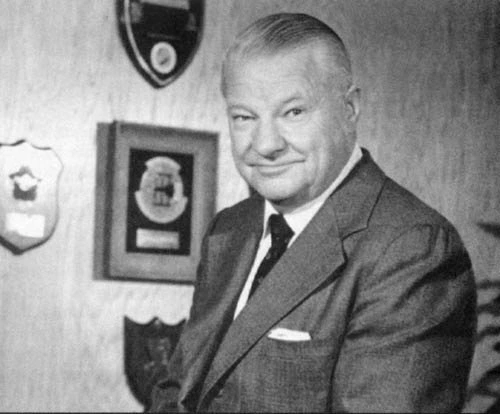
Life and work in aviation
Clarence "Kelly" Johnson (1910-1990) - American aviation engineer and head of promising projects Lockheed. Its work is associated with the P-38 Lightning, U-2 high-altitude and a family of high-speed devices A-12 and SR-71. He became known for organizing small specialized teams that are able to quickly solve complex problems. In his biography, technical solutions are closely related to the management of the project: the new machine required the coordination of the engine, materials, aerodynamics and test program.
Education and Work at Lockheed
Johnson received his aviation engineering education at the University of Michigan and came to Lockheed. He worked on the stability and other characteristics of the aircraft, then led major developments. The engineer here should take into account not one successful detail, but the behavior of the whole machine. Changing the wing or plumage affects the control, mass and load, so the solution is checked together with the calculation and experiment.
Team of promising developments
Johnson headed a direction known as Skunk Works. Its organization of work involved close interaction of specialists and clear responsibility for the result. Such management is important in projects where the usual ready-made solutions are still few. A small team does not mean work without verification: a complex apparatus requires a constant exchange of data between calculators, production, testers and those who formulate requirements for future operation.
Height U-2
The U-2 was designed as a long-wing high-altitude aircraft. His task was different from that of a heavy passenger liner or high-speed fighter. Large wing elongation is associated with aerodynamic efficiency, but has implications for strength and piloting. Through this project, the principle of specialized design is clearly visible: the most important characteristics are chosen for a certain mode and purpose, and not for the sake of universal superiority over any other aircraft.
Family A-12 and SR-71
High-speed A-12 and SR-71 required the coordination of aerodynamics, power plant and thermal loads. At high speeds, heating becomes an independent design task. Johnson directed the team's work, rather than doing all the calculations and manufacturing in person. The heritage of the engineer is associated with specific machines and methods of organizing complex development. Later Lockheed projects can not be automatically attributed to him by belonging to the same enterprise.
Engine, thrust and flight mode
The engine shall provide enough thrust for the selected task at an acceptable mass and fuel consumption. The maximum power does not describe the entire power plant. Reliability, cooling, launch, resource and interaction with the aircraft are important. In early aviation, separately, the task was to get an engine that can generally be lifted into the air along with the design and the person. The development of materials and production gradually expanded the available opportunities.
A piston engine typically transmits power to an air propeller, and a turbojet plant creates thrust through a stream of gases. These schemes are not interchangeable without changing the project. The choice is influenced by the speed, height and purpose of the machine. A screw plane can be convenient for one transport task, a jet one for another. The comparison requires taking into account the entire operating mode, and not declaring one technology the best for any routes and dimensions of the device.
As you approach the speed of sound, the behavior of the airflow changes. The design of the high-speed aircraft affects the wing, air intakes, stability and control. A more powerful engine does not solve these issues alone. Calculations and tests of the design under the expected conditions are needed. The result of the experimental machine also does not mean that the same mode is suitable for normal serial operation, with passengers and regular maintenance.
The history of the engine should be distinguished from the history of the aircraft on which it was used. The power plant could be created by other teams, and the pilot checked its behavior in the car. Accurate indication of these roles helps to understand the contribution of each specialist. For the serial program, deliveries, technical documentation and service preparation are important: without them, even a promising engine remains a separate experimental product, and not a ready basis for regular flights.
Major achievements
- Led Lockheed's Advanced Developments
- Participated in the creation of P-38 and high-altitude U-2
- Head of the A-12 / SR-71 family
Aircraft and flying machines
- Lockheed P-38 Lightning
- Lockheed U-2
- Lockheed A-12
- Lockheed SR-71
Organisations and events
Lockheed · Skunk Works
- Development of P-38
- The first flight of U-2 in 1955
- Creating a high-speed Blackbird family
Questions about this biography
Why is Clarence "Kelly" Johnson in the history of aviation?
He led the promising developments of Lockheed. He participated in the creation of the P-38 and high-altitude U-2. He was head of the A-12/SR-71 family.
With what field of aviation is this biography connected?
Clarence "Kelly" Johnson (1910-1990) - American aviation engineer and head of promising projects Lockheed.
What aircraft are involved in this work?
Related to the biography: Lockheed P-38 Lightning, Lockheed U-2, Lockheed A-12, Lockheed SR-71. Their role and period are described in the main sections.
What events help to understand the professional path?
Main historical episodes: Development of the P-38; First flight of the U-2 in 1955; Creation of the high-speed Blackbird family.
What organizations are mentioned in the biography?
The professional path is connected with organizations and communities: Lockheed, Skunk Works.
U-2 and SR-71 solve the same engineering problem?
Both are associated with high-altitude aviation, but their layout and modes are different. The U-2 uses a long effective wing, and the SR-71 is designed for high-speed flight with other thermal and aerodynamic requirements.
What is the technical context of this story?
The engine shall provide enough thrust for the selected task at an acceptable mass and fuel consumption. The maximum power does not describe the entire power plant. Reliability, cooling, launch, resource and interaction with the aircraft are important. In early aviation, separately, the task was to get an engine that can generally be lifted into the air along with the design and the person. The development of materials and production gradually expanded the available opportunities.