
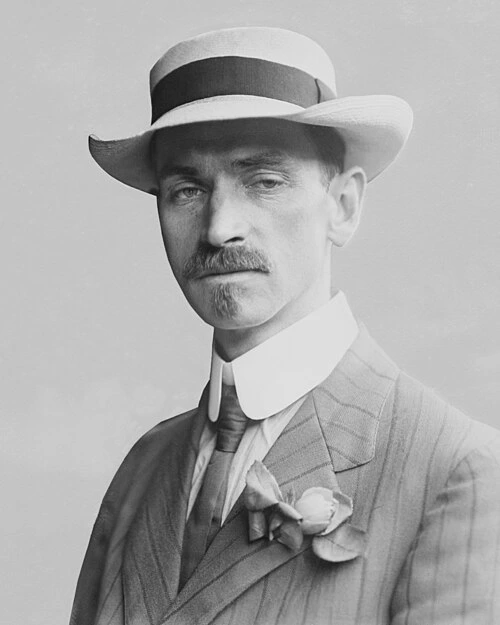
Life and work in aviation
Glenn Curtiss (1878–1930) was an American engine designer, pilot, and aircraft manufacturer. He came to aviation from the production of motorcycles, where a light and powerful engine was of the same decisive importance. His work with the Aerial Experiment Association, record demonstrations, seaplanes and the production of aircraft for pilot training made him one of the central figures of early American aviation. In his biography, the connection between the power plant, the design of the aircraft and industrial production is especially clearly visible.
The engine as the beginning of an aviation career
Curtiss designed engines and did high-speed motorcycles. Aviation required even stricter coordination of mass, power and reliability from the same engineering task. His engines were used in experimental vehicles, and he himself became a member of the Aerial Experiment Association. In this group, the work was shared among several researchers, so the results should be seen as a collaborative process rather than as one person's activity.
June Bug and Flight Recognition
On July 4, 1908, Curtiss piloted June Bug in a demonstration related to the Scientific American Trophy. The flight was an important milestone in the recognition of American aviation. In 1909, he competed in aviation competitions in Reims. Such events made it possible to compare the capabilities of machines in foreseeable conditions and turned technical improvements into a result understandable to observers: speed, distance and quality of control.
Plane on water
Curtiss developed seaplanes and flying boats. Water could serve as a place of takeoff and landing where there were few ground airfields, but created its own restrictions: wave, resistance to run-off and requirements for the strength of the hull. This work has become important for naval aviation. It is useful to distinguish between a float plane and a flying boat: they have different ways of placing the hull relative to the water surface.
Production and training aviation
A family of JN training aircraft is associated with the name Curtiss, including the famous JN-4 Jenny. The training machine is valuable in that it helps to reproduce piloting skills on the scale of many schools and crews. Industrial development required not only a successful prototype, but also supplies, repairs, components and training of specialists. Therefore, his contribution covers both the inventive side of aviation and the creation of a sustainable production base.
How the wing, stability and design are related
The aircraft must simultaneously create lift, overcome resistance and maintain control. A good wing does not solve all problems by itself. Suitable controls are required, and the structure and distribution of the mass is strong enough. Therefore, the history of the aviation project is useful to consider as the coordination of several functions. Changing one element affects the rest: a heavier vehicle requires different flight conditions, and a new engine can change the layout and behavior of the machine.
The glider helps to explore the flight without its own power plant. It uses altitude stock and movement relative to air; duration depends on design and atmospheric conditions. Early experiments allowed us to study the stability and actions of the pilot before the advent of a suitable engine. At the same time, a small model does not automatically confirm the behavior of a full-size machine. To go to the apparatus with a person, separate strength calculations, manufacturing and practical verification under the appropriate load are needed.
The material is selected taking into account the mass, strength, manufacture and maintenance. Wood, metal alloys and composites have different joining properties and technologies. The new design may be promising, but its advantages need to be confirmed by tests. The name of the material is not a guarantee of safety or economy. Important are the power kit layout, the quality of the parts and how the body perceives real loads during operation, including repeated takeoffs and landings.
The design result consists of calculations, manufacture, ground inspection and flight observations. The engineering school passes on ways to solve problems to the next generation, not just the appearance of the aircraft. When studying the biography, it is useful to associate projects with their purpose: the training machine, transport and experimental glider require different compromises. So it is clearer why two apparently similar designs can have a completely different operational role and history of development.
Major achievements
- Piloted June Bug on a prize flight in 1908
- Developed seaplanes and flying boats
- Created an aviation enterprise that produced training and other aircraft
Aircraft and flying machines
- June Bug
- Curtiss JN-4 Jenny
- Flying boats Curtiss
Organisations and events
Aerial Experiment Association · Curtiss Aeroplane and Motor Company
- Flight of June Bug in 1908
- Aviation competitions in Reims in 1909
Questions about this biography
Why does Glenn Curtiss go down in aviation history?
He piloted the June Bug in a 1908 prize flight. He developed seaplanes and flying boats. He created an aviation enterprise that produced training and other aircraft.
With what field of aviation is this biography connected?
Glenn Curtiss (1878–1930) was an American engine designer, pilot, and aircraft manufacturer.
What aircraft are involved in this work?
Related: June Bug, Curtiss JN-4 Jenny, Curtiss Flying Boats. Their role and period are described in the main sections.
What events help to understand the professional path?
Major historical episodes: Flight of June Bug in 1908; Aviation competition in Reims in 1909.
What organizations are mentioned in the biography?
The professional path is connected with organizations and communities: Aerial Experiment Association, Curtiss Aeroplane and Motor Company.
Curtiss only did planes?
Oh, no. His career included motorcycles, engines, piloting, and the development of hydroaviation. The experience of creating light power plants helped him move to aircraft.
What is the technical context of this story?
The aircraft must simultaneously create lift, overcome resistance and maintain control. A good wing does not solve all problems by itself. Suitable controls are required, and the structure and distribution of the mass is strong enough. Therefore, the history of the aviation project is useful to consider as the coordination of several functions. Changing one element affects the rest: a heavier vehicle requires different flight conditions, and a new engine can change the layout and behavior of the machine.