
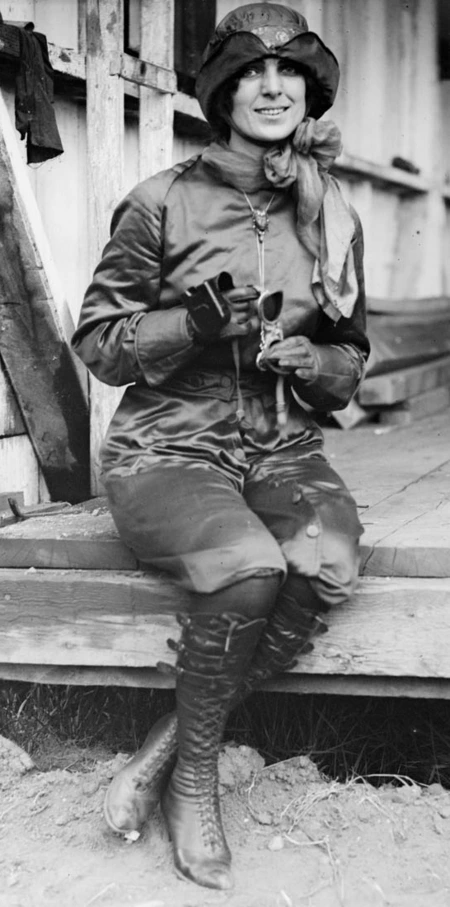
Life and work in aviation
Harriet Quimby (1875–1912) was an American journalist and an early professionally trained woman pilot. In 1911, she became the first American woman to receive a pilot licence; in April 1912, she flew solo across the English Channel. Her short career, amid open cockpits and developing training rules, combined practical flying with public accounts of the new profession.
Journalism and Aviation
Before mastering flights, Quimby worked in journalism and traveled. Aviation demonstrations led her to decide to learn to fly. Publicity helped to attract attention, but did not replace training. It was necessary to master the control of the airplane, understand the conditions of take-off and landing and learn how to assess the suitability of the weather. At Moisant's school, she gained practical experience on early aircraft.
Pilot certificate
In 1911, Quimby was certified by the Aero Club of America. She was the first licensed female pilot in the United States. Raymonda de Laroche received a French certificate earlier, so the world priority of licensing belongs to another aviator. This sequence shows how training has spread across countries. Each national school had its own procedure for preparing and confirming qualifications.
Via Channel
On 16 April 1912, Quimby crossed the English Channel on her Blériot flight from England to France. The route required orienting over water and assessing the wind. Due to the proximity of the date to the Titanic disaster, the world press paid relatively little attention to it. The significance of the flight remains regardless of the amount of newspaper coverage at that time.
Short career
Quimby died in July 1912 during an air show in Massachusetts. In her biography, obtaining a certificate, demonstration flights and a sea route are independent professional episodes. It represents the early stage of women's access to official flight training. Through this story, the transition from spectator interest to a profession that required practice and responsibility is visible.
How the wing, stability and design are related
The aircraft must simultaneously create lift, overcome resistance and maintain control. A good wing does not solve all problems by itself. Suitable controls are required, and the structure and distribution of the mass is strong enough. Therefore, the history of the aviation project is useful to consider as the coordination of several functions. Changing one element affects the rest: a heavier vehicle requires different flight conditions, and a new engine can change the layout and behavior of the machine.
The glider helps to explore the flight without its own power plant. It uses altitude stock and movement relative to air; duration depends on design and atmospheric conditions. Early experiments allowed us to study the stability and actions of the pilot before the advent of a suitable engine. At the same time, a small model does not automatically confirm the behavior of a full-size machine. To go to the apparatus with a person, separate strength calculations, manufacturing and practical verification under the appropriate load are needed.
The material is selected taking into account the mass, strength, manufacture and maintenance. Wood, metal alloys and composites have different joining properties and technologies. The new design may be promising, but its advantages need to be confirmed by tests. The name of the material is not a guarantee of safety or economy. Important are the power kit layout, the quality of the parts and how the body perceives real loads during operation, including repeated takeoffs and landings.
The design result consists of calculations, manufacture, ground inspection and flight observations. The engineering school passes on ways to solve problems to the next generation, not just the appearance of the aircraft. When studying the biography, it is useful to associate projects with their purpose: the training machine, transport and experimental glider require different compromises. So it is clearer why two apparently similar designs can have a completely different operational role and history of development.
Major achievements
- The first woman in the United States received a pilot certificate
- She crossed the English Channel by herself in 1912.
- She talked about aviation through journalistic work
Aircraft and flying machines
- Blériot XI
- Moisant School Planes
Organisations and events
Aero Club of America, Moisant Flight School
- Obtaining a certificate in 1911
- Flight 16 April 1912
Questions about this biography
Why does Harriet Quimby go down in aviation history?
She was the first woman to receive a pilot’s certificate. She crossed the English Channel on her own in 1912. She talked about aviation through journalistic work.
With what field of aviation is this biography connected?
Harriet Quimby (1875-1912) was an American journalist and one of the first professionally trained female pilots.
What aircraft are involved in this work?
Related to biography: Blériot XI, Moisant School Planes. Their role and period are described in the main sections.
What events help to understand the professional path?
Major historical episodes: Obtaining a certificate in 1911; Flight April 16, 1912.
What organizations are mentioned in the biography?
The professional path is associated with organizations and communities: Aero Club of America, Moisant Flight School.
Quimby was the first licensed woman in the world?
Oh, no. It was the first in the United States; world priority is associated with Raymonda de Laroche.
What is the technical context of this story?
The aircraft must simultaneously create lift, overcome resistance and maintain control. A good wing does not solve all problems by itself. Suitable controls are required, and the structure and distribution of the mass is strong enough. Therefore, the history of the aviation project is useful to consider as the coordination of several functions. Changing one element affects the rest: a heavier vehicle requires different flight conditions, and a new engine can change the layout and behavior of the machine.