
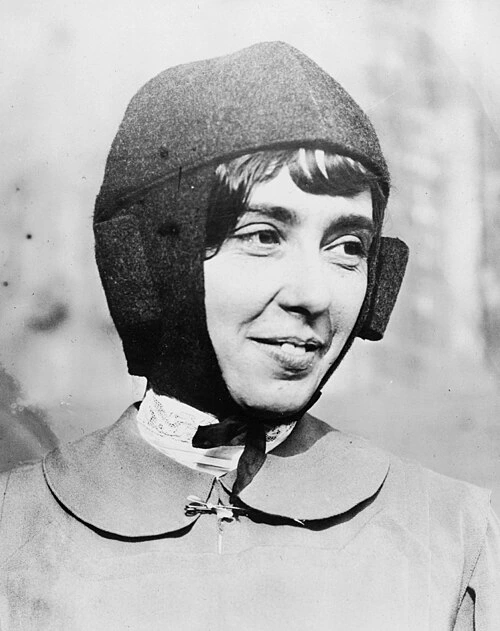
Life and work in aviation
Hélène Dutrieu (1877–1961) was a Belgian athlete and aviator, and an early officially qualified woman pilot. Before flying, she was known for cycling and stage performances. She participated in aviation competitions and demonstration routes. Her career shows how technical experience and persistent learning opened access to the emerging world of early European aircraft.
From Sport to Plane
Duttier came to aviation after a sports career. The cycling experience helped coordination, but the management of the airplane required separate training. She mastered light cars with limited engine and control capabilities. Fame in another occupation did not give the pilot qualification. Practical exercises were necessary to align their actions with the behavior of the new technique.
Certificate in Belgium
On 25 November 1910, Dutrie became the first licensed female pilot in Belgium. Raymonde de Laroche received a French certificate earlier that year. The difference between national and world priority allows you to accurately describe both biographies. The certificate confirmed the training and helped to participate in aviation life as an independent specialist, and not only to the audience of public performances.
the Royal Cup
In 1911, Dutrie won the Royal Cup in Florence, competing with men. It was a measurable flying achievement, not a symbolic appearance at the event. The conditions of the competition required to keep the specified mode and take into account the capabilities of the airplane. Such meetings showed observers the results of training and gave pilots the opportunity to compare the practical experience of different schools.
Importance of Career
Dutrie became a prominent member of European aviation. Her story complements the biographies of de Laroche and Quimby, revealing different ways to train women. In the early industry, sports, demonstration, and vocational training often overlapped. When assessing the contribution, it is useful to compare the evidence and the tasks of the flights performed. They allow you to see a specific result behind spectacular newspaper nicknames and public photos.
How the wing, stability and design are related
The aircraft must simultaneously create lift, overcome resistance and maintain control. A good wing does not solve all problems by itself. Suitable controls are required, and the structure and distribution of the mass is strong enough. Therefore, the history of the aviation project is useful to consider as the coordination of several functions. Changing one element affects the rest: a heavier vehicle requires different flight conditions, and a new engine can change the layout and behavior of the machine.
The glider helps to explore the flight without its own power plant. It uses altitude stock and movement relative to air; duration depends on design and atmospheric conditions. Early experiments allowed us to study the stability and actions of the pilot before the advent of a suitable engine. At the same time, a small model does not automatically confirm the behavior of a full-size machine. To go to the apparatus with a person, separate strength calculations, manufacturing and practical verification under the appropriate load are needed.
The material is selected taking into account the mass, strength, manufacture and maintenance. Wood, metal alloys and composites have different joining properties and technologies. The new design may be promising, but its advantages need to be confirmed by tests. The name of the material is not a guarantee of safety or economy. Important are the power kit layout, the quality of the parts and how the body perceives real loads during operation, including repeated takeoffs and landings.
The design result consists of calculations, manufacture, ground inspection and flight observations. The engineering school passes on ways to solve problems to the next generation, not just the appearance of the aircraft. When studying the biography, it is useful to associate projects with their purpose: the training machine, transport and experimental glider require different compromises. So it is clearer why two apparently similar designs can have a completely different operational role and history of development.
Major achievements
- Belgium's first woman to receive pilot's certificate
- She won the Royal Cup in Florence in 1911.
- Participated in European aviation competitions
Aircraft and flying machines
- Santos-Dumont Demoiselle
- Early European airplanes
Organisations and events
Belgian Aviation Community
- Testimony of 25 November 1910
- Competition in Florence in 1911
Questions about this biography
Why is Helene Dutrier in the history of aviation?
She was the first woman in Belgium to receive a pilot certificate. She won the Royal Cup in Florence in 1911. Participated in European aviation competitions.
With what field of aviation is this biography connected?
Helene Dutrier (1877-1961) was a Belgian athlete and aviator, one of the first women with an official pilot qualification.
What aircraft are involved in this work?
The biography is associated with: Santos-Dumont Demoiselle, Early European aeroplanes. Their role and period are described in the main sections.
What events help to understand the professional path?
Main historical episodes: Testimony 25 November 1910; Competition in Florence in 1911.
What organizations are mentioned in the biography?
The professional path is linked to organizations and communities: the Belgian Aviation Community.
Did Dutrie get a certificate before de Laroche?
Oh, no. De Laroche received it in March 1910, Duttier in November of the same year.
What is the technical context of this story?
The aircraft must simultaneously create lift, overcome resistance and maintain control. A good wing does not solve all problems by itself. Suitable controls are required, and the structure and distribution of the mass is strong enough. Therefore, the history of the aviation project is useful to consider as the coordination of several functions. Changing one element affects the rest: a heavier vehicle requires different flight conditions, and a new engine can change the layout and behavior of the machine.