
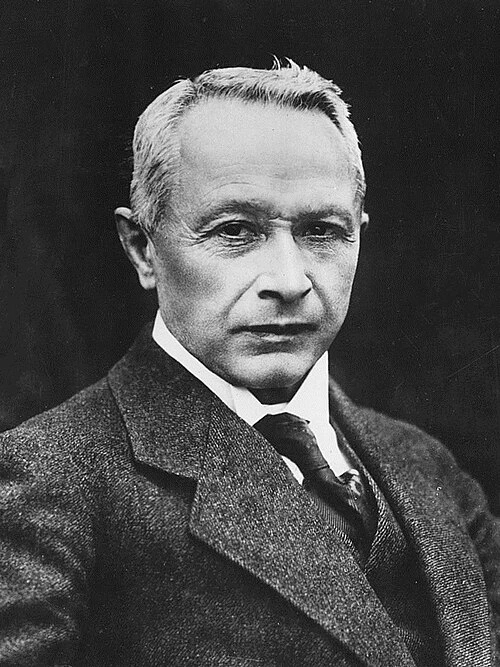
Life and work in aviation
Hugo Junkers (1859–1935) was a German engineer, entrepreneur and all-metal aircraft pioneer. His school developed the experimental J 1 and influential F 13 passenger aircraft. Junkers was not a Nazi official: the Nazis removed him from his businesses after taking power. His personal work must be distinguished from later military products made after he lost control and after his death.
Engineer to Aviation Enterprise
Junkers was engaged in heat engineering, mechanical engineering and industrial developments. In aviation, he transferred interest in materials and engineering calculation. The metal plane required a different design organization than the early wooden machine with canvas lining. For him, the work of sheet material, compounds and mass were important. This path involved experimentation and the gradual accumulation of knowledge, rather than the mere use of metal for the sake of unusual appearance.
Experimental J1
J 1, first flown in 1915, became an early all-metal aircraft. It served to test the principles of design and was not a mass passenger liner. The solutions used required further development and facilitation. The historical significance of the project is associated with the proof of the practicality of the metal machine. It should be distinguished from later devices with similar designations, so as not to attribute the entire history of the company to one prototype.
F 13 and passenger aviation
The Junkers F 13 first flew in 1919 and became an important all-metal passenger car. The closed cabin and strong construction corresponded to the development of commercial transportation. The aircraft was used in different countries and conditions. For such a device, regular operation and repair, and not only a spectacular demonstration, were important. Junkers’ work helped the transition of aviation from an individual experiment to a sustainable transport system.
Exclusion and boundaries of historical heritage
After 1933, the Nazi authorities deprived Junkers of control over enterprises. He died in 1935. Junkers military aircraft of the later period cannot automatically be considered his personal projects or proof of his political position. In the biography, it is important to maintain a confirmed chronology. His real contributions relate to early metal structures, passenger aviation, and the industrial school created prior to this suspension.
How the wing, stability and design are related
The aircraft must simultaneously create lift, overcome resistance and maintain control. A good wing does not solve all problems by itself. Suitable controls are required, and the structure and distribution of the mass is strong enough. Therefore, the history of the aviation project is useful to consider as the coordination of several functions. Changing one element affects the rest: a heavier vehicle requires different flight conditions, and a new engine can change the layout and behavior of the machine.
The glider helps to explore the flight without its own power plant. It uses altitude stock and movement relative to air; duration depends on design and atmospheric conditions. Early experiments allowed us to study the stability and actions of the pilot before the advent of a suitable engine. At the same time, a small model does not automatically confirm the behavior of a full-size machine. To go to the apparatus with a person, separate strength calculations, manufacturing and practical verification under the appropriate load are needed.
The material is selected taking into account the mass, strength, manufacture and maintenance. Wood, metal alloys and composites have different joining properties and technologies. The new design may be promising, but its advantages need to be confirmed by tests. The name of the material is not a guarantee of safety or economy. Important are the power kit layout, the quality of the parts and how the body perceives real loads during operation, including repeated takeoffs and landings.
The design result consists of calculations, manufacture, ground inspection and flight observations. The engineering school passes on ways to solve problems to the next generation, not just the appearance of the aircraft. When studying the biography, it is useful to associate projects with their purpose: the training machine, transport and experimental glider require different compromises. So it is clearer why two apparently similar designs can have a completely different operational role and history of development.
Major achievements
- Developed an all-metal aircraft design
- Created experimental J 1
- Developed passenger F 13 and aircraft production
Aircraft and flying machines
- Junkers J 1
- Junkers F 13
Organisations and events
Hugo Junkers
- The first flight of J 1 in 1915
- First flight of F 13 in 1919
- Removal from business after 1933
Questions about this biography
Why is Hugo Junkers in aviation history?
He developed the all-metal design of the aircraft. He created experimental J1. Developed passenger F 13 and aircraft production.
With what field of aviation is this biography connected?
Hugo Junkers (1859–1935) was a German engineer and entrepreneur, one of the pioneers of all-metal aircraft manufacturing.
What aircraft are involved in this work?
Related to biography: Junkers J 1, Junkers F 13. Their role and period are described in the main sections.
What events help to understand the professional path?
Main historical episodes: First flight of J 1 in 1915; First flight of F 13 in 1919; Removal from enterprises after 1933.
What organizations are mentioned in the biography?
The professional path is related to organizations and communities: Hugo Junkers Enterprises.
Did Junkers run the firm during World War II?
Oh, no. He was suspended after the Nazis came to power and died in 1935. Later military aircraft of the company should not be automatically attributed to him personally.
What is the technical context of this story?
The aircraft must simultaneously create lift, overcome resistance and maintain control. A good wing does not solve all problems by itself. Suitable controls are required, and the structure and distribution of the mass is strong enough. Therefore, the history of the aviation project is useful to consider as the coordination of several functions. Changing one element affects the rest: a heavier vehicle requires different flight conditions, and a new engine can change the layout and behavior of the machine.