
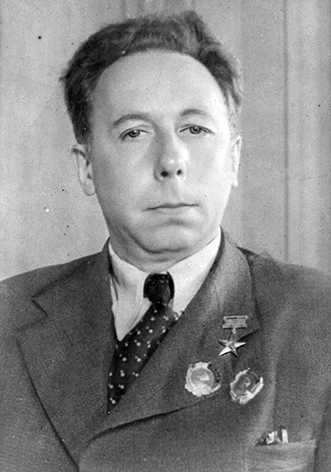
Life and work in aviation
Semyon Alexeyevich Lavochkin (1900–1960) was a Soviet designer whose work progressed from piston fighters to jets and missiles. He developed the LaGG-3 with Vladimir Gorbunov and Mikhail Gudkov; his team later created the La-5 and La-7. His career shows how engine changes and design refinement alter performance, and how an aviation school moves into a new technological era.
Education and joint project
Lavochkin graduated from MVTU and worked in several design teams. The I-301 project, from which LaGG-3 grew, united the work of Lavochkin, Gorbunov and Gudkov. The compound designation retains the names of the three developers. This fact is important for an accurate biography: the early aircraft should not be attributed to Lavochkin alone, although it was his subsequent school that developed part of the laid decisions and created new machines.
Transition to La-5
La-5 appeared as a result of deep redesign with the installation of the air-cooled engine ASH-82. Replacement of the engine affected the nose, cooling, mass and flight properties. Such a project can not be described as a simple tightening of the new engine to the previous aircraft. The team had to check the operation of the entire system and agree on improvements with the possibility of serial production in military conditions.
La-7 and post-war aviation
La-7 was a further development of the piston fighter, and after the war the bureau worked on La-9, La-11 and jet aircraft. Among the new projects were experimental aircraft for high-speed research. The results of the tests helped to solve the issues of wing and control. Serial production and research value are different forms of result: an experienced machine could be important even without becoming a mass type.
From aircraft to rocket technology
Lavochkin's later work included air defense systems and the Burya intercontinental cruise missile. Modern space activities of the enterprise in his name refers to the continuation of school after 1960. Therefore, the biography should separate the personal projects of the designer and the work of the successors. Lavochkin's legacy is associated with the methods of organizing research and the transition of the team to new tasks, and not with the personal authorship of all later spacecraft.
Engine, thrust and flight mode
The engine shall provide enough thrust for the selected task at an acceptable mass and fuel consumption. The maximum power does not describe the entire power plant. Reliability, cooling, launch, resource and interaction with the aircraft are important. In early aviation, separately, the task was to get an engine that can generally be lifted into the air along with the design and the person. The development of materials and production gradually expanded the available opportunities.
A piston engine typically transmits power to an air propeller, and a turbojet plant creates thrust through a stream of gases. These schemes are not interchangeable without changing the project. The choice is influenced by the speed, height and purpose of the machine. A screw plane can be convenient for one transport task, a jet one for another. The comparison requires taking into account the entire operating mode, and not declaring one technology the best for any routes and dimensions of the device.
As you approach the speed of sound, the behavior of the airflow changes. The design of the high-speed aircraft affects the wing, air intakes, stability and control. A more powerful engine does not solve these issues alone. Calculations and tests of the design under the expected conditions are needed. The result of the experimental machine also does not mean that the same mode is suitable for normal serial operation, with passengers and regular maintenance.
The history of the engine should be distinguished from the history of the aircraft on which it was used. The power plant could be created by other teams, and the pilot checked its behavior in the car. Accurate indication of these roles helps to understand the contribution of each specialist. For the serial program, deliveries, technical documentation and service preparation are important: without them, even a promising engine remains a separate experimental product, and not a ready basis for regular flights.
Major achievements
- Jointly participated in the creation of LaGG-3
- Development of La-5 and La-7
- Developed jet aircraft and rocket technology
Aircraft and flying machines
- LaGG-3
- La-5
- La-7
- La-9
- Experimental jet aircraft La
- “The Tempest”
Organisations and events
OKB Lavochkin
- Creation of LaGG-3
- The development of La-5 and La-7 during the war
- Works on "Bura" in the 1950s
Questions about this biography
Why is Semen Lavochkin included in the history of aviation?
Jointly participated in the creation of LaGG-3. He led the development of the La-5 and La-7. He developed jet aircraft and rocket technology.
With what field of aviation is this biography connected?
Semyon Alekseevich Lavochkin (1900-1960) was a Soviet aircraft designer whose work went from piston fighters to jet aircraft and rocket technology.
What aircraft are involved in this work?
The biography is associated with: LaGG-3, La-5, La-7, La-9, Experimental jet aircraft La, "Storm". Their role and period are described in the main sections.
What events help to understand the professional path?
Major historical episodes: Creation of LaGG-3; Development of La-5 and La-7 during the war years; Works on "The Tempest" in the 1950s.
What organizations are mentioned in the biography?
The professional path is connected with organizations and communities: OKB Lavochkin.
What do the letters LaGG mean?
They are associated with the names of Lavochkin, Gorbunov and Gudkov - participants of the joint project. The later La-5 and La-7 refer to the development of Lavochkin's school.
What is the technical context of this story?
The engine shall provide enough thrust for the selected task at an acceptable mass and fuel consumption. The maximum power does not describe the entire power plant. Reliability, cooling, launch, resource and interaction with the aircraft are important. In early aviation, separately, the task was to get an engine that can generally be lifted into the air along with the design and the person. The development of materials and production gradually expanded the available opportunities.